
Is Your Outboard Acting Up? A Deep Dive into Engine Diagnostics
Why Your Outboard's "Check Engine" Light Isn't a Light at All
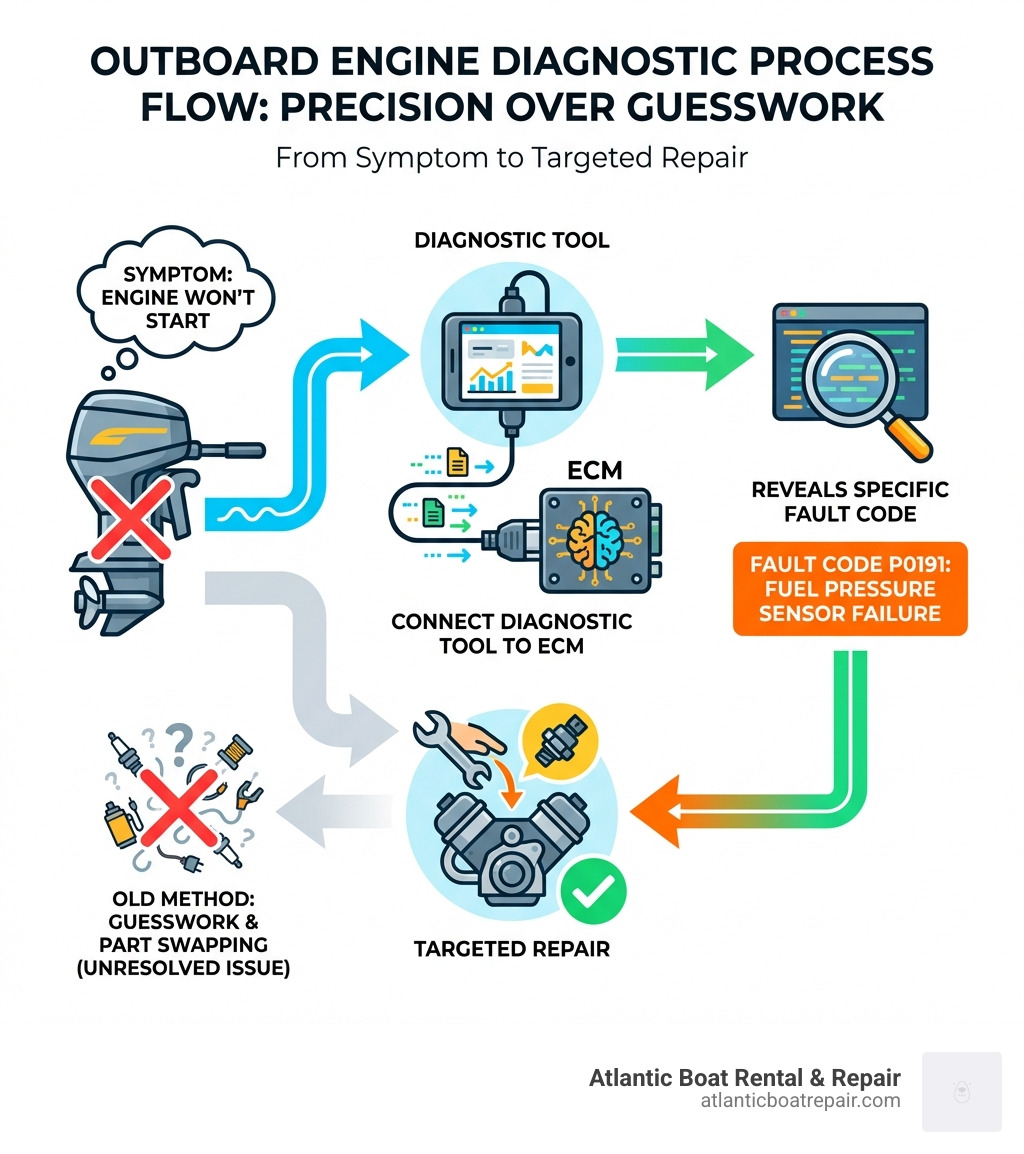
Outboard engine diagnostics is the process of connecting specialized tools to your engine's computer system (the Electronic Control Module or ECM) to read stored data about its performance, history, and any faults. Here's what you need to know:
What Diagnostics Reveals:
- Engine hours - Actual runtime, not what the seller claims
- RPM history - How hard the engine has been run
- Fault codes - Current and past error codes stored in memory
- System health - Real-time sensor readings from fuel, ignition, and cooling systems
Why It Matters:
- Identifies problems before they strand you on the water
- Verifies the true condition of a used engine you're buying
- Pinpoints exact issues instead of guessing and replacing parts
- Prevents minor problems from becoming expensive catastrophic failures
Unlike your car, most outboard engines don't have a dashboard warning light. The engine's computer is quietly logging every problem, every overheat, every fault—but you need the right tools to read it. That's where professional diagnostic equipment comes in, connecting to your engine's brain to tell you exactly what's happening under the cowling.
Think of it this way: your outboard has been keeping a detailed diary of its entire life. Diagnostics lets you read that diary before a small issue becomes a weekend-ruining breakdown or an expensive rebuild.
I'm Ron Cribbie, owner of Atlantic Boat Repair, and I've spent decades diagnosing and repairing marine engines across New England. Our team uses professional-grade outboard engine diagnostics daily to help boat owners understand exactly what's happening with their engines—whether it's troubleshooting a performance issue or verifying the condition of a potential purchase.
Recognizing the Red Flags: Common Symptoms of Outboard Trouble
Even without a "check engine" light, your outboard often gives subtle (or not-so-subtle) clues when something isn't right. Learning to recognize these common symptoms is the first step in effective outboard engine diagnostics. Ignoring them can lead to more serious problems and potentially leave you adrift.

Here's a list of red flags that often signal trouble:
- Engine won't start: This is perhaps the most frustrating symptom. You turn the key, and nothing happens, or it cranks endlessly without firing up. This could point to fuel issues, electrical problems, or even a simple battery fault.
- Overheating: If your engine starts to steam, emits smoke, or an alarm sounds, it's likely overheating. This is a critical issue that demands immediate attention, as sustained overheating can cause severe engine damage.
- Stalling or rough running: Does your engine sputter, lose RPMs, or die unexpectedly, especially at idle or low speeds? This "rough running" can indicate problems with the fuel system, ignition, or even fouled spark plugs.
- Loss of power: If your boat struggles to get on plane, can't reach its usual top speed, or feels sluggish, your engine might be experiencing a loss of power. This often suggests an issue with fuel delivery, compression, or propeller damage.
- Unusual noises: Any new or strange sounds—knocking, clanking, grinding, or excessive vibrations—are definite warning signs. These often point to internal mechanical issues that need professional inspection.
- Excessive smoke: While some smoke is normal, particularly on older two-stroke engines, thick, discolored smoke (blue, white, or black) can indicate serious problems with oil burning, water in the combustion chamber, or an overly rich fuel mixture.
- High fuel consumption: If you're suddenly burning through more fuel than usual for the same journey, it could be a sign of inefficient combustion, fuel leaks, or engine issues affecting performance.
- Electrical failures: Problems with your boat's electrical system can manifest as flickering lights, instruments not working, or the engine failing to charge the battery. This can often trace back to the engine's charging system or wiring.
- Steering problems: While not directly an engine issue, stiff or loose steering can impact your control and is worth checking if you notice changes in handling.
What to Do When You Spot a Symptom
Spotting a symptom means it's time to act, not panic. Your immediate actions can prevent further damage and ensure your safety.
First and foremost, if you experience sudden, severe symptoms like overheating, loud knocking noises, or a complete loss of oil pressure, shut off the engine immediately. Continuing to run a distressed engine can turn a minor repair into a catastrophic failure. For example, the Tohatsu manual advises immediate professional overhaul for engines submerged in water, and our own team at Atlantic Boat Repair knows that early intervention is key.
For less severe issues, such as rough running or a slight loss of power, you can often safely reduce speed and head back to shore. Always prioritize safety: ensure you have appropriate safety gear onboard, check your surroundings, and communicate your situation if necessary.
Once you're safely docked in Plymouth, Kingston, Duxbury, Bourne, or Sandwich, it's time to begin investigating. Even basic checks can help narrow down the problem. For general maintenance questions that might relate to your symptoms, you can always refer to resources like the Yamaha Outboard FAQs.
Your First Line of Defense: Basic DIY Troubleshooting
Before calling in the cavalry, there are several basic checks you can perform yourself. Think of these as your preliminary outboard engine diagnostics steps. They require minimal tools and can often help you identify simple issues or at least provide valuable information to a technician.
Here’s where to start:
- Visual inspection: A thorough look can reveal a lot. Check for loose wires, disconnected hoses, obvious leaks (fuel, oil, water), corrosion, or damaged components. Look under the cowling for anything out of place.
- Checking the fuel system: Fuel is often the culprit. Ensure your fuel tank has enough fresh, clean fuel. Squeeze the primer bulb—it should feel firm. Check fuel lines for kinks, cracks, or leaks. Inspect the fuel filter for water or debris. Many fuel-related problems can be avoided with proper maintenance, as highlighted in Honda's guidelines.
- Inspecting spark plugs: Remove and inspect the spark plugs. Are they fouled with carbon, oil, or fuel? Are they wet? A quick visual can tell you if a cylinder isn't firing correctly or if there's an issue with fuel mixture or oil consumption.
- Battery and connections check: A dead battery is a common reason for a non-starting engine. Check the battery's charge. Ensure battery terminals are clean, tight, and free of corrosion. Also, check all major electrical connections leading to the engine.
- Checking for water intake blockages: If your engine is overheating, check the water intake grates (usually on the lower unit) for debris like seaweed, plastic bags, or mud. Make sure the tell-tale (pee stream) is strong and consistent.
- Propeller inspection: A damaged propeller can cause vibrations, loss of power, or poor handling. Visually inspect the blades for bends, chips, or excessive wear. Ensure it's correctly secured.
If these basic checks don't resolve the issue, or if you're uncomfortable performing them, it's always best to reach out to professionals. Our team at Atlantic Boat Repair is always ready to assist boaters in Plymouth, Kingston, Duxbury, Bourne, and Sandwich. You can easily Contact Us to schedule a service.
How to Perform Basic Outboard Engine Diagnostics Yourself
Beyond the visual checks, you can perform a few more active diagnostic steps:
- Fuel filter check: Many outboards have a small, transparent fuel filter or a water separator. Regularly check this for water or excessive sediment. Draining or replacing it can often resolve rough running or stalling issues. For more detailed instructions on avoiding fuel problems, Honda Marine provides specific guides for both Fuel-Injected Models and Carburetor Models.
- Oil level check: For four-stroke outboards, check the engine oil level with the dipstick, ensuring it's within the recommended range. For two-strokes with separate oil injection, check the oil reservoir level. Low oil can trigger alarms and lead to serious damage.
- Cooling system water flow check: After starting the engine (with the boat in water or on muffs), observe the tell-tale stream. A strong, steady stream indicates proper water circulation. A weak, intermittent, or absent stream suggests a blockage or a failing water pump impeller. Honda Marine provides extensive Maintenance and Operation Information that covers cleaning and flushing instructions for various engine types, which is crucial for cooling system health.
- Reading basic warning indicators: While not a "check engine" light, many modern outboards have warning buzzers or indicator lights on the dash or tiller. Familiarize yourself with your owner's manual to understand what these mean. For instance, a continuous buzzer might indicate low oil pressure or overheating, prompting immediate action as detailed in resources like the Honda Outboard Engine Warning System Troubleshooting guide. Addressing these promptly can prevent significant damage.
The Power of Professional Outboard Engine Diagnostics
When DIY troubleshooting reaches its limits, or when you need a definitive answer, it's time for professional outboard engine diagnostics. This is where specialized tools and expertise truly shine, delving deep into your engine's electronic brain.
Basic Troubleshooting vs. Advanced Diagnostics
The difference between what you can do at home and what a professional can do is like comparing a basic first-aid kit to a fully equipped emergency room.
- Limitations of DIY checks: While helpful, basic DIY checks are primarily visual and mechanical. They can identify obvious problems but can't see inside the engine's electronic control unit (ECU) or interpret complex sensor data. They rely on symptoms, which can sometimes be misleading.
- Specialized software: Modern outboards are complex, computer-controlled machines. Professional diagnostics use sophisticated software, like Diacom Marine or M.E.D.S., that communicates directly with the engine's ECM. This software allows technicians to read real-time data, historical fault codes, and even perform active tests on components.
- Specialized hardware: These software packages require specific hardware interfaces (cables, adapters, diagnostic tools) to connect to different engine brands and models. These tools are often rugged and designed for demanding marine environments.
- Accessing the Engine Control Module (ECM): The ECM is the "brain" of your engine, collecting data from numerous sensors and controlling various engine functions. Professional tools can access this module to retrieve stored information, analyze performance parameters, and even recalibrate settings.
- Accuracy and efficiency: Advanced diagnostics pinpoint the exact cause of a problem, eliminating guesswork. This saves time, reduces labor costs, and prevents unnecessary parts replacements.
What a Professional Diagnostic Scan Reveals
A professional outboard engine diagnostics scan provides a wealth of information that goes far beyond what you could ever glean from a visual inspection. It's like getting a full medical history and current health report for your engine.
Here's what we can uncover:
- Engine hours: This is crucial, especially for pre-purchase inspections. The ECM logs the actual total operating hours, which can differ significantly from what an hour meter might display.
- RPM run history: We can see how the engine has been operated throughout its life—how many hours at idle, at cruising speed, or at wide-open throttle. This gives insight into how hard the engine has been pushed.
- Current and historic fault codes: The ECM stores fault codes (Diagnostic Trouble Codes or DTCs) for any detected malfunctions. This includes active faults (present now) and historical faults (occurred in the past but may not be present currently). These codes are invaluable for identifying specific issues like sensor failures, ignition problems, or fuel delivery issues.
- Freeze frame data: When a fault code is triggered, the ECM often records a "snapshot" of engine parameters (RPM, temperature, throttle position, etc.) at that exact moment. This "freeze frame" data helps us understand the conditions under which the fault occurred.
- Sensor readings: We can monitor real-time data from all engine sensors: temperature (engine, air, water), oxygen, manifold pressure, throttle position, fuel pressure, and more. This helps identify sensors that are out of calibration or failing intermittently.
- Actuator tests: Diagnostic tools allow us to command specific components (actuators) to operate, such as fuel injectors, ignition coils, or idle air control valves, to verify their functionality.
- Service history: Some advanced systems can even log basic service events, providing a more complete picture of the engine's maintenance.
The Benefits of Specialized Diagnostic Tools
Investing in specialized diagnostic tools is a game-changer for marine repair shops like ours. These tools are not just fancy gadgets; they are essential for delivering the precision and reliability our customers in Massachusetts expect.
- Pinpointing exact issues: Instead of replacing parts based on a hunch, diagnostic tools allow us to identify the precise component or system that's malfunctioning. This means faster, more accurate repairs.
- Identifying intermittent problems: Some engine problems only occur under specific conditions (e.g., high RPM, certain temperatures). Diagnostic tools can capture intermittent fault codes and freeze-frame data, making these elusive issues much easier to diagnose.
- Calibrating engine systems: After replacing components or performing certain services, diagnostic tools are used to calibrate engine systems, ensuring everything is operating within manufacturer specifications. This includes sensor calibration, injector coding, and idle speed adjustments.
- Supporting different brands: A comprehensive diagnostic system supports a wide range of outboard engine brands and models. For example, Diacom Marine diagnostic tools from Rinda Technologies are designed to support Mercury Outboards, Honda, Yamaha, and many other leading marine engine brands, allowing us to service a diverse fleet of boats. This broad compatibility ensures we can diagnose nearly any outboard that comes into our shops in Plymouth, Kingston, Duxbury, Bourne, or Sandwich.
The Long-Term Payoff: Diagnostics for Engine Health and Value
Think of professional outboard engine diagnostics not as a cost, but as an investment. The insights gained from a thorough scan have far-reaching benefits for your engine's health, performance, and even your wallet in the long run.
Regular diagnostics contribute significantly to preventative maintenance, improving performance, increasing engine lifespan, and optimizing fuel efficiency. It's about keeping your outboard running like new, just like our "0" time rebuilt engines aim to do.
How Regular Diagnostics Prevent Costly Breakdowns
One of the most compelling reasons for routine diagnostic checks is breakdown prevention. An ounce of prevention is truly worth a pound of cure, especially on the water.
- Early detection of wear: Diagnostic tools can detect subtle changes in sensor readings or performance parameters that indicate components are starting to wear out before they completely fail. For example, a slightly out-of-spec fuel pressure reading might warn of a failing fuel pump before it leaves you stranded.
- Addressing minor issues: Catching small problems early means they can be addressed with minor repairs or adjustments, preventing them from escalating into major, expensive failures. This early detection is a core benefit of modern diagnostic services.
- Creating a maintenance strategy: Diagnostic data helps us create a custom maintenance plan for your specific engine and usage patterns. Knowing your engine's true hours and operational history allows for more precise scheduling of fluid changes and component servicing.
- Avoiding catastrophic failure: By monitoring critical parameters like engine temperature and oil pressure, diagnostic systems provide crucial warnings that can prevent events like engine seizure due to overheating or lack of lubrication.
Using Diagnostic Reports for Pre-Purchase Inspections
Buying a used boat is an exciting prospect, but it can also be a minefield of hidden problems. This is where outboard engine diagnostics becomes your best friend. A diagnostic report is like a background check for the engine.
- Verifying seller claims: Don't just take the seller's word for it. A diagnostic scan provides verifiable data on actual engine hours, unlike potentially manipulated hour meters. We've seen many discrepancies in our years of service in Massachusetts.
- Uncovering hidden problems: The ECM stores historical fault codes, even if the problem has been seemingly resolved or is intermittent. These codes can reveal past issues like overheating events, sensor failures, or ignition problems that the seller might not disclose.
- Assessing true engine condition: Beyond fault codes, the RPM run history shows how the engine has been used—whether it's been babied or constantly run at wide-open throttle, indicating potential wear. This comprehensive assessment gives you a clear picture of the engine's true health.
- Negotiating power: Armed with an unbiased diagnostic report, you have strong negotiating leverage. Any finded issues can be used to ask for a lower price or to request that the seller addresses them before purchase.
Before you make that big purchase, let us help you perform a thorough diagnostic check on any used outboard. It's an investment that can save you thousands down the line. While you're here, you can also View our current inventory of carefully re-manufactured engines.
The Role of the Certified Technician and Associated Costs
While the diagnostic tools are powerful, they are only as good as the person operating them. That's where the expertise of a certified marine technician becomes indispensable.
Why a Certified Technician Matters
In our shops across Plymouth, Kingston, Duxbury, Bourne, and Sandwich, our technicians are the backbone of our diagnostic and repair services.
- Interpreting complex data: Diagnostic software generates a lot of data. A certified technician knows how to interpret these numbers, graphs, and codes within the context of the engine's operation. They can distinguish between a critical fault and a minor anomaly.
- Expertise in specific engine brands: Our technicians are factory-trained and certified across various leading outboard brands. This specialized knowledge means they understand the unique nuances, common issues, and diagnostic procedures for your specific engine, whether it's a Yamaha, Mercury, Honda, Suzuki, or Evinrude.
- Access to factory service information: Certified technicians have access to proprietary service manuals, technical bulletins, and software updates directly from the engine manufacturers. This ensures repairs are performed using the latest methods and specifications.
- Performing complex repairs: Once a diagnosis is made, the repair itself often requires specialized tools and skills. From recalibrating sensors to replacing internal components, our technicians ensure the job is done right, the first time.
- Ensuring safety: Proper diagnostics and repairs are crucial for safe boating. A certified technician adheres to strict safety protocols and ensures all systems are functioning correctly before your boat leaves our shop.
Understanding the Costs of Professional Outboard Engine Diagnostics and Repairs
The cost of professional outboard engine diagnostics and subsequent repairs can vary, but it's important to view it as a necessary investment in your boating enjoyment and safety.
- Diagnostic service fees: A diagnostic scan typically has a flat fee, which covers the technician's time, the use of specialized equipment, and the generation of a detailed report. This fee is often a small fraction of what you might spend on unnecessary parts or labor if problems are misdiagnosed.
- Labor rates: If repairs are needed, labor is usually charged at an hourly rate. Our technicians are highly skilled, and while their rates reflect their expertise, their efficiency with diagnostic tools often means less overall labor time compared to trial-and-error troubleshooting.
- Parts costs: The cost of parts can vary widely depending on the component and engine brand. We always use genuine or high-quality aftermarket parts to ensure reliability and performance.
- Factors affecting price: The total cost will depend on the complexity of the issue, the time required for repair, and the cost of replacement parts. For example, a simple sensor replacement will be less costly than a major engine overhaul. However, catching a problem early through diagnostics can prevent a small issue from becoming a very expensive one.
We believe in transparency. After a diagnostic scan, we'll provide you with a detailed report and a clear estimate for any recommended repairs. For a personalized estimate or to discuss your specific needs, please don't hesitate to Request a Quote from our team.
Conclusion: Invest in Certainty for More Time on the Water
In boating, uncertainty can quickly turn a peaceful day into a frustrating ordeal. That's why outboard engine diagnostics is not just a service; it's an investment in certainty. It provides peace of mind, knowing that your engine's health is understood and proactively managed.
By embracing both basic DIY checks and professional diagnostic services, you gain several key advantages:
- Peace of mind: You'll know the true condition of your engine, reducing anxiety about breakdowns.
- Reliability: Proactive maintenance and accurate repairs mean your outboard is less likely to fail when you need it most.
- Cost savings: Early detection prevents minor issues from becoming major, expensive repairs.
- Extended lifespan: A well-maintained and accurately diagnosed engine will simply last longer, protecting your investment.
At Atlantic Boat Repair, we pride ourselves on a precision approach to marine engine repair. When we remanufacture and sell "0" time rebuilt outboard engines, we adhere to standards that are twice manufacturer specifications, coupled with rigorous testing. This commitment to superior precision and reliability ensures our engines offer new-like performance and durability. This same dedication extends to all our diagnostic and repair services for boaters in Plymouth, Kingston, Duxbury, Bourne, and Sandwich.
Don't let a mystery symptom ruin your next outing. Understand your engine's story before it writes a bad ending. Trust our expertise and advanced diagnostic tools to keep you on the water, enjoying the beauty of Massachusetts's coastline.
Explore Our Expert Marine Engine Services today to learn how we can help you with all your outboard engine needs.
Comments
Be the first to comment on this article!