
Don’t Get Stranded: A Boater’s Guide to Engine Problem Solving
Why Boat Engine Diagnostics Matter
Boat engine diagnostics is the systematic process of inspecting and analyzing your marine engine to identify faults, performance issues, or potential problems before they leave you stranded on the water. Here's what you need to know:
What Modern Diagnostics Can Do:
- Read Diagnostic Trouble Codes (DTCs) - Your engine's ECU stores fault codes that pinpoint specific issues
- Monitor Real-Time Data - Track sensor values like fuel pressure, temperature, and voltage as the engine runs
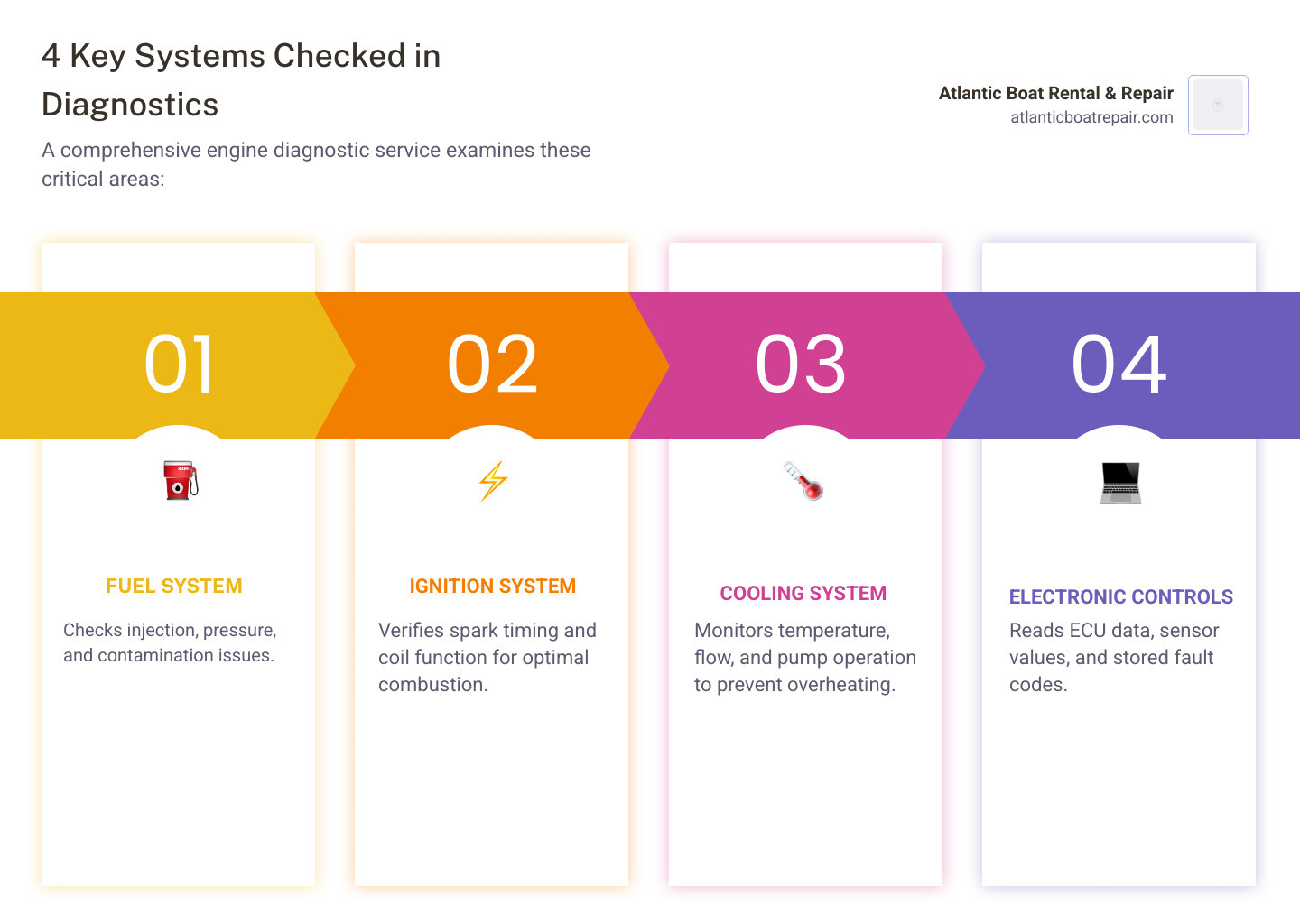
- Test Individual Components - Verify each part of your fuel, ignition, cooling, and electronic control systems
- Predict Future Failures - Catch small problems before they become expensive breakdowns
- Verify Engine Hours and History - Essential for pre-purchase inspections or warranty claims
Modern boat engines constantly monitor themselves. They watch dozens of systems and sensors to catch problems before they become disasters. But without the right diagnostic tools and expertise, those warnings can be hard to understand.
The marine engine diagnostics market is growing rapidly—from $1.2 billion in 2023 to a projected $2.1 billion by 2030—driven by increasingly complex electronic engine systems and the growing demand for predictive maintenance. Today's engines use specialized software and hardware to communicate with technicians, replacing the guesswork of the past.
I'm Ron Cribbie, owner of Atlantic Boat Repair, and I've spent decades diagnosing and repairing marine engines across New England. Boat engine diagnostics has evolved dramatically over my career, and I've seen how proper diagnostic work prevents catastrophic failures and saves boat owners thousands in unnecessary repairs.
Decoding Your Engine's Language: Warning Signs & Alarms
Before we even connect a diagnostic tool, your engine is often trying to tell you something is wrong. Understanding these basic signals is the first step in effective boat engine diagnostics. Think of it as your engine speaking to you in its own language.
Common signs that your boat engine might need diagnostics include:
- Unusual noises: Clunking, grinding, persistent knocking, or excessive whining can all point to mechanical issues.
- Performance loss: If your boat feels sluggish, struggles to reach top speed, or experiences intermittent power, it's a red flag.
- Increased fuel consumption: Suddenly burning through more fuel than usual could indicate inefficient engine operation or a fuel system problem.
- Starting issues: Difficulty starting, prolonged cranking, or failure to start altogether demands immediate attention.
- Overheating: An engine running hotter than normal, often indicated by a temperature gauge or warning light, is a serious concern that can lead to catastrophic damage.
- Irregular fuel consumption, engine misfires, or electronic malfunctions: These are all symptoms that advanced diagnostics can pinpoint.
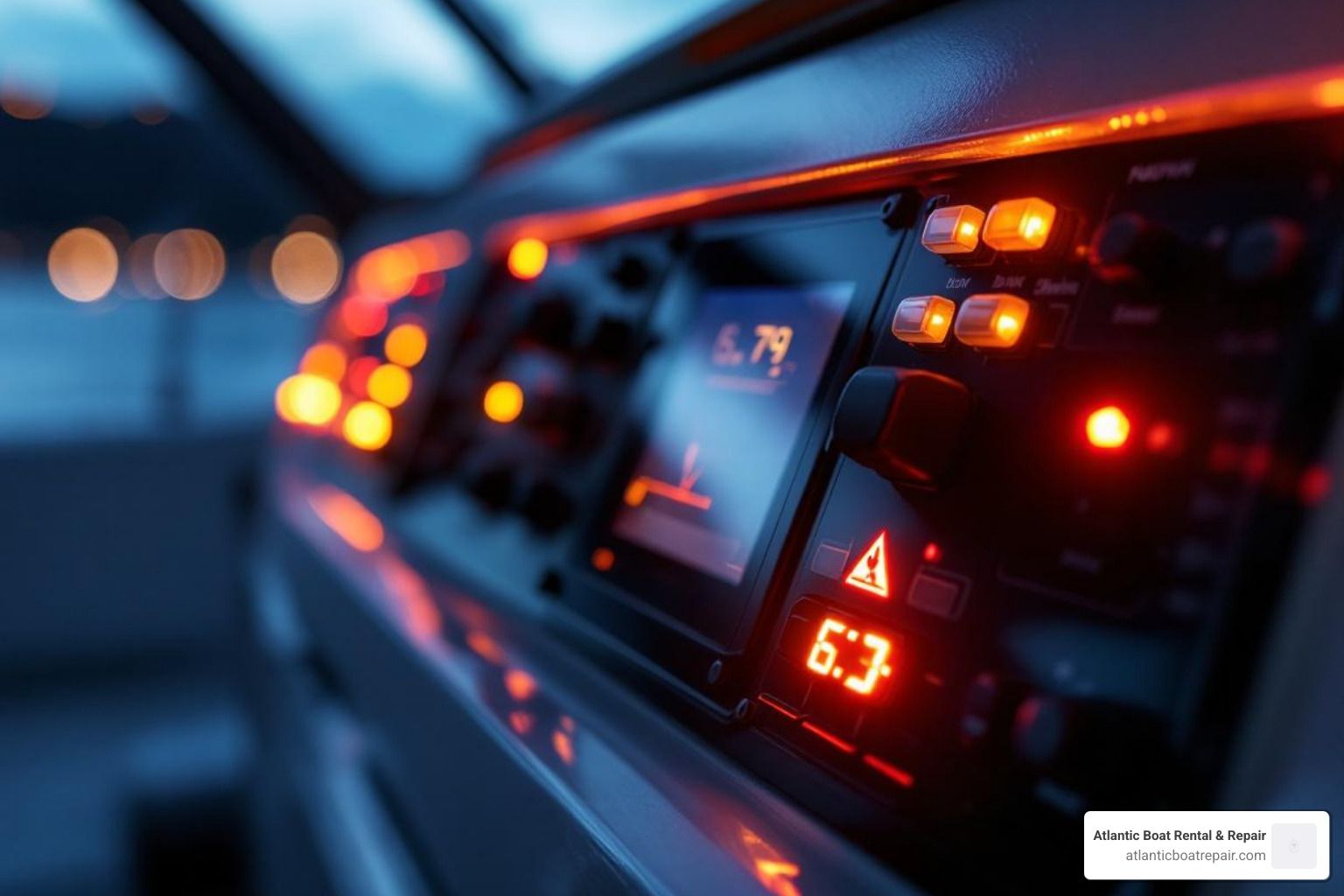
Visual Alerts: Dashboard Warning Lights
Modern boat engines are equipped with sophisticated warning systems. Your dashboard isn't just for showing speed and RPMs; it's a crucial communication hub.
- Check Engine Light (MIL - Malfunction Indicator Lamp): This is the most common and often the most mysterious light. A yellow or amber "Check Engine" light signals that the Engine Control Unit (ECU) has detected a fault in one of your engine's systems. Even if your engine feels perfectly normal, a fault code is stored in the ECU, requiring attention. For Yamaha outboards, for example, this light means a fault code is present, and while the engine might seem fine, ignoring it can lead to bigger issues down the line.
- Engine Temperature Warning Light: A red thermometer symbol or a "HOT" indicator means your engine is overheating. This is critical! Overheating can warp cylinder heads, damage gaskets, or seize internal parts. If this light comes on, immediately reduce throttle, check your tell-tale stream for cooling water flow, and prepare to shut down safely.
- Low Oil Pressure or Oil Level Warning: This red light indicates critically low oil pressure (common in four-stroke engines) or dangerously low oil levels (in two-stroke engines with injection systems). Running an engine without adequate oil pressure can destroy it in minutes. Reduce throttle, shut down safely, check your oil level, and add oil if necessary before attempting to restart.
- Low Battery Voltage or Charging System Warning: If this light appears, it means your battery isn't charging correctly. This could be due to a faulty alternator, loose connections, or a bad battery. Reduce electrical load by turning off non-essential accessories and head back to port soon.
- Water in Fuel Warning: Water contamination in your fuel can cause rough running, power loss, or complete engine failure, and it promotes corrosion. If this light appears, stop the engine as soon as practical and drain or replace your fuel filter before continuing operation.
It's essential to consult your boat's owner's manual for specific interpretations of your engine's warning lights, as they can vary by manufacturer and model. For example, Honda's manuals provide detailed troubleshooting for these indicators, including specific actions to take.
Audible Alarms: What Do Those Beeps Mean?
Beyond the visual cues, your engine also uses sound to get your attention. These audible alarms are often tied to critical issues.
- Continuous beeping: A steady, continuous alarm typically signals a critical fault requiring immediate attention. This often activates the engine's "Guardian System" or "limp mode," which automatically reduces power to prevent catastrophic damage. If you hear this, reduce throttle immediately and prepare to shut down.
- Intermittent beeping patterns: Shorter, repeated beeps (e.g., two, three, or four beeps) usually indicate less critical but still important issues, such as low oil in a two-stroke injection system, water in the fuel separator, or a fault in the AC generator. For example, Honda outboards use specific buzzer patterns for water in the fuel separator or ACG issues.
- Specific alarm patterns: Each engine manufacturer has its own set of codes for these audible alarms. Consulting your owner's manual is key to understanding what a particular beep pattern means for your specific Yamaha, Honda, or other marine engine.
These systems are designed to protect your engine and you. Heeding these warnings promptly is crucial for preventing minor issues from escalating into major, costly repairs.
The Core of Modern Boat Engine Diagnostics
Gone are the days when a mechanic could simply listen to an engine and pinpoint every problem. While experience still counts, the shift from purely mechanical to highly electronic marine engines has revolutionized boat engine diagnostics. Today's marine engines are essentially floating computers, managed by an Engine Control Unit (ECU), similar to the On-Board Diagnostics (OBD) systems in cars. This increasing complexity is precisely why the marine engine diagnostics market is experiencing significant growth.
The Technology: Specialized Software and Hardware
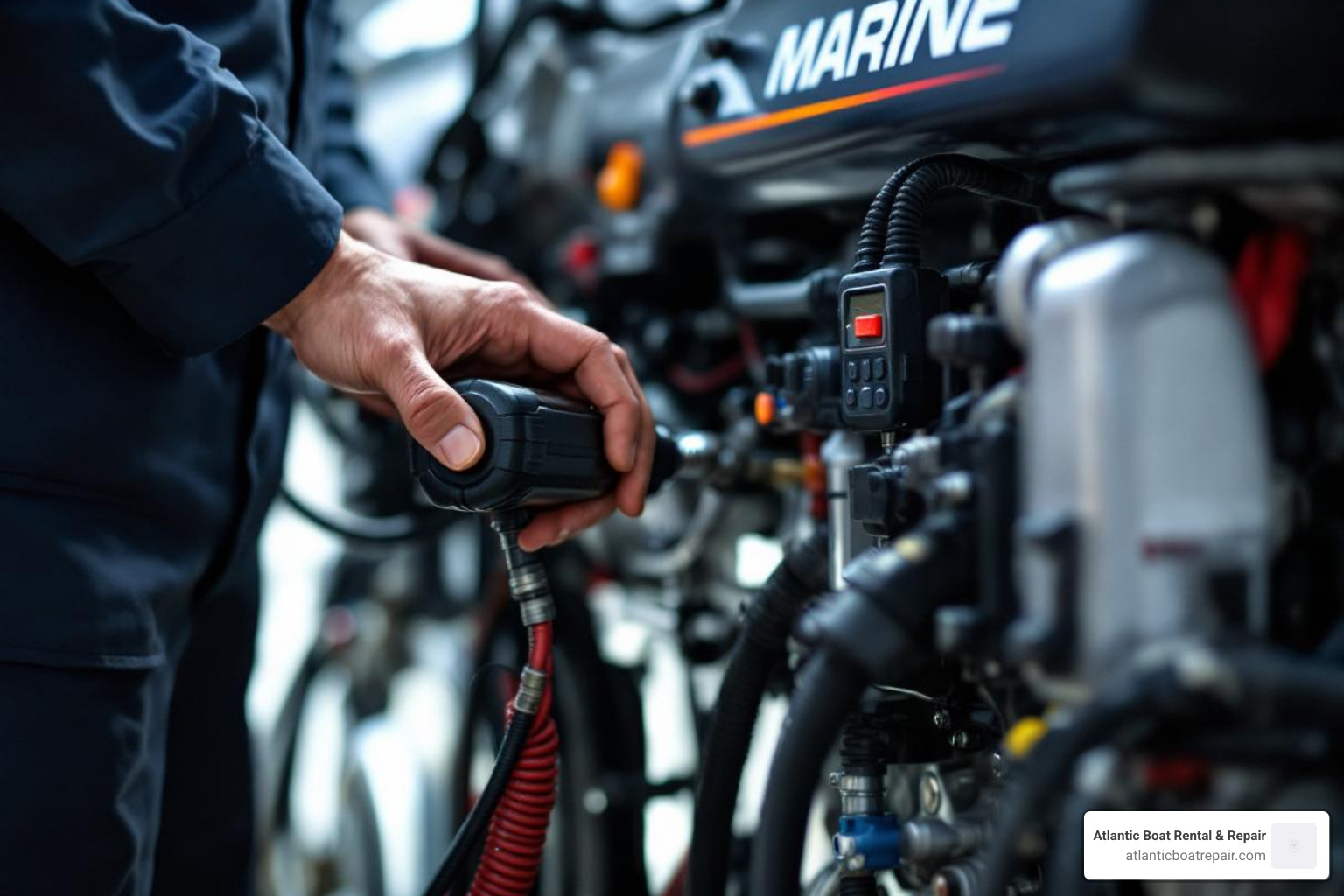
Modern boat engine diagnostics relies heavily on specialized software and robust hardware. These tools allow us to "talk" to your engine's computer.
- PC-based diagnostic tools: Systems like Diacom Marine leverage the power of standard notebook PCs, offering flexibility and cost-effectiveness. They connect to your engine's ECU to retrieve valuable information, including actual engine hours, RPM run history, and current/historic fault codes. This allows for efficient and accurate troubleshooting of EFI (Electronic Fuel Injection) systems.
- Rugged tablets and interface cables: Other systems, like those used by our technicians, use rugged tablets and specialized interface cables designed to withstand the harsh marine environment. These tools provide real-time data streaming, allowing us to monitor dozens of sensor values as the engine runs, giving us a comprehensive "big picture" view of engine performance.
- The role of specialized software: Software is the brain behind these operations. It not only reads fault codes but also offers:
- Troubleshooting guides by fault codes and symptoms: Many systems provide step-by-step guidance based on the detected issues.
- Technical data and diagrams: Access to detailed information about specific vessel models and engine components, which is invaluable for accurate repairs.
- Advanced features: Some software offers "Expert Mode" for advanced diagnostics, allowing for modification of ECU parameters, sensor/actuator calibration, and even DPF (Diesel Particulate Filter) replacement/regeneration for applicable diesel engines.
This technology allows us to move beyond guesswork, providing precise data for effective problem-solving.
Key Differences in Engine Diagnostics
While the principles of boat engine diagnostics are similar across different types of marine engines, there are distinct differences in their systems and common issues.
| Feature | Outboard Engines | Inboard Engines | Sterndrive Engines |
|---|---|---|---|
| Engine Type | Typically 2-stroke or 4-stroke gasoline | Often diesel, but also gasoline | Gasoline (automotive derivatives) |
| ECU/Electronics | Highly integrated, often proprietary systems (e.g., Yamaha YDS, Evinrude ICON) | Can be complex, sometimes more industrial-grade systems (e.g., Scania, Nanni, Caterpillar) | Often uses automotive-derived ECUs, adapted for marine use (e.g., MerCruiser, Volvo Penta) |
| Accessibility | Relatively easy to access, often exposed | Can be difficult to access in confined engine rooms | Engine in hull, drive unit exposed |
| Cooling System | Raw water cooling, sometimes closed-loop | Heat exchanger (closed-loop) with raw water intake | Heat exchanger (closed-loop) with raw water intake |
| Common Issues | Water in fuel, cooling system blockages, prop damage, trim/tilt issues | Fuel contamination, overheating (cooling system), exhaust system issues, corrosion | Exhaust manifold corrosion, shift interrupt issues, cooling issues |
| Diagnostic Tools | Specialized manufacturer-specific tools or multi-brand systems like Jaltest Marine | Manufacturer-specific software, industrial diagnostic tools | Manufacturer-specific software (e.g., Diacom for MerCruiser) |
- Inboard engine specifics: Inboard engines, especially diesel power plants, often involve more robust and sometimes industrial-grade diagnostic systems. Their installation within the hull can make physical access more challenging, and their larger, heavier components require specialized handling. Issues like fuel system cleanliness are paramount for high-precision diesel injection systems.
- Outboard engine systems: Outboards, whether two-stroke or four-stroke, are highly integrated units. Their diagnostic systems often focus on fuel injection, ignition timing, and sensor data. Manufacturers like Yamaha, Honda, and Evinrude (with systems like ICON) have developed sophisticated proprietary diagnostic tools that provide detailed insights into their specific engine designs.
- Sterndrive considerations: Sterndrive engines often use automotive-derived blocks adapted for marine use. This means their diagnostic systems share some similarities with car diagnostics but have marine-specific components (like exhaust manifolds and cooling systems) that require specialized knowledge. Corrosion in these areas, particularly around exhaust components, is a common issue we see in our area.
Regardless of the engine type, the goal of boat engine diagnostics remains the same: to accurately identify problems, ensure optimal performance, and get you back on the water safely.
The Diagnostic Process: From Symptom to Solution
When you bring your boat to us with an engine concern, our boat engine diagnostics process is systematic and thorough. We don't just guess; we investigate.
- Initial visual inspection: We start by thoroughly inspecting the engine and surrounding components. We look for obvious issues like leaks, loose wires, corrosion, or damaged parts. This initial step can often quickly identify simple problems that might not trigger an electronic code.
- Connecting the diagnostic tool: Using our specialized software and hardware, we connect to your engine's ECU. This is where the real "conversation" with your engine begins.
- Retrieving data: Our tools download information from the ECU, including any stored Diagnostic Trouble Codes (DTCs), real-time sensor readings, and historical performance data.
- Expert analysis: This is where our experience shines. We analyze the retrieved data, interpret the codes, and correlate them with your reported symptoms and our visual inspection findings. This comprehensive approach allows us to pinpoint the root cause of the problem, rather than just treating symptoms.
Understanding Diagnostic Trouble Codes (DTCs)
DTCs are alphanumeric identifiers stored by your engine's ECU when it detects a malfunction. Think of them as your engine's internal report card, detailing specific issues.
- What are DTCs? They are codes that correspond to specific sensor readings or system failures. For example, a code might indicate a problem with a specific oxygen sensor, an ignition coil, or a fuel injector.
- How DTCs identify engine issues: Each code is linked to a particular circuit or component. When a sensor reads outside its expected range, or a component fails to respond correctly, the ECU records a DTC. These codes help us narrow down the potential source of a problem significantly.
- Active vs. Stored codes: An "active" code indicates a current problem, while a "stored" code means the issue occurred in the past but may not be present now. Both are valuable. Stored codes can point to intermittent problems that are harder to replicate.
- Interpreting codes: While basic code readers can display DTCs, truly interpreting them requires specialized knowledge and often manufacturer-specific software. A single code can sometimes have multiple underlying causes, and our technicians use their expertise to determine the precise issue. The iboats forum highlights that diagnosing modern EFI/MPI engines without diagnostic software is "very, very difficult" due to the complexity and overlapping symptoms.
- Diagnosing problems with modern marine engines: Modern engines, like those from Yamaha, Mercury, Volvo Penta, and Evinrude, are highly integrated. Their ECUs constantly monitor systems like fuel, ignition, cooling, and electronic controls. Diagnostic software provides real-time sensor values, historical data, and often even allows for resetting codes and performing specific tests.
Beyond the Codes: Live Data and Component Testing
While DTCs are a great starting point, a thorough diagnostic goes much deeper.
- The importance of live data analysis: Our diagnostic tools allow us to view live sensor data as your engine runs. This is crucial for understanding how different systems are interacting in real-time. We can see fuel pressure, injector pulse width, ignition timing, engine temperature, and many other parameters. This live data helps us identify intermittent issues that might not set a hard code or to verify that a repair has truly solved the problem. The ability to see what isn't wrong, as one forum user noted, goes a long way in finding the actual problem.
- Testing individual components: Specialized software also enables us to test individual components. For example, we can:
- Fuel system pressure tests: Verify that your fuel pump is delivering fuel at the correct pressure and that injectors are firing properly.
- Ignition system checks: Test individual ignition coils and spark plugs to ensure a consistent, powerful spark.
- Cooling system flow tests: Monitor water flow and temperature to identify blockages or pump inefficiencies.
- Sensor checks: Verify that oxygen sensors, MAP (Manifold Absolute Pressure) sensors, and TPS (Throttle Position Sensors) are providing accurate readings to the ECU. CDI's M.E.D.S. software, for instance, allows for individual component testing.
The value of a comprehensive boat engine diagnostics service is that it provides a complete picture of your engine's health, allowing for precise, effective, and lasting repairs.
The Payoff: Prevention, Performance, and Peace of Mind
Investing in professional boat engine diagnostics isn't just about fixing what's broken; it's about protecting your investment, enhancing your boating experience, and ensuring your safety on the water.
How Diagnostics Prevent Future Problems and Costly Repairs
The old adage "an ounce of prevention is worth a pound of cure" holds true for marine engines.
- Catching issues early: Regular diagnostics allow us to identify minor issues before they escalate into major failures. For example, a slightly off sensor reading might not trigger a warning light immediately but could indicate an impending problem. Early detection of issues like irregular fuel consumption, engine misfires, or overheating can prevent more serious future problems and costly breakdowns.
- Avoiding costly repairs: Addressing small problems proactively is almost always cheaper than waiting for a catastrophic failure. A failing water pump impeller, if caught early, is a relatively inexpensive fix. If ignored, it could lead to severe engine overheating and a much more expensive engine rebuild or replacement.
- Predictive maintenance: With the data gathered from diagnostics, we can often predict when certain components might fail, allowing for scheduled maintenance during the off-season rather than emergency repairs during peak boating season.
Optimizing Performance and Fuel Efficiency
A well-diagnosed and maintained engine isn't just reliable; it's also efficient.
- How regular engine diagnostics contribute to optimal performance: By ensuring all systems are operating within manufacturer specifications, diagnostics help your engine deliver its rated horsepower and torque consistently. This means better acceleration, smoother operation, and a more enjoyable boating experience.
- Fine-tuning engine parameters: Advanced diagnostic tools allow for the adjustment of certain engine parameters, ensuring they are optimized for your specific boating conditions and fuel type.
- Ensuring correct fuel-to-air ratio: An engine running too rich or too lean will waste fuel and potentially cause long-term damage. Diagnostics verify that the fuel injection system is delivering the precise amount of fuel needed for optimal combustion.
- Maximizing reliability: Our commitment to precision, testing every engine twice manufacturer specifications, means that with regular diagnostics, your engine can achieve new-like performance and reliability.
Diagnostics for Boat Buyers and Sellers
Boat engine diagnostics plays a critical role in the buying and selling process, providing transparency and confidence.
- Role in pre-purchase inspections: If you're considering buying a used boat, a diagnostic check is non-negotiable. It provides an unbiased assessment of the engine's current condition.
- Verifying engine hours: Diagnostic tools can accurately read the engine hours stored in the ECU, which is crucial for assessing wear and tear and confirming the seller's claims.
- Checking for historical faults: Even if an engine seems to run fine, stored fault codes can reveal past problems or intermittent issues that might resurface. This allows you to make an informed decision and negotiate accordingly.
- Making informed decisions: For sellers, a clean diagnostic report can be a powerful selling point, demonstrating the engine's health and increasing buyer confidence.
Whether buying or selling, we encourage our customers to consider a thorough engine diagnostic. It's a small investment that can prevent big surprises. If you're in the market, be sure to check out our Pre-Owned Inventory.
Frequently Asked Questions about Boat Engine Diagnostics
We often get questions from boat owners in Plymouth, Kingston, Duxbury, Bourne, and Sandwich about their engine's health. Here are some of the most common ones:
How often should I get a professional engine diagnostic check?
We generally recommend a professional boat engine diagnostics check at least once a year, typically as part of your annual service or winterization process. However, there are other times when it's particularly advisable:
- Before long trips: A diagnostic check can provide peace of mind before you start on extended voyages.
- After purchasing a used boat: This is crucial for verifying the engine's health and history, as discussed above.
- When performance issues arise: Any time you notice the warning signs we discussed earlier (unusual noises, performance loss, etc.), it's time for a diagnostic check.
Regular fluid changes, component servicing, and safety checks are also part of a comprehensive maintenance plan that includes diagnostics.
What are the typical costs for boat engine diagnostics?
The cost of a boat engine diagnostics service can vary depending on the complexity of your engine, the type of diagnostic tools required, and the depth of the analysis. While we can't give exact figures here, factors influencing the cost include:
- Engine type: Inboard diesels may require more specialized tools and time than a simple outboard.
- Severity of the issue: A quick code read is less involved than extensive live data analysis and component testing for an intermittent problem.
- Labor rates: Our certified technicians provide expert service, and our rates reflect that specialized skill.
However, consider this: the cost of a diagnostic service is almost always significantly less than the potential cost of a major engine repair or replacement that could have been prevented. Early detection through diagnostics can prevent more serious future problems and costly breakdowns.
What should I look for in a marine diagnostic service provider?
Choosing the right service provider for your boat engine diagnostics is critical. Here's what we believe you should prioritize:
- Certified technicians: Look for technicians who are certified by engine manufacturers or organizations like the ABYC (American Boat & Yacht Council). Our team includes certified professionals who are continuously trained on the latest marine engine technologies.
- Experience with your engine brand: While many diagnostic tools are multi-brand, experience with your specific engine manufacturer (e.g., Yamaha, Mercury, Volvo Penta, Evinrude) means they understand the nuances of its systems.
- Use of advanced diagnostic tools: Ensure they use state-of-the-art diagnostic software and hardware, not just generic code readers. Tools that offer real-time data, component testing, and comprehensive reporting are essential.
- Clear communication: A good service provider will explain the diagnostic findings in plain language, outlining the problem, proposed solutions, and estimated costs.
- Comprehensive reports: Ask for a detailed report of the diagnostic findings, including any retrieved fault codes, sensor readings, and recommended actions.
Conclusion
Getting stranded on the water is every boater's nightmare. But with proactive boat engine diagnostics, it doesn't have to be your reality. By understanding your engine's warning signs and leveraging the power of modern diagnostic tools, you can ensure your vessel remains reliable, performs optimally, and keeps you and your loved ones safe.
At Atlantic Boat Repair, we're committed to providing the highest level of marine engine service in Plymouth, Kingston, Duxbury, Bourne, and Sandwich, Massachusetts. Our expertise in engine diagnostics, combined with our commitment to superior precision and rigorous testing, means we offer new-like performance and reliability. Don't wait for a problem to leave you adrift.
Comments
Be the first to comment on this article!