
Understanding 2-Stroke and 4-Stroke Outboards: A Comprehensive Guide
Why Understanding 2-Stroke Outboards Matters for Boat Owners
2 stroke outboard engines remain a popular choice for many boaters, but understanding how they compare to their 4-stroke counterparts is essential before making a replacement or upgrade decision. Here's what you need to know:
Quick Comparison: 2-Stroke vs. 4-Stroke Outboards
| Feature | 2-Stroke Outboard | 4-Stroke Outboard |
|---|---|---|
| Weight | Lighter and more compact | Heavier and larger |
| Acceleration | Faster hole shot and acceleration | Slower acceleration |
| Fuel Economy | Lower (improving with DFI technology) | Better fuel efficiency |
| Maintenance | Simpler, fewer parts | More complex, higher service costs |
| Noise | Louder operation | Quieter operation |
| Cost | Lower initial purchase price | Higher initial cost |
| Emissions | Higher (unless DFI-equipped) | Lower, cleaner burning |
If your outboard has failed or performance has declined, choosing the right replacement depends on your specific boating needs. 2 stroke outboard engines excel in lightweight portability, strong acceleration, and simple maintenance—making them ideal for small boats, fishing applications, and budget-conscious buyers. They feature a simpler engine structure with fewer moving parts, which translates to easier repairs and lower service costs.
Modern 2-stroke technology has evolved significantly. Direct Fuel Injection (DFI) systems now offer improved fuel economy and reduced emissions compared to traditional carbureted models, narrowing the gap with 4-stroke engines while maintaining the lightweight, high-power characteristics that made 2-strokes popular.
The choice between a 2-stroke and 4-stroke outboard isn't about which is "better"—it's about which matches your priorities. Power range also varies, with manufacturers like Mercury offering 2-stroke models from 2.5 to 50hp, while brands like Parsun and Tohatsu provide options ranging from portable models to 90hp+ engines.
I'm Ron Cribbie, owner of Atlantic Boat Repair, and over my decades in the marine industry, I've serviced, rebuilt, and advised on countless 2 stroke outboard replacements for boat owners seeking reliable, cost-effective solutions. Understanding the real-world trade-offs between engine types helps ensure you get an outboard that matches your vessel and boating style.
The Core Differences: How 2-Stroke and 4-Stroke Outboards Work
At the heart of every outboard engine lies a fascinating dance of combustion, converting fuel into the power that propels your boat across the water. While both 2-stroke and 4-stroke engines achieve this, they do so through fundamentally different mechanical processes, each with its own set of advantages and characteristics. Understanding these core differences is key to appreciating why one might be better suited for your needs than the other.
If you want to dive even deeper into engine theory in general, the overview of two-stroke engines on Wikipedia is a useful supplemental reference.
How a 2-Stroke Engine Operates
A 2 stroke outboard engine, as its name suggests, completes a full power cycle in just two strokes of the piston, or one revolution of the crankshaft. This means that for every revolution, there's a power stroke. This inherent simplicity is one of its defining features.
Here's the simplified breakdown:
- Upward Stroke (Compression & Intake): As the piston moves up, it compresses the air-fuel-oil mixture in the combustion chamber. Simultaneously, it creates a vacuum in the crankcase, drawing in a fresh charge of air, fuel, and lubricating oil through intake ports.
- Downward Stroke (Power & Exhaust): The compressed mixture ignites, driving the piston downward. As the piston descends, it first uncovers the exhaust port, allowing spent gases to escape. Then, it uncovers the transfer port, allowing the fresh mixture from the crankcase to rush into the combustion chamber, pushing out remaining exhaust gases. This process is known as "scavenging."
This design means that intake and exhaust occur almost simultaneously, and there are no complex valves or camshafts. The lubricating oil is mixed directly with the fuel (or injected separately but still consumed during combustion), making for a simpler, self-contained system. The result? A relatively simple, lightweight engine that delivers a power stroke with every rotation.
How a 4-Stroke Engine Operates
In contrast, a 4-stroke engine requires four strokes of the piston, or two full revolutions of the crankshaft, to complete a single power cycle. This more intricate process allows for greater efficiency and cleaner operation.
The four strokes are:
- Intake Stroke: The piston moves down, and the intake valve opens, drawing a fresh charge of air and fuel into the cylinder.
- Compression Stroke: The intake valve closes, and the piston moves up, compressing the air-fuel mixture.
- Power Stroke: The compressed mixture ignites, driving the piston forcefully downward, generating power.
- Exhaust Stroke: The exhaust valve opens, and the piston moves up, pushing the spent gases out of the cylinder.
Unlike the 2-stroke, lubrication in a 4-stroke engine is handled by a separate oil system, similar to a car engine. Oil is stored in a sump and circulated to lubricate moving parts, meaning it's not consumed during combustion. This design, while more complex with additional parts like valves, camshafts, and an oil pump, leads to a more controlled combustion process, better fuel economy, and significantly lower emissions.
Performance Showdown: Power, Acceleration, and Portability
When we talk about what an outboard engine can do, performance is often at the top of the list. Here, 2 stroke outboard engines traditionally shine in specific areas, though modern advancements are blurring the lines.
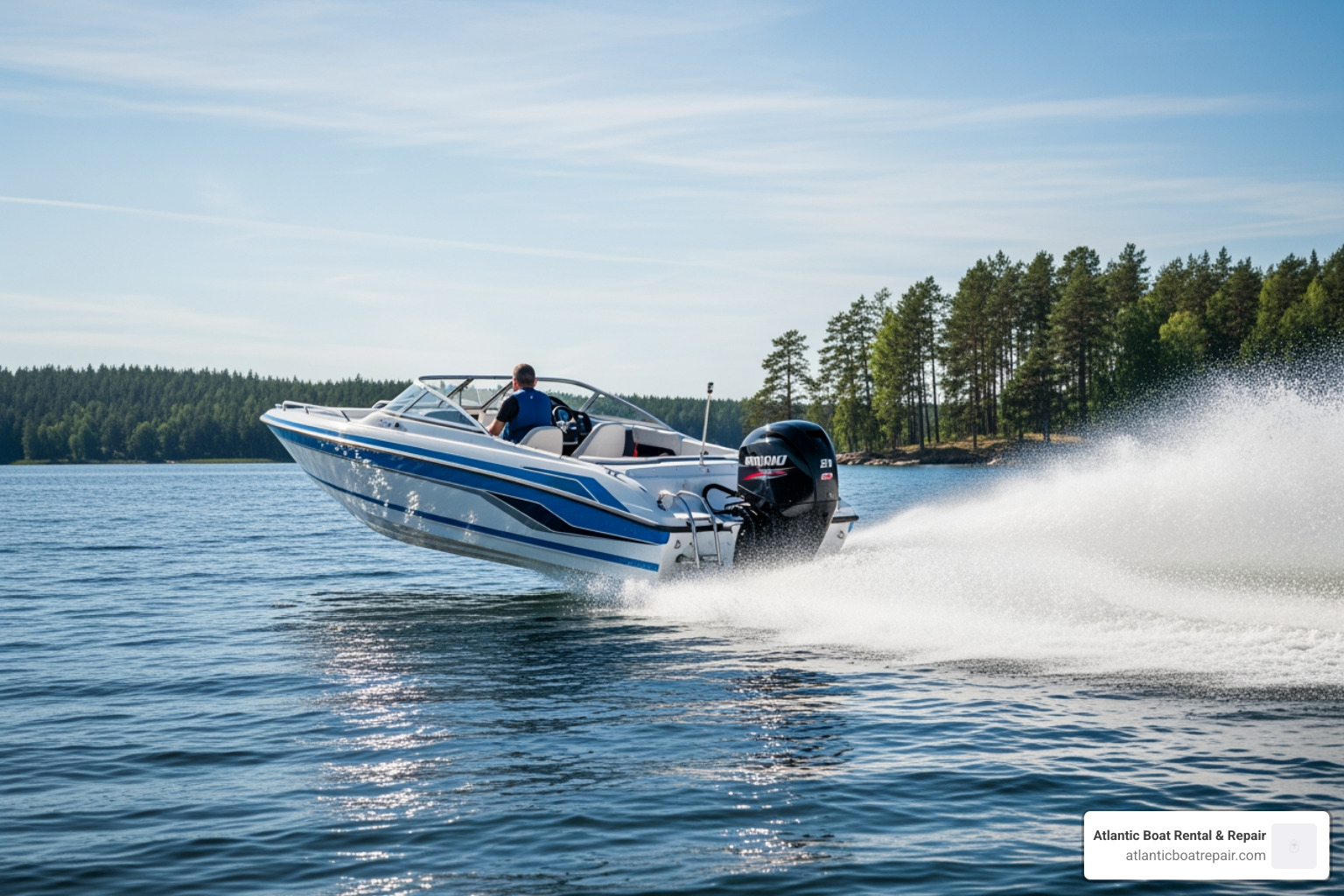
One of the most celebrated characteristics of a 2 stroke outboard is its impressive power-to-weight ratio. Because they fire every revolution and have fewer internal components, they are inherently lighter and more compact for a given horsepower output. This means a smaller, lighter engine can often deliver comparable thrust to a heavier 4-stroke.
This lightweight nature directly translates to exhilarating acceleration and a quick "hole shot"—the ability to get a boat up on plane rapidly. For activities like watersports, or for those who simply enjoy the thrill of quick throttle response, a 2 stroke outboard often feels more responsive and powerful off the line. While some argue that 4-strokes can achieve similar top speeds, the initial punch and overall feel of acceleration in a 2-stroke are often favored by performance enthusiasts.
Portability is another huge win for 2 stroke outboard engines, especially in lower horsepower ranges. For small boats, dinghies, or tenders that need to be frequently moved on and off the transom, or even carried short distances, the lighter weight is a significant advantage. Imagine trying to hoist a heavy 4-stroke onto a small jon boat versus a nimble 2-stroke! Even in the smallest classes, like the 2.5hp range, the difference is noticeable. For instance, while Honda's BF2.3 is one of the world's lightest 4-stroke outboards, it still aims to rival the weight of many 2HP 2-stroke engines. The core principle holds: less mass equals easier handling.
The Modern 2 Stroke Outboard: Efficiency and Environmental Concerns
Historically, the Achilles' heel of the 2 stroke outboard has been its environmental impact and fuel efficiency. Traditional carbureted 2-strokes, with their inherent design of expelling some unburnt fuel mixture along with exhaust gases, were known for higher emissions, more smoke, and thirstier fuel consumption. This often led to them being restricted or even banned on certain waterways, particularly in environmentally sensitive areas.
However, it's crucial to understand that the landscape of 2 stroke outboard technology has dramatically evolved. Modern 2-strokes are a far cry from their smoky predecessors. For boaters in Massachusetts and elsewhere, understanding these advancements is key.
The Evolution of 2-Stroke Technology
The game-changer for 2 stroke outboard engines has been the advent of Direct Fuel Injection (DFI). This technology fundamentally alters how fuel is delivered into the combustion chamber.
In traditional carbureted 2-strokes, fuel and oil are mixed with air before entering the cylinder. During the scavenging process, when the fresh charge pushes out exhaust gases, some of that unburnt fuel-air-oil mixture inevitably escapes through the exhaust port, leading to:
- Higher Emissions: Unburnt hydrocarbons (fuel) escaping into the environment.
- Lower Fuel Economy: Fuel being wasted out the exhaust.
- More Smoke: Especially at idle, from the burning of lubricating oil.
- Louder Operation: Due to the less controlled combustion.
DFI technology addresses these issues head-on. With DFI, fuel is injected directly into the combustion chamber after the exhaust port has closed. This precision timing means that virtually all the fuel injected is burnt, leading to:
- Improved Fuel Economy: Significantly less fuel is wasted, often rivaling or even surpassing the efficiency of some 4-strokes.
- Reduced Emissions: Dramatically lower levels of unburnt hydrocarbons, making DFI 2-strokes much cleaner and compliant with stringent EPA standards.
- Less Smoke: Modern DFI systems burn the fuel and oil much more efficiently, virtually eliminating the tell-tale smoke cloud.
- Quieter Operation: The more controlled combustion process also contributes to a noticeably quieter running engine.
Manufacturers like Mercury and Tohatsu have been at the forefront of this evolution, offering advanced DFI 2 stroke outboard models that retain the lightweight and powerful characteristics while addressing the traditional drawbacks. This means that a modern DFI 2-stroke can offer the best of both worlds for many boaters.
Regardless of your engine type, regular maintenance is paramount for performance and longevity. We always recommend checking out general outboard maintenance tips for best practices.
Cost of Ownership: Upfront Price vs. Long-Term Maintenance
When evaluating any significant purchase, the total cost of ownership is a critical factor. For 2 stroke outboard engines, this involves looking beyond the initial sticker price to consider ongoing running costs and maintenance.
Comparing Upfront and Running Costs
Historically, a traditional 2 stroke outboard engine typically had a lower initial purchase price compared to a comparable 4-stroke. This made them an attractive option for budget-conscious boaters. While the gap has narrowed with advanced DFI 2-strokes, they often still offer a competitive entry point, especially in the used market.
The used market for 2-stroke engines remains robust, particularly for carbureted models, due to their simpler design and ease of repair. This can be a huge benefit for those looking for a reliable, yet affordable, engine.
However, the running costs present a different picture. While DFI technology has made significant strides in fuel efficiency for 2-strokes, traditional carbureted models are generally less fuel-efficient than 4-strokes. This means more trips to the pump over time.
Additionally, 2 stroke outboard engines require 2-stroke oil to be mixed with their fuel (either pre-mixed manually or via an oil injection system). This oil is consumed during operation, representing an ongoing cost that 4-stroke owners don't have. While the cost per gallon of oil might seem small, it adds up over a season of heavy use.
For instance, if you're running a traditional 2-stroke, you'll need to factor in the recurring cost of oil and the careful mixing of oil with fuel to avoid serious damage. This is a maintenance consideration that 4-strokes simply don't have.
Maintenance Needs of a 2 Stroke Outboard
One of the enduring advantages of the 2 stroke outboard is its mechanical simplicity. With fewer moving parts (no valves, camshafts, or separate oil sump), there's inherently less that can go wrong. This often translates to easier diagnosis and repair, and potentially lower labor costs when professional help is needed.
Common maintenance tasks specific to 2-strokes include:
- Spark Plug Fouling: Because oil is burnt with the fuel, spark plugs can sometimes foul (get carbon buildup) more quickly than in 4-strokes, especially if the oil-to-fuel ratio is off or the engine idles a lot. Regular inspection and cleaning or replacement are key.
- Carburetor Cleaning: For carbureted models, if the engine isn't used frequently or if old fuel sits in the carburetor, it can gum up, leading to rough idling or starting issues. Regular use or proper winterization can mitigate this.
- Correct Fuel-Oil Ratio: For pre-mix engines, ensuring the correct ratio is paramount. Too little oil means insufficient lubrication and catastrophic engine failure; too much means excessive smoke and fouling.
While the maintenance schedule for a 2-stroke might seem more "hands-on" for the owner (e.g., mixing fuel), the actual mechanical work can often be less complex for a qualified technician. Our team at Atlantic Boat Rental & Repair has decades of experience with both 2-stroke and 4-stroke engines, offering expert outboard services from routine tune-ups to complex rebuilds. We understand the nuances of keeping your engine running smoothly, whether it's a classic carbureted 2-stroke or a modern DFI unit.
Making the Choice: Which Outboard Engine Suits Your Boating Style?
The decision between a 2 stroke outboard and a 4-stroke comes down to your personal boating style, the type of vessel you own, and your priorities on the water. There's no universal "best" engine; there's only the best engine for you.

Consider your typical usage: Are you a fisherman who needs to troll for hours at low speeds? Do you enjoy watersports that demand rapid acceleration? Is portability a major concern for your small dinghy or tender? Your answers to these questions will guide your choice.
Why a 2 Stroke Outboard Might Be Your Best Bet
For certain applications and boaters, the 2 stroke outboard remains an unbeatable choice:
- Lightweight Applications: If you have a small boat, a dinghy, a canoe, or a tender, the lighter weight of a 2-stroke makes it easier to handle, transport, and mount. This is particularly true for portable models.
- High-Performance Needs: For those who prioritize quick acceleration, a strong "hole shot," and a responsive feel, the raw power delivery of a 2-stroke is often preferred. They can get your boat on plane faster, which is great for waterskiing, tubing, or simply getting to your fishing spot quickly.
- Budget-Conscious Buyers: While modern DFI 2-strokes can be pricier than their carbureted cousins, the initial purchase price for many 2-strokes, especially in the robust used market, can be lower than a comparable 4-stroke. This makes them accessible to more boaters.
- Simple Maintenance Preference: If you appreciate a simpler mechanical design that can be easier to troubleshoot and repair, a 2-stroke might appeal to you. For some, mixing fuel is a small price to pay for this simplicity.
- Fishermen: Parsun's 2-stroke outboards, for example, have "won the favor of customers, especially among fisherman, due to novel design, simple structure, convenient maintenance, stronger power output and product stability." This highlights their practical appeal for those who rely on their engines.
When to Choose a 4-Stroke Outboard
While our focus is on 2 stroke outboard engines, it's important to acknowledge where 4-strokes excel:
- Fuel Economy Priority: For long-distance cruising or extended periods on the water, the superior fuel efficiency of a 4-stroke can lead to significant savings over time.
- Long-Distance Cruising and Trolling: Their smoother, quieter operation and better fuel economy make them ideal for covering long distances or for trolling at very low speeds, where a 2-stroke might run a bit rougher.
- Quiet Operation: If stealth is important (like for some fishing), or if you simply prefer a quieter ride for conversation and comfort, a 4-stroke is generally the quieter option.
- Lower Emissions Requirements: Many 4-strokes naturally meet stricter emission standards, making them suitable for waterways with environmental regulations that might restrict older or carbureted 2-strokes.
To help you make an informed decision, here's a comparison across key attributes:
| Attribute | 2-Stroke Outboard (General) | 4-Stroke Outboard (General) |
|---|---|---|
| Weight | Lighter | Heavier |
| Acceleration | Excellent (quick hole shot) | Good (smoother, but often slower initial punch) |
| Fuel Economy | Lower (traditional), improved (DFI) | Higher |
| Noise | Louder | Quieter |
| Maintenance | Simpler (fewer parts), more frequent (spark plugs, carb) | More complex (more parts), less frequent (oil changes) |
| Initial Cost | Often lower | Often higher |
Frequently Asked Questions about Outboard Engines
We encounter many questions from boat owners in Plymouth, Kingston, Duxbury, Bourne, and Sandwich, Massachusetts, about their engines. Here are some of the most common questions regarding 2 stroke outboard motors.
What is DFI on a 2-stroke outboard?
DFI stands for Direct Fuel Injection, and it's a significant technological advancement for 2 stroke outboard engines. Unlike older carbureted 2-strokes where fuel and oil are mixed with air before entering the combustion chamber, DFI systems inject fuel directly into the cylinder after the exhaust port has closed.
This precise control over fuel delivery offers several key benefits:
- Improved Efficiency: By preventing unburnt fuel from escaping through the exhaust, DFI engines achieve much better fuel economy, often comparable to or even better than some 4-strokes.
- Lower Emissions: The more complete combustion drastically reduces hydrocarbon emissions, making DFI 2-strokes environmentally cleaner and compliant with modern EPA standards.
- Less Smoke and Odor: Say goodbye to the smoky starts and lingering exhaust smells often associated with older 2-strokes.
- Smoother Running: DFI engines generally run smoother and quieter, with better low-speed performance.
DFI technology allows 2 stroke outboard engines to retain their advantages of lightweight, high power-to-weight ratio, and strong acceleration, while largely overcoming their traditional drawbacks concerning fuel efficiency and environmental impact.
Can I use a 2-stroke outboard on any lake?
This is a crucial question, especially with evolving environmental regulations. The answer is: it depends on the specific lake and the type of 2 stroke outboard you have.
Historically, older carbureted 2-stroke engines, due to their higher emissions, have been restricted or banned on certain bodies of water, particularly those designated as "no-discharge" or "zero-emission" zones. This is less common in salt-water environments like our coastlines in Massachusetts, but check local regulations for any freshwater lakes or ponds you plan to visit.
Modern DFI 2 stroke outboard engines, however, meet much stricter EPA emission standards. Many DFI 2-strokes are rated as "ultra-low emission" and are often permitted on waterways where older 2-strokes are banned.
Our advice: Always check with the local authorities or park rangers governing any specific body of water before launching your boat, especially if you have a carbureted 2 stroke outboard. Regulations can vary widely from one location to another, even within Massachusetts.
Is it hard to mix oil and gas for a 2-stroke?
For older, carbureted 2 stroke outboard engines that require pre-mixing, it's not "hard," but it does require accuracy and consistency. The key is to use the correct fuel-to-oil ratio specified by your engine's manufacturer and to mix thoroughly.
Common fuel/oil mixture ratios:
- 50💯 This is a very common ratio for many modern (non-DFI) 2-strokes, meaning 50 parts gasoline to 1 part 2-stroke oil.
- 25💯 Older or smaller engines might require a richer mix, like 25:1.
- 100💯 Some very early or specialized engines might have used leaner mixes, but this is rare today.
It's absolutely critical to use the specific type of 2-stroke oil recommended by your manufacturer (e.g., TC-W3 certified) and to measure accurately. We've seen what happens when owners guess or use the wrong ratio – it can lead to fouled spark plugs, excessive smoke, or, worse, severe engine damage due to insufficient lubrication.
Many modern 2 stroke outboard engines, particularly DFI models, feature automatic oil injection systems. These systems have a separate oil reservoir, and the engine's computer automatically mixes the correct amount of oil with the fuel based on RPMs and load. This eliminates the need for manual pre-mixing, making operation much more convenient and precise. If you have an auto-injection system, just make sure to keep the oil reservoir topped up with the correct type of oil!
Conclusion
Choosing an outboard engine is a significant decision, and we hope this comprehensive guide has shed some light on the unique characteristics of the 2 stroke outboard compared to its 4-stroke counterpart. We've seen that 2-strokes offer undeniable advantages in lightweight, powerful acceleration, and often a more accessible initial cost, especially in the pre-owned market. While traditional models presented challenges with emissions and fuel consumption, the advent of Direct Fuel Injection (DFI) technology has revitalized the 2-stroke, making modern versions cleaner, more efficient, and smoother than ever before.
There's no single "best" engine type. The ideal choice depends entirely on your specific boating needs, your budget, and your priorities for performance, maintenance, and environmental impact. Whether you're powering a small dinghy for quick trips around the harbor or a fishing boat that demands quick responsiveness, understanding these trade-offs empowers you to make an informed decision.
Here at Atlantic Boat Rental & Repair, we specialize in giving 2 stroke outboard engines a new lease on life. Our "0" time rebuilt outboard engines are remanufactured with superior precision—often exceeding manufacturer specifications—and undergo rigorous testing to ensure new-like performance and reliability. We believe in providing reliable, cost-effective solutions for boaters across Plymouth, Kingston, Duxbury, Bourne, and Sandwich, Massachusetts. If you're looking for expert advice, maintenance, or a high-quality rebuilt 2 stroke outboard, we invite you to explore our services. We're here to help you get back on the water with confidence.
Comments
Be the first to comment on this article!