
Troubleshooting Your Outboard: Common Issues and How to Fix Them
Why Boat Engine Repair Matters for Every Outboard Owner
Boat engine repair is one of the most critical skills and services for maintaining reliable performance on the water. Whether you're dealing with a no-start condition at the ramp, losing power mid-run, or noticing weak water flow from your cooling system, understanding how to troubleshoot and when to call for help can save you thousands of dollars and keep you fishing instead of sitting at the dock.
Quick Answer: Most Common Outboard Issues and Solutions
| Problem | Likely Cause | Quick Fix or Next Step |
|---|---|---|
| Engine cranks but won't start | Fuel delivery, bad spark plugs, or kill switch | Check fuel primer bulb, inspect spark plugs, verify kill switch |
| No crank at all | Dead battery or bad starter | Test battery voltage, check connections |
| Overheating alarm | Failed water pump impeller or blockage | Inspect water flow, replace impeller if needed |
| Loss of power underway | Clogged fuel filter or prop damage | Replace fuel filter, inspect propeller |
| Rough idle or stalling | Bad fuel, fouled plugs, or air leak | Drain old fuel, replace spark plugs, check fuel lines |
Around Plymouth and the South Shore, we see a lot of outboard issues that could've been avoided with routine maintenance—or caught early with basic troubleshooting. Some problems you can handle yourself with a few tools and your owner's manual. Others require hands-on experience with marine systems and the right diagnostic equipment.
This guide walks you through:
- How to diagnose common outboard problems step-by-step
- What repairs experienced owners can tackle on their own
- When it's time to bring your engine to a professional
- Preventative maintenance that keeps major repairs off the table
- How to decide between repairing, rebuilding, or repowering
I'm Ron Cribbie, owner of Atlantic Boat Repair, and I've spent decades working on everything from routine outboard service to full engine rebuilds and repowers. In that time, I've seen how proper boat engine repair and maintenance—done right the first time—keeps boats running season after season without surprise failures or costly downtime.
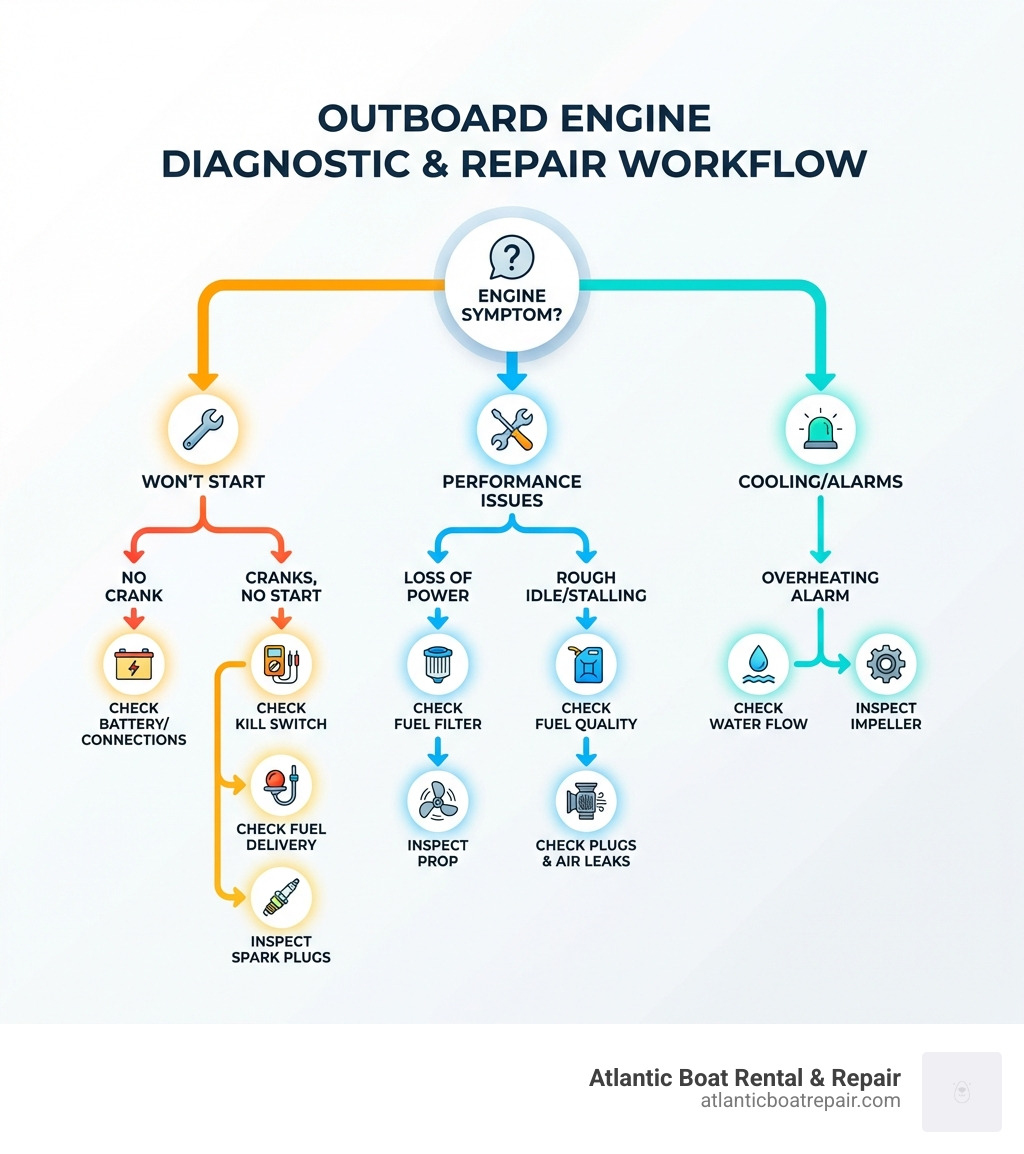
Outboard Won't Start? A Practical Diagnostic Walkthrough
Few things are as frustrating as heading out for a day on the water, only to have your outboard refuse to cooperate. Whether it's a no-start at the dock or sputtering out miles from shore, understanding the basic operational principles of your engine can help you diagnose the issue. Most modern marine engines, whether gasoline or diesel, outboard or inboard, operate on the same fundamental principles: they need fuel, spark (or compression for diesel), and air in the right proportions, at the right time.
When something goes wrong, it's often one of these three fundamental elements that's out of whack. We've seen nearly 95% of engine problems stem from a lack of maintenance, highlighting just how crucial a basic understanding of your engine can be.
Recognizing the Symptoms: What Your Engine Is Telling You
Your engine communicates problems through various symptoms. Learning to interpret these can be the first step in effective boat engine repair.
- Engine cranks but won't start: This is a classic symptom. It means your battery and starter are likely working, but the engine isn't catching. This points to an issue with fuel delivery, ignition (spark), or air intake. We often see this around Plymouth in early spring if fuel wasn't properly stabilized over winter.
- No crank at all: If you turn the key and hear nothing, or just a click, it's usually an electrical issue. The battery is the prime suspect, followed by connections, the starter motor, or the ignition switch itself.
- Sputtering or stalling underway: This often suggests inconsistent fuel delivery or ignition problems. It might feel like the engine is "starving" or misfiring. Clogged fuel filters or old, fouled spark plugs are common culprits here.
- Weak or interrupted water stream (pee hole): This is a critical warning sign for your cooling system. A strong, steady stream indicates proper water flow. A weak or intermittent stream, or no stream at all, means your water pump impeller might be failing or the intake is blocked. Overheating can quickly lead to catastrophic engine damage.
- Audible alarms: Modern outboards have sophisticated alarm systems to warn you of low oil pressure, overheating, or other critical issues. Never ignore an alarm. Consult your owner's manual immediately to understand what the specific alarm indicates.
- Diagnosing issues on the water or at the ramp: When you're away from the shop, a systematic approach is key. Start with the simplest checks: is the kill switch engaged? Is there enough fuel? Is the primer bulb firm? These basic checks can often resolve a surprising number of problems.
Pinpointing the Cause: Fuel, Spark, or Air?
When your engine acts up, especially if it cranks but won't start, we always go back to the basics: Is it getting fuel? Is it getting spark? Is it getting air?
- Fuel filter inspection: Your fuel filter is designed to catch contaminants before they reach your engine. A clogged filter restricts fuel flow, leading to sputtering, stalling, or a no-start condition. If your engine is struggling, especially under load, check your fuel filter. We often find dirty filters on boats that haven't had their annual service.
- Primer bulb firmness: On many outboards, a primer bulb allows you to manually pump fuel into the engine. A soft or collapsed bulb indicates a lack of fuel, possibly due to a leak, a clogged fuel line, or an empty tank. It should be firm after a few squeezes. If it doesn't firm up, you have a fuel delivery issue.
- Spark plug check: Spark plugs ignite the fuel-air mixture. If they're fouled with carbon, oil, or fuel, they won't produce a strong spark. To check them, carefully remove one plug (when the engine is cool) and inspect the electrode for damage or excessive buildup. You can also test for spark by grounding the plug against the engine block (away from the spark plug hole) and having someone briefly turn the key. A strong blue spark is what you're looking for. Always use the correct spark plug for your engine type.
- Kill switch position: This sounds simple, but it's a common oversight. The kill switch is a safety device that immediately stops the engine. Ensure the lanyard is properly attached and the switch is in the "run" position.
- Battery voltage basics: While a cranking engine suggests battery power, a weak battery might not provide enough juice for a strong spark or proper fuel pump operation. Use a multimeter to check your battery's voltage. A fully charged 12V battery should read around 12.6V or higher. If it's significantly lower, charging or replacing the battery might be necessary.
- Systematic troubleshooting steps: Don't just randomly swap parts. Follow a logical sequence:
- Check the easy stuff: Kill switch, fuel level, primer bulb.
- Verify fuel delivery: Is fuel getting to the engine? Is the filter clean?
- Check for spark: Are the plugs firing? Are the wires intact?
- Confirm air intake: Is the air filter clear? Is anything obstructing the intake?
This systematic approach helps you narrow down the problem efficiently, whether you're performing the boat engine repair yourself or communicating the issue to a professional.
Boat Engine Repair: What You Can Tackle vs. When to Call In Help
Many boat owners in Massachusetts, especially around our local waterways, are mechanically inclined and enjoy hands-on maintenance. Performing routine checks and preventative maintenance yourself is a great way to understand your engine better and catch small issues before they become major problems. However, there's a clear line between DIY-friendly repairs and those that require specialized tools, diagnostic equipment, and certified expertise.
DIY Outboard Maintenance Tasks for Experienced Owners
With a basic outboard toolkit and your owner's manual, you can handle a surprising amount of routine maintenance, which is crucial for preventing costly boat engine repair.
- Basic Outboard Toolkit:
- Socket set with appropriate sizes for spark plugs and other fasteners
- Screwdrivers (Phillips and flathead)
- Pliers (needle-nose and channel lock)
- Adjustable wrench
- Grease gun and marine-grade grease
- Fuel filter wrench (if applicable)
- Oil filter wrench (if applicable)
- Spark plug gap tool
- Multimeter
- Propeller wrench
- Safety gear: gloves, eye protection
- Owner's manual (invaluable for torque specs and specific procedures)
- Changing engine oil: For 4-stroke outboards, this is a straightforward process. Ensure you use the manufacturer-recommended oil type and filter. Changing the oil before winter storage is particularly important, as used oil can contain contaminants that corrode the engine during inactivity.
- Replacing fuel filters: Your engine likely has both a primary (external) and secondary (on-engine) fuel filter. Replacing these annually, or more frequently if you suspect fuel contamination, is vital for smooth operation. We often see issues from old fuel filters, especially with ethanol-blended fuels common around here.
- Inspecting and replacing spark plugs: As discussed, clean, properly gapped spark plugs are essential. Inspect them for wear and fouling, and replace them according to your owner's manual.
- Checking gearcase lube: The lower unit (gearcase) contains gears that require lubrication. Check the oil level and inspect for milky discoloration, which indicates water intrusion—a serious issue that needs professional attention. It's best to change this annually, ideally before winter.
- Propeller removal and inspection: Periodically remove your propeller to inspect for fishing line wrapped around the shaft, which can damage seals, and for dings or bends that affect performance. Lubricate the prop shaft with marine grease before reinstalling.
- Anode replacement: Sacrificial anodes protect your engine from galvanic corrosion, especially in saltwater. Inspect them regularly and replace any that are more than 50% eaten away. Ensure you use the correct material for your boating environment (zinc for saltwater, aluminum for brackish, magnesium for freshwater).
- Greasing fittings: Locate all grease fittings (usually on the trim/tilt mechanism, steering, and pivot points) and apply marine grease annually. This prevents corrosion and ensures smooth operation.
Always remember: follow your engine’s manual for specific instructions, torque specifications, and recommended parts.
Knowing When to Call a Pro
While DIY maintenance is commendable, some boat engine repair issues go beyond the scope of a home mechanic. Attempting complex repairs without the right knowledge or tools can lead to more damage and higher costs in the long run.
- Unusual internal noises: Grinding, knocking, or persistent clunking sounds from inside the engine are serious warnings. These often indicate internal wear or damage to components like bearings, pistons, or crankshafts.
- Major fluid leaks: While a small drip might be manageable, significant leaks of oil, coolant, or fuel require immediate professional attention. Fuel leaks are particularly dangerous.
- Persistent electrical issues: Beyond a simple battery check, complex electrical problems like intermittent power, charging system failures, or sensor malfunctions often require specialized diagnostic tools and expertise.
- Overheating after impeller replacement: If your engine still overheats after you've replaced the water pump impeller, it indicates a deeper cooling system problem, such as blockages in the cooling passages, a faulty thermostat, or a compromised cylinder head gasket.
- Low compression: A compression test measures the health of your engine's cylinders. Low compression in one or more cylinders can indicate worn piston rings, damaged valves, or a blown head gasket—all of which require significant internal engine work.
- How to describe symptoms clearly to your mechanic: When you call us, precise information helps us diagnose the problem faster. Be ready to describe:
- When the problem started.
- The exact symptoms (e.g., "cranks but no start," "sputters above 3000 RPM").
- Any unusual noises, smells, or visual cues (smoke, leaks).
- What you've already checked or tried.
- Your engine's make, model, and year.
We're happy to take a look and give you an honest recommendation. You can learn more about our services, including diagnostics and major repairs, by visiting our website at More about our local services.
Preventative Maintenance: The Key to Avoiding Major Repairs

The old adage "an ounce of prevention is worth a pound of cure" is particularly true for marine engines. Regular preventative maintenance is the single most effective way to ensure the longevity and consistent performance of your outboard, ultimately leading to significant cost savings on boat engine repair over time. Engines today, especially modern 4-stroke outboards, are incredibly reliable and can run for hundreds, even thousands, of hours with proper care. Neglecting routine tasks, however, is a direct path to major failures.
What’s Included in a 100-Hour Outboard Service?
The "100-hour service" is a comprehensive maintenance interval recommended annually or every 100 hours of use, whichever comes first. It goes beyond basic checks and digs into critical component health. For 4-stroke outboards, this service is paramount.
Typically, a 100-hour service includes:
- Engine oil and filter change: Essential for lubricating internal components and removing contaminants.
- Gearcase lube replacement: Ensures the lower unit gears are properly lubricated and checks for water intrusion.
- Fuel system inspection: Includes replacing fuel filters, inspecting fuel lines, primer bulb, and connections for cracks or leaks. Also involves checking for water in the fuel.
- Water pump impeller service: The impeller is a rubber component that wears out over time. Replacing it annually, or at least every 300 hours or three years, is crucial to prevent overheating.
- Thermostat check/replacement: Ensures the engine operates at its optimal temperature.
- Greasing all fittings: Lubricates all moving parts on the engine and associated components like steering and trim/tilt.
- Inspecting belts and hoses: Checks for wear, cracks, or loose connections in drive belts and cooling hoses.
- Spark plug inspection/replacement: Ensures proper ignition.
- Visual inspection: A thorough check for corrosion, loose fasteners, and any other anomalies.
We see a lot of issues in Plymouth and the South Shore from skipped maintenance. Many boat owners think they can stretch these intervals, but New England's variable weather and saltwater environments can be tough on engines. A neglected impeller or clogged fuel filter can quickly turn a beautiful day on the water into an expensive tow.
Seasonal Maintenance: Winterization and Spring Prep
Given our New England climate, seasonal maintenance is non-negotiable for protecting your investment and avoiding unexpected boat engine repair costs.
- Winterization steps for New England:
- Fuel stabilization: Add a high-quality fuel stabilizer to your fuel tank and run the engine for a while to ensure it circulates through the entire fuel system, including the carburetor or injectors. This prevents fuel degradation and gumming over the long storage period.
- Fogging the engine: This involves spraying a fogging oil into the engine's cylinders (usually via the spark plug holes) to coat internal components and protect them from rust and corrosion during storage.
- Draining water from cooling passages: If your engine is raw-water cooled, it's critical to drain all water from the cooling system or flush with marine-grade antifreeze to prevent freezing and cracking components.
- Battery care and storage: Remove your battery, clean the terminals, and store it in a cool, dry place. Connect it to a smart charger to maintain its charge throughout the winter.
- Lower unit oil change: Change the gearcase oil to remove any water that may have entered, preventing corrosion and damage over winter.
- General cleaning and protection: Wash and wax the engine cowling, and consider an engine cover to protect it from the elements.
- Spring pre-launch checklist:
- Reinstall battery: Ensure terminals are clean and connections are tight.
- Check fluid levels: Engine oil, power steering fluid, trim/tilt fluid.
- Inspect fuel system: Check all fuel lines, primer bulb, and connections for cracks or leaks that might have developed over winter.
- Inspect belts and hoses: Look for any signs of wear or damage.
- Test electrical systems: Lights, bilge pumps, horn, electronics.
- Check propeller: Ensure it's secure and undamaged.
- Test run (on muffs): Before launching, run the engine on muffs with fresh water to ensure proper cooling and operation.
- Local tips for avoiding common seasonal mistakes: Around Plymouth, Kingston, and Duxbury, we often see issues from inadequate winterization. Freezing temperatures can wreak havoc on an engine's cooling system if not properly drained or protected with antifreeze. Similarly, skipping spring checks can lead to unexpected failures on your first trip out. Taking the time for thorough seasonal prep saves you headaches and major boat engine repair bills down the line.
Major Repairs: Repair, Rebuild, or Repower?
When an outboard suffers a major failure, the decision-making process becomes more complex than routine maintenance. Engine failure scenarios like water intrusion, persistent low compression, or excessive oil consumption signal internal damage that often requires significant boat engine repair. These are not quick fixes and involve considerable cost and downtime. Understanding your options—repair, rebuild, or repower—is crucial for making an informed decision that aligns with your budget and boating goals.
Weighing Your Options: Repair vs. Rebuild vs. Repower
| Option | What It Involves | Typical Cost Factor | Turnaround Time | Warranty | When It's Best |
|---|---|---|---|---|---|
| Repair | Fixing specific faulty components (ee.g., starter, alternator, fuel pump, sensor, lower unit issues). Engine's core components are still sound. | Lowest | Shortest | Limited, specific to repaired part | Ancillary part failure, minor component issues. |
| Rebuild | Disassembling the engine, inspecting, cleaning, replacing worn internal parts (pistons, rings, bearings) with a mix of new and refurbished components. Often done by a local shop. | Medium | Medium to Long | Varies by shop, often 6-12 months | Significant internal wear, but block/crank are salvageable. |
| Repower | Replacing the entire powerhead or the complete engine (new or remanufactured) with a factory-built or professionally assembled unit. | Highest upfront | Medium (if engine is in stock) | Best, often 1-3 years | Catastrophic internal failure, desire for new technology/warranty, or when rebuilding is uneconomical. |
- What’s involved in a rebuild: A rebuild means taking the existing engine apart, inspecting all internal components, cleaning usable parts, and replacing worn items like pistons, rings, bearings, and gaskets. It's labor-intensive and requires meticulous attention to detail. While it can extend the life of an engine, the cost of labor in a boatyard can sometimes make it less economical than a repower, especially if many internal components are damaged.
- When a repower makes sense: A repower is often the best choice for catastrophic engine failures (like a hole in the block, bent connecting rods from water intrusion, or extensive corrosion), when the cost of rebuilding exceeds the value of the engine, or when you want to upgrade to newer, more fuel-efficient technology with a full factory warranty. For many boat owners in Bourne and Sandwich, a repower provides peace of mind and significantly improves the boating experience.
- Ancillary parts to consider: When deciding on a rebuild or repower, ancillary systems (starter, alternator, fuel system, trim/tilt unit, wiring harness) often remain from the old engine. Factor in their condition and potential replacement costs. A new engine often comes with new ancillary systems, which can be a significant advantage.
We help owners in the Plymouth area make these calls every season. Our experience with local conditions and countless engine assessments allows us to provide straightforward advice on the most cost-effective and reliable path forward.
The Value of a Professionally Rebuilt or Repowered Engine
Choosing a professionally rebuilt or remanufactured engine, or a brand-new one, offers distinct advantages over a typical boatyard rebuild.
- Factory-level specs: Reputable remanufacturers, like us at Atlantic Boat Repair, tear down engines completely. Components are cleaned, inspected, and machined to meet or exceed original factory specifications. We pride ourselves on superior precision—often twice manufacturer specs—and rigorous testing to ensure new-like performance and reliability.
- New and remanufactured parts: A quality remanufactured engine uses a mix of new and expertly refurbished internal parts (e.g., new pistons, rings, bearings, and refurbished block, crankshaft). This ensures consistent quality across all critical components.
- Testing and break-in: Professionally rebuilt or new engines undergo rigorous testing procedures, often including dyno testing, to ensure they meet performance standards before they ever leave the shop. This reduces the risk of early failures.
- Warranty coverage: This is a major benefit. New engines come with a manufacturer's warranty, and quality remanufactured engines typically carry a significant warranty (e.g., 18 months to two years), offering peace of mind that a basic rebuild often can't match.
- Turnaround time: While a repower might have a higher upfront cost, the turnaround time for installing a ready-to-go engine is often much faster than waiting for a complex rebuild, getting you back on the water sooner.
- Real-world reliability: Our goal with every rebuilt or repowered engine is to deliver the kind of reliability you'd expect from a brand-new unit, ensuring countless trouble-free hours on the water.
Getting You Back on the Water—With Confidence
At Atlantic Boat Repair, we understand that your time on the water is precious. Whether you're a seasoned fisherman heading out from Duxbury or a family enjoying the beaches of Cape Cod, a reliable engine is non-negotiable. Our approach to boat engine repair and maintenance is rooted in honest, local assessment and a commitment to long-term reliability.
We bring decades of hands-on experience with New England conditions. We've seen how the salt, the seasons, and the unique demands of boating in Massachusetts affect engines. This practical knowledge allows us to anticipate common issues and provide solutions that truly last.
If you’re weighing a major repair or repower, we’re happy to take a look and give you a straight answer. We'll assess your engine, discuss your options, and provide a clear, no-nonsense recommendation based on what's best for you and your boat.
Get in touch with our team to schedule an inspection or discuss your engine needs.
Comments
Be the first to comment on this article!