
Smooth Sailing: Your Annual Boat Motor Maintenance Checklist
Why Boat Motor Maintenance Determines How Long Your Engine Lasts
Boat motor maintenance is the set of routine inspections, fluid changes, and part replacements that keep your outboard running reliably and prevent costly breakdowns on the water.
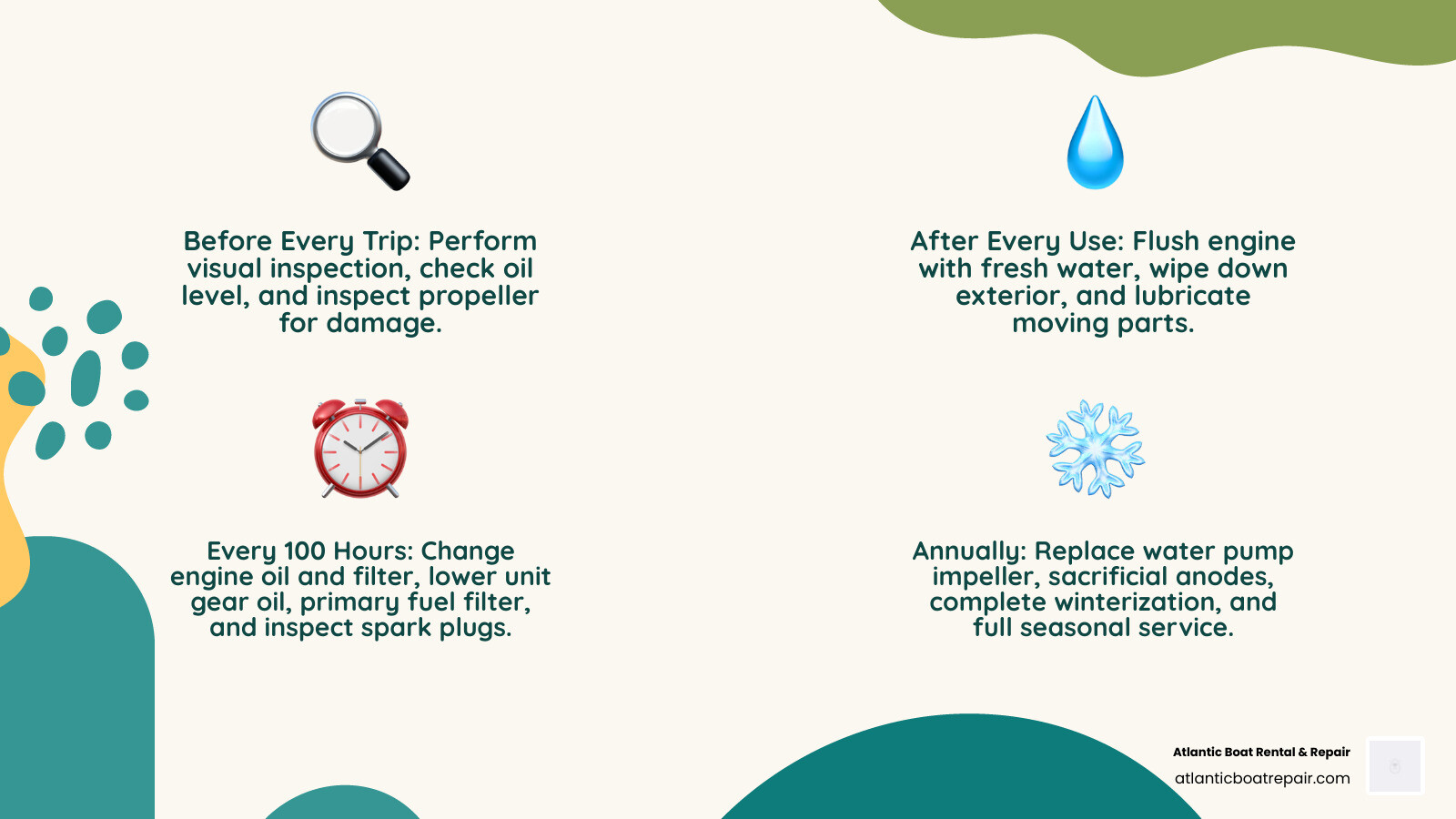
Here is a quick overview of the core tasks and how often they need to happen:
| Maintenance Task | Interval |
|---|---|
| Visual inspection | Before every trip |
| Flush with fresh water | After every use |
| Engine oil and filter change | Every 100 hours or annually |
| Lower unit gear oil | Every 100 hours (first change at 20 hours on new motors) |
| 10-micron fuel/water separator filter | Every 50 hours |
| Primary fuel filter | Every 100 hours |
| Water pump impeller inspection | Annually (saltwater) / every 2 seasons (freshwater) |
| Spark plugs (4-stroke) | Every 200 hours or every other season |
| Sacrificial anodes | Replace when 50% consumed |
| VST filter | Every 300 hours |
| Winterization | End of season |
Outboard motors live in a brutal environment. Saltwater, ethanol fuel, heat, vibration, and long periods of sitting idle all take a steady toll. The difference between an engine that runs strong at 1,000 hours and one that fails at 300 is almost always maintenance — or the lack of it.
Today's gasoline can begin to break down in a matter of weeks. A water pump impeller can harden and crack from sitting unused over a New England winter. Fishing line wrapped around a propeller shaft can quietly destroy a lower unit seal without any warning. These are not edge cases. They are the kinds of problems we see regularly on boats coming in for service.
I'm Ron Cribbie, owner of Atlantic Boat Repair, and with decades of hands-on experience in marine repair and maintenance across New England, boat motor maintenance is one of the most common — and most preventable — issues I deal with. The checklist and guidance in this article reflects what we actually do and recommend to the boat owners we work with every day.
The 100-Hour Service: A Comprehensive Boat Motor Maintenance Routine
The "100-hour service" is the industry standard for a major tune-up. Whether you hit that mark in three months or a full season, this is the milestone where we dig deep into the engine's health. It isn't just about changing the oil; it's a comprehensive routine designed to catch small issues before they leave you stranded in the middle of Cape Cod Bay.

A standard 100-hour service includes changing the engine oil and filter, replacing the lower unit gear oil, inspecting or replacing spark plugs, and checking all fuel filters. For four-stroke outboards, pulling spark plugs every 200 hours is the rule, but we often check them at the 100-hour mark to read the "health" of the combustion. Healthy plugs should look light brownish with sharp edges.
When changing fluids, we recommend using a self-contained, spill-proof oil extractor. This is much cleaner than trying to drain oil through a traditional plug, especially while the boat is on a trailer or in a slip. You can click here to find out more about our professional services if you'd rather have an expert handle the mess.
| Component | 2-Stroke Needs | 4-Stroke Needs |
|---|---|---|
| Engine Oil | Mixed with fuel or injected from tank | Reservoir in crankcase (needs regular changes) |
| Oil Filter | None | External or internal canister (replace annually) |
| Lubrication | TC-W3 certified oil | FC-W certified marine oil |
Essential Steps for Routine Boat Motor Maintenance
Between those 100-hour milestones, your eyes and ears are your best tools. Before every launch, perform a thorough visual inspection. Check hoses for cracks or "soft" spots that could indicate internal rot. Look at your belts—marine belts are cogged and cannot be flipped to extend their life; if they are fraying, they need to go.
Check your battery terminals for the "green fuzz" of corrosion. A simple mixture of baking soda and water can clean this up, but ensure the connections are tight. Loose terminals are a leading cause of electrical gremlins and charging failures. Finally, hit all grease points with a marine-grade lubricant. This includes the tilt tube, steering linkages, and swivel bracket. If you aren't sure where your grease zerks are located, you can request a service quote and we can walk you through it.
Tracking Your Boat Motor Maintenance Schedule
In the South Shore area, our boating season is relatively short, making it easy to lose track of hours. If your boat doesn't have a built-in hour meter, we strongly recommend installing one. It’s a simple two-wire hookup that provides the data you need for an accurate maintenance log.
Many modern boaters use maintenance apps or digital logbooks to track their service history. This isn't just for your peace of mind; a well-documented service history significantly increases the resale value of your boat. Always keep your manufacturer’s manual on board—it is the final authority on torque specs and fluid capacities for your specific model.
Fuel System Integrity and Ethanol Mitigation
Fuel issues account for nearly 80% of the engine problems we see in Plymouth and Kingston. Modern gasoline is a solvent, and the ethanol (E10) added to it is "hygroscopic," meaning it actively pulls moisture out of the air.
Your first line of defense is a 10-micron fuel/water separating filter. We recommend replacing these every 50 hours. When water concentration in fuel reaches just 0.5%, it bonds with the ethanol and sinks to the bottom of the tank—a process called phase separation. Once this happens, no additive can "fix" the fuel; it must be drained.
Beyond the external separator, your engine has internal filters. Primary and in-line fuel filters should be replaced every 100 hours. Vapor Separator Tank (VST) filters are more complex and should be inspected or replaced every 300 hours. To keep your system clean, you can learn more about fuel system maintenance and filter replacement through detailed guides.
Managing Ethanol in Marine Engines
To mitigate the effects of ethanol, never use fuel with more than 10% ethanol (E10). In fact, if you can find ethanol-free gas at a local dock, use it. If not, use a high-quality fuel stabilizer in every single tank. This helps prevent the fuel from breaking down and forming "gum" or varnish in your injectors or carburetors.
Another pro tip: keep your fuel tank about 7/8 full during the season. This minimizes the "headspace" in the tank where condensation can form on the walls and contaminate your fuel.
Cooling System Health: Flushing and Impeller Replacement
Your outboard’s cooling system is its lifeblood. Unlike a car, which uses a closed radiator, an outboard sucks in the water it’s floating in. In the salt and brackish waters around Duxbury and Bourne, this means your engine is constantly exposed to salt and silt.
The water pump impeller is a small rubber wheel that does the heavy lifting. Even if you don't use the boat, these impellers can "take a set" or become brittle over time. We recommend replacing the impeller every year if you boat in saltwater or turbid water, or every two seasons in clean freshwater.
Always monitor the "telltale" stream (the pee stream) coming from the back of the engine. If it’s weak or hot, shut the engine down immediately. Sometimes a piece of debris or a mud dauber nest is just clogging the nozzle—you can often clear this with a piece of wire—but a weak stream usually points to a failing impeller or a stuck thermostat.
The Importance of Flushing After Every Use
You must flush your engine with fresh water after every single use, even if you only boat in freshwater. All water contains minerals and contaminants that can build up in the cooling passages. In saltwater, the salt begins to crystallize at temperatures above 170°F, which can quickly restrict flow and lead to "dry corrosion" in the exhaust system.
Flush for at least 15 minutes at idle to ensure the thermostats open and fresh water reaches every corner of the block. While you're at it, check out our Tohatsu inventory if you're looking for a motor known for its robust cooling design.
Lower Unit Protection and Propeller Care
The lower unit houses the expensive gears that turn your propeller. It operates under immense pressure and is submerged the entire time you're on the water.
The most critical maintenance task here is changing the gear lubricant. For a new outboard, do this after the first 20 hours, then every 100 hours thereafter. When you drain the oil, look at the color. If it looks like chocolate milk, you have water intrusion. This usually means a seal has been compromised, often by discarded fishing line.
Inspecting and Greasing the Propeller
We recommend pulling your propeller several times a season to check for fishing line wrapped around the shaft. That thin monofilament can melt into the rubber seals, allowing water into the gearcase and oil out into the ocean.
While the prop is off, inspect the blades for dents or "curls." Even a small nick can cause a vibration that destroys bearings over time. Apply a liberal coat of marine-grade grease to the propeller shaft before reinstalling. This prevents the prop from "seizing" to the shaft, which would make it impossible to remove later. Always use a new cotter pin to secure the prop nut.
Sacrificial anodes (often called "zincs") are also vital. These are designed to corrode so your engine doesn't. Replace them once they are 50% consumed. If you boat in saltwater, stick with zinc or aluminum anodes; magnesium is generally reserved for freshwater use.
Winterization and Long-Term Storage in Massachusetts
In Massachusetts, winterization isn't optional. The freezing temperatures in Sandwich and Plymouth can crack an engine block if water is left inside.
Proper winterization involves:
- Stabilizing the fuel: Run the engine with stabilized fuel so it reaches the injectors.
- Fogging the engine: This coats the internal cylinders with a thin layer of oil to prevent rust.
- Changing fluids: Always store a boat with fresh engine and gear oil to prevent acidic buildup.
- Draining the block: Ensure all water is out of the cooling system.
- Battery care: Remove the battery and keep it on a maintenance charger in a cool, dry place.
Frequently Asked Questions about Outboard Care
Should beginners perform maintenance themselves or hire a professional?
Basic tasks like flushing and visual inspections are perfect for beginners. However, things like VST filter replacement or impeller changes often require specialized tools and torque settings. If your engine is under warranty, having a professional perform the 100-hour service ensures your coverage remains intact.
How does maintenance differ between saltwater and freshwater use?
Saltwater is significantly more aggressive. You need to be much more diligent about flushing and replacing anodes. In freshwater, you can often get two seasons out of an impeller, whereas saltwater users should stick to an annual schedule.
What are the signs that professional service is needed?
If you notice a sudden loss of RPM, unusual vibrations, or an overheating alarm, it’s time to call us. Milky gear oil is another "red alert" that requires professional seal replacement before the gears are destroyed.
Conclusion
At Atlantic Boat Rental & Repair, we know that a boat is more than just a machine; it's your gateway to the South Shore's best fishing and family memories. Whether you need a routine 100-hour service or you're looking for one of our precision-remanufactured "0" time rebuilt engines, we bring a level of local expertise you won't find at a big-box dealership. We test every engine we build to twice the manufacturer's specs because we know exactly what the Atlantic can throw at you.
If you want to talk through your maintenance options, give us a call. We're happy to take a look and give you an honest recommendation to keep you on the water all season long.
Comments
Be the first to comment on this article!