
Don’t Get Tangled: A DIY Guide to Boat Trailer Wiring
Why Proper Boat Trailer Wiring Matters for Safety and Compliance
Boat trailer wiring connects your tow vehicle to your trailer, powering essential lights like brake lights, turn signals, and tail lights to signal your intentions to other drivers.
Quick Answer: Basic Boat Trailer Wiring Setup
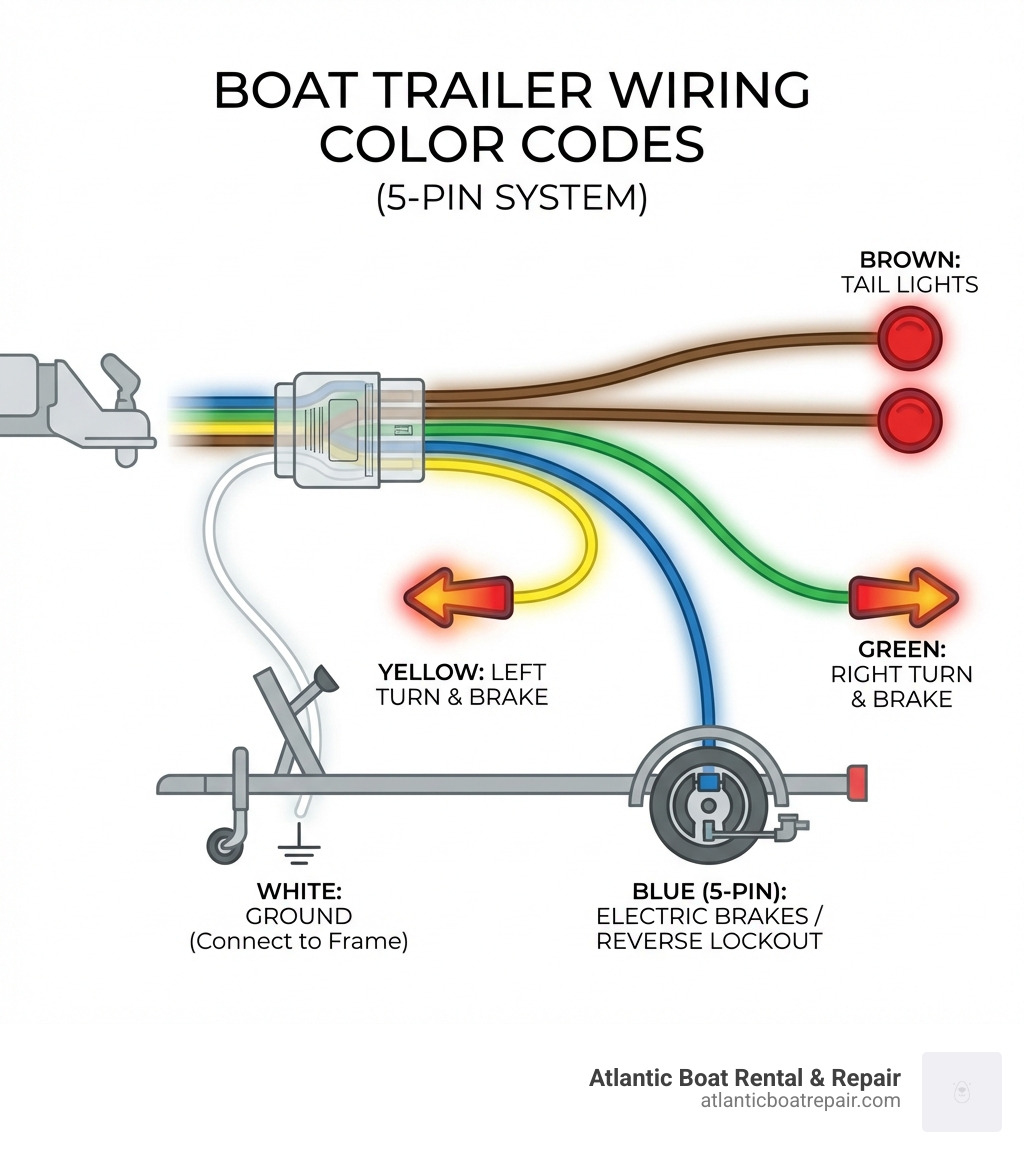
- White Wire - Ground (connects to trailer frame)
- Brown Wire - Tail/running lights and side markers
- Yellow Wire - Left turn signal and brake light
- Green Wire - Right turn signal and brake light
- Blue Wire (5-pin)** - Electric brakes or reverse lockout for surge brakes
Most boat trailers use a 4-pin flat connector for basic lighting. If you have electric brakes or need reverse lights, you'll need a 5-pin or 7-pin connector.
Many boaters know the frustration of trailer lights failing right before a trip. This is preventable.
Trailer lights are a legal requirement for safe towing. Failed lights risk more than a ticket—they risk collisions that could damage your boat, your vehicle, and put lives at risk.
The good news is that rewiring a boat trailer is a straightforward DIY project. Most failures stem from three culprits: corrosion, poor grounding, and damaged connections. With the right knowledge, you can install a reliable wiring system in a few hours.
This guide will walk you through everything you need to know, from understanding wire color codes and choosing the correct gauge to making waterproof connections and troubleshooting common issues. We'll cover basic 4-pin setups and more complex systems with electric brakes.
Before you start: Always disconnect your vehicle's battery before working on any electrical system. If you're not comfortable with electrical work, seek professional help.
I'm Ron Cribbie, owner of Atlantic Boat Repair. With decades of experience repairing marine vessels and trailers in New England, I've diagnosed every wiring failure imaginable. I'm here to share what works in real-world conditions.
Understanding Your Boat Trailer Wiring System
Your boat trailer wiring is a communication system ensuring your trailer's lights mirror your vehicle's actions—braking, turning, and running lights.
Essential components include the wiring harness, vehicle connectors, and lights (tail, brake, turn, marker). The harness carries signals from your vehicle to the lights, ensuring visibility and legal compliance.
The type of connector dictates your trailer's electrical functions. Here's a rundown of common types:
| Connector Type | Number of Pins | Primary Functions |
|---|---|---|
| 4-Pin Flat | 4 | Ground, Tail/Running Lights, Left Turn/Brake, Right Turn/Brake. The most common connector for smaller trailers with basic lighting. |
| 5-Pin Flat | 5 | Adds one function to the 4-Pin, typically for electric brakes or a reverse lockout solenoid on surge brakes. |
| 6-Pin Round | 6 | Adds a 12-volt accessory/charging wire to the 4-Pin functions, often for RVs or utility trailers needing to power accessories or charge a battery. |
| 7-Pin RV Blade | 7 | Most comprehensive, adding Electric Brakes, 12-volt Accessory/Charging, and Reverse Lights to the basic functions. Used on larger trailers and RVs. |
You may encounter SAE and RV wiring standards. The main difference is the color coding, especially on 7-pin connectors. The SAE J2863 standard is most common. Regardless of wire color, the system will work if the wire is connected to the correct pin position on the connector.
Decoding the Trailer Wire Color Code
Understanding the standard color code for boat trailer wiring demystifies your trailer's electrical system. The SAE standard is the one we generally follow.
- White Wire (Ground): The most critical wire, providing the return path for all circuits. A poor ground is the #1 cause of light malfunctions. It must connect to a clean, unpainted section of the trailer frame.
- Brown Wire (Tail/Running Lights): Powers all running lights, side markers, and the license plate light when your vehicle's headlights or parking lights are on.
- Yellow Wire (Left Turn/Brake): Controls the left-side turn signal and brake light.
- Green Wire (Right Turn/Brake): Controls the right-side turn signal and brake light.
- Blue Wire (Brakes/Reverse Lockout): On 5-pin+ systems, this wire activates electric trailer brakes or a reverse lockout solenoid on hydraulic surge brakes. The lockout prevents brakes from engaging while backing up, which is crucial for launching a boat.
- Red/Black Wire (Auxiliary Power): On 7-pin connectors, this provides 12-volt power from the tow vehicle to charge a trailer battery or power accessories.
- Purple/Gray Wire (Reverse Lights): On 7-pin connectors, this powers the trailer's reverse lights.
Knowing these color codes is your first step to confidently diagnosing and repairing any boat trailer wiring issue.
Gearing Up for the Job
Before you start, gather the right tools and materials. Using the proper equipment makes the job smoother and prevents frustration and poor connections.
Here's a list of what we recommend having on hand:
- Wire Strippers/Cutters: Essential for cleanly removing insulation and cutting wires.
- Wire Crimpers: For securing connectors to wires.
- Heat Gun: Crucial for activating heat-shrink tubing to create a watertight seal.
- Multimeter/Test Light: Invaluable for diagnosing electrical issues and confirming power.
- Basic Hand Tools: Pliers, screwdrivers, adjustable wrench, and a socket set.
- Utility Knife/Box Cutter: For cutting old wiring harnesses.
- Wire Brush/Sandpaper: For cleaning ground contact points on the trailer frame.
And for materials, we'll need:
- Boat Trailer Wiring Kit: Ensure it's long enough for your trailer.
- Heat-Shrink Crimp Connectors: Non-negotiable for boat trailers in coastal areas like Plymouth, Kingston, Duxbury, Bourne, and Sandwich, Massachusetts, where saltwater corrosion is a constant threat.
- Dielectric Grease: Prevents moisture from reaching electrical connections.
- Zip Ties/Wire Clips: To secure your new wiring neatly. Galvanized clips are best for marine use.
- Electrical Tape: For added insulation or bundling wires.
- Marine-Grade Primary Wire: If replacing sections, ensure it's marine-grade to resist corrosion.

Choosing the Correct Wire Gauge for Your Boat Trailer Wiring
Choosing the correct wire gauge is critical for safety and performance. The American Wire Gauge (AWG) system is counter-intuitive: a smaller number means a thicker wire (e.g., 10-gauge is thicker than 16-gauge). You can learn more about AWG dimensions.
Two factors determine the gauge: wire length and amperage (current). Longer runs and higher loads require thicker wires to prevent voltage drop and overheating, which can cause dim lights or fire hazards.
As a general guideline, here are our recommendations for common boat trailer wiring functions:
- Tail Lights, Running Lights, Brake Lights, Turn Signals, Reverse Lights: 16-gauge wire is typically sufficient.
- Ground Wire: We recommend a heavier gauge for the main ground, such as 12-gauge, to ensure a robust return path.
- Electric Trailer Brakes & Battery Charging Wire: These draw more power, so a 10-gauge wire is recommended.
Trailer length is critical. For longer trailers, use a thicker gauge to compensate for voltage drop. For example, a 14-gauge wire can handle 10 Amps for about 9 feet, but you'd need a thicker wire for a longer run at the same amperage.
| Total Wire Length (one-way) | Minimum Recommended Gauge |
|---|---|
| Up to 10 feet | 16-gauge |
| 10-20 feet | 14-gauge |
| 20-30 feet | 12-gauge |
| 30+ feet | 10-gauge |
Always err on the side of using a thicker wire if you're unsure.
The Step-by-Step Guide to Rewiring Your Trailer
Rewiring a boat trailer is a manageable DIY project. We'll break it down into simple steps to ensure your trailer is safe and legal. For a visual guide, see Boating Mag's article on How to Rewire Your Boat Trailer. If you need help, contact our team at Atlantic Boat Repair. Learn more about our professional trailer maintenance on our Services page.
Step 1: Removal and Preparation
- Sketch a Diagram: Before cutting anything, photograph and sketch your existing boat trailer wiring layout. Note wire runs, connections, and ground points. This will be your roadmap.
- Disconnect the Battery: Disconnect the negative terminal on any trailer battery (e.g., for a breakaway system). Also, disconnect your tow vehicle's battery to prevent shorts.
- Remove Old Lights and Harness: Unbolt the old lights and cut the wires. If the old harness runs inside the frame, you can tape the new harness to the old one and use it to pull the new wires through.
Step 2: Running New Wires and Proper Grounding
- Routing the New Harness: Plan a route that protects wires from sharp edges and debris, ideally inside frame members. Secure the harness every 12-18 inches with zip ties or galvanized clips. Leave enough slack at the connector for sharp turns.
- Protecting Wires from Chafing: Use rubber grommets or loom where wires pass through holes in the frame to prevent chafing, which is crucial for longevity in harsh coastal conditions.
- Importance of a Solid Ground Connection: A solid ground is the backbone of reliable boat trailer wiring and prevents most light problems. Connect the white ground wire to a clean, unpainted, rust-free spot on the trailer frame. Use a wire brush to expose bare metal and secure the wire tightly with a screw or bolt.
- Dedicated Ground Wire vs. Frame Ground: For the most reliable connection, run a dedicated ground wire from each light back to the main ground point. This is better than relying on the frame, as mounting bolts can rust.
Step 3: Making Connections and Preventing Corrosion
- Connecting Lights: Following your color code diagram, connect the wires to each light. For boat trailers in saltwater areas like Plymouth, Kingston, or Duxbury, heat-shrink crimp connectors are essential. They create a watertight seal when heated, protecting connections from corrosion.
- Applying Dielectric Grease: Apply dielectric grease to all connections for an extra layer of moisture protection.
- Securing Wires: Double-check that all wires are neatly routed and secured to the frame with zip ties or clips to prevent snagging or chafing.
Step 4: Testing Your New Boat Trailer Wiring
- Connect to Tow Vehicle: Plug the trailer into your tow vehicle, ensuring the connector is fully seated.
- Test All Functions: With a helper, systematically test each lighting function:
- Running Lights: Turn on your vehicle's headlights. All tail, side marker, and clearance lights should illuminate.
- Brake Lights: Press the brake pedal. Both tail lights should glow brighter.
- Turn Signals: Test the left and right turn signals independently.
- Reverse Lights (if applicable): Put your vehicle in reverse (engine off, parking brake on).
- Troubleshooting with a Multimeter: If lights don't work, check your vehicle's fuses. Use a multimeter to check for voltage at the vehicle's connector pins. If there's power, the problem is on the trailer. Check for continuity on the trailer's wires and for faulty grounds at the non-working lights. To isolate the issue, you can also power the trailer directly from a battery; if the lights work, the problem is with the tow vehicle or adapter.
Advanced Systems and Troubleshooting Common Problems
Let's cover advanced systems and common troubleshooting for boat trailer wiring.
Most wiring issues stem from a few culprits:
- Bad Ground: A poor ground is the #1 cause, leading to dim, flickering, or intermittent lights.
- Corrosion: Corrosion attacks connections, blocking current. Use heat-shrink connectors and dielectric grease to prevent it, especially in coastal areas.
- Short Circuits: Damaged insulation can cause wires to touch, creating a short that blows fuses.
- Blown Fuses: A blown fuse, which usually indicates a short, will cause a light to fail. Check fuses in your tow vehicle.
When it comes to lights, you have a choice between traditional incandescent bulbs and modern LEDs.
- LED vs. Incandescent Lights:
- Incandescent: Cheaper upfront but less durable and more susceptible to water damage.
- LED: We highly recommend LED lights. While more expensive initially, they are more durable, use less power, and are much brighter.
- Submersible Lights: Always use submersible lights for boat trailers. They are sealed units designed to be fully immersed in water during launch and retrieval without failing.
Wiring for Electric Brakes and Breakaway Systems
Larger boat trailers (over 3,000 lbs GTW) often require electric brakes and breakaway systems for safety and legal compliance.
- How Electric Brakes Work: Electric brakes on heavier trailers are controlled by an in-cab unit. It sends a signal down the blue wire (on a 7-pin connector) to activate electromagnets in the trailer's brake drums or an electric-over-hydraulic actuator for disc brakes. The driver can adjust braking force and use an override to control sway. You can learn more about the workings of electric trailer brakes from Bendix.
- Breakaway Kit Components: A breakaway kit is a required safety feature in Massachusetts for trailers over 3,000 lbs GVWR. It automatically applies the trailer's brakes if it detaches from the tow vehicle. It consists of a small battery, a switch with a lanyard, and a charger.
- Wiring the Switch and Battery: The breakaway battery charges from the tow vehicle's 12V line (via the 7-pin connector). The switch is wired between this battery and the brake circuit. If the trailer detaches, a pin is pulled from the switch, sending full power to the brakes to stop the trailer.
Frequently Asked Questions about Boat Trailer Wiring
Here are answers to common questions about boat trailer wiring we hear from customers in Plymouth, Kingston, and beyond.
What are the legal requirements for trailer lights?
Trailer lighting laws ensure your trailer is visible and your intentions are clear to other drivers. General requirements in Massachusetts and most of the U.S. include:
- Tail Lights & Stop Lights: Red, on the rear.
- Turn Signals: Amber or red, on the rear.
- Side Marker Lights: Amber on the front sides, red on the rear sides (for longer or wider trailers).
- Clearance Lights: Amber on the front, red on the rear (for trailers 80 inches or wider).
- Reflectors: Red on the rear, amber on the sides.
- License Plate Light: White light illuminating the plate.
Always check current local regulations to ensure full compliance.
How much does it cost to rewire a trailer?
The cost to rewire a trailer varies based on a DIY vs. professional approach and trailer complexity.
- DIY Cost: A DIY rewire costs $50 to $200 for a complete boat trailer wiring kit, plus any tools or specialized connectors you need.
- Professional Service: Professional service costs $150 to $500+, including parts and labor, depending on trailer design and regional labor rates. This provides peace of mind with an expert installation.
Why do only some of my trailer lights work?
When only some lights work, it points to a specific circuit or connection problem, not a total system failure. Here's how to troubleshoot:
- Isolate the Problem:
- First, test your tow vehicle's connector with a multimeter to confirm it's not the source of the problem.
- Then, inspect the trailer's connector for corrosion or bent pins.
- Bad Bulb: For incandescent lights, the simplest cause is often a blown bulb.
- Specific Wire Connection Issue: If only the left turn signal is out, trace the yellow wire circuit. Look for loose, corroded, or damaged connections from the harness to the light.
- Faulty Ground at One Light: A single light can have a bad ground even if the main trailer ground is good. If a light is dim or flickering, run a temporary ground wire from the light to the frame. If it works, you've found the problem. Clean the light's mounting area or install a dedicated ground wire.
- Corrosion: Inspect all connections for green or white powdery residue, especially at light fixtures and wire splices.
Conclusion: Safe Towing Starts with Solid Wiring
We've covered everything from wire colors to brake systems. Properly maintaining your boat trailer wiring is crucial for your safety and peace of mind.
Remember the keys to success: a solid ground, marine-grade heat-shrink connectors to fight corrosion, the correct wire gauge, and thorough testing. Regular checks prevent frustration and dangerous situations on the road.
At Atlantic Boat Repair, we believe in empowering boat owners with knowledge, but we're also here when you need an expert. If you're in the Bourne and Sandwich area and run into a wiring problem you can't solve, our team is ready to help.
For professional help with your boat trailer and other marine systems, explore our expert Services. We're committed to keeping you and your boat safe on the water and the road.
Comments
Be the first to comment on this article!