
Pre-Loved Propulsion: Smart Buys in Outboard Motors
Why Used Outboard Motors Are a Smart Alternative to Buying New
Used outboard motors offer a practical path to reliable propulsion without the premium price of a new engine. Whether you're replacing a failed motor or repowering an older vessel, the secondary market provides access to quality engines at significant savings.
Quick Answer: What You Need to Know About Buying Used Outboard Motors
- Cost Savings: Used motors typically cost 30-60% less than new equivalents.
- Where to Buy: Marine dealerships, online marketplaces, private sellers, and specialized marine shops.
- Key Inspection Points: Compression test, lower unit condition, corrosion, engine hours, and cooling system.
- Typical Price Range: $500-$15,000 depending on horsepower, age, brand, and condition.
- Warranty Options: "As-is" from private sellers; limited warranties from dealers; 12+ months on remanufactured units.
- Best Brands: Yamaha, Mercury, Honda, Suzuki (known for durability and parts availability).
The market for used outboards is diverse, with everything from vintage two-strokes to recent four-stroke models. For many boat owners facing expensive repairs, buying used is the key to staying on the water without breaking the budget.
I'm Ron Cribbie, owner of Atlantic Boat Repair. With decades in the marine service industry, I've seen how a carefully selected used or remanufactured engine can deliver years of reliable service at a fraction of the cost of a new one.
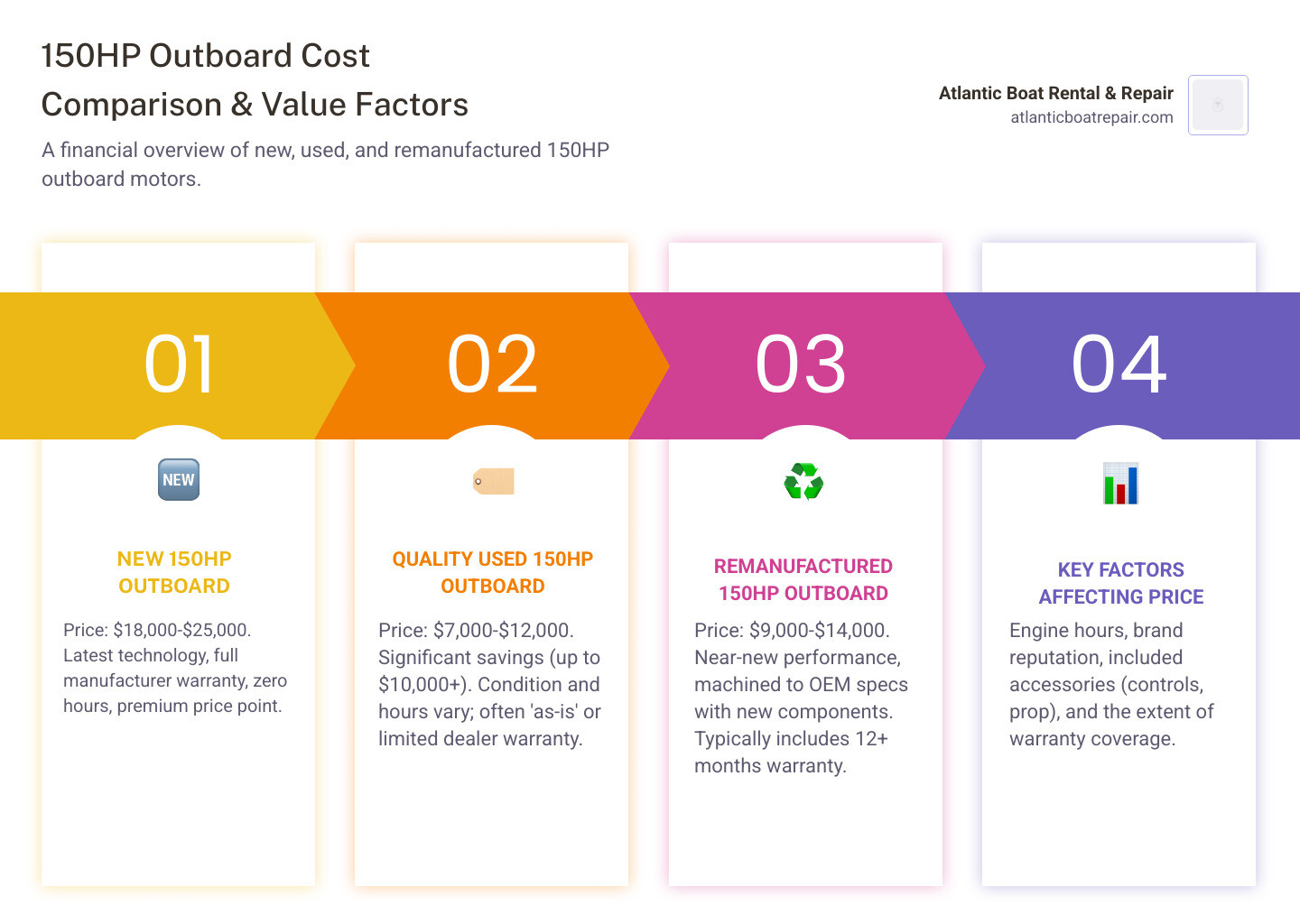
The Buyer's Compass: Navigating Your Used Outboard Motor Purchase
Starting on a used outboard motor purchase can feel like charting unknown waters, but our goal at Atlantic Boat Repair is to equip you with the knowledge to make a smart investment.
The Value Proposition: Why Buy Used?
For many of our customers in Plymouth, Kingston, Duxbury, Bourne, and Sandwich, Massachusetts, the benefits of buying used are compelling:
- Significant Cost Savings: A used motor can cost 30-60% less than its new equivalent, making boating more accessible and freeing up your budget.
- Accessibility and Repowering: For new boaters or those with a failed engine, a used motor is an economical way to get on the water and extend the life of a beloved boat.
- Wider Selection: The used market offers a vast array of brands and models, including vintage or specific engines that are no longer produced new.
- Repowering Options: If your current motor is beyond repair, a used outboard offers a cost-effective solution to get you back on the water quickly.
Key Decision Factors: Horsepower, Brand, and Age
Choosing the right used outboard motor is about finding the right fit for your boat and needs. Consider these critical factors:
- Horsepower Requirements: Your boat has a maximum horsepower rating that should not be exceeded. Consider your boat's size, weight, and how you'll use it (e.g., watersports vs. cruising).
- Brand Reputation: Brands like Yamaha, Mercury, Honda, and Suzuki have earned a reputation for reliability and parts availability.
- Condition, Age, and Hours: A well-maintained older motor can outperform a neglected newer one. Engine hours are like a car's mileage; under 100 hours per year is typically light use for a recreational motor.
- Two-Stroke vs. Four-Stroke: Each type has its pros and cons, especially in the used market.
| Feature | Two-Stroke Outboard | Four-Stroke Outboard |
|---|---|---|
| Weight | Generally lighter | Generally heavier |
| Fuel Efficiency | Less fuel-efficient, consumes oil alongside fuel | More fuel-efficient, separate oil sump |
| Maintenance | Simpler design, fewer moving parts | More complex, requires regular oil changes |
| Noise & Emissions | Louder, higher emissions (especially older models) | Quieter, lower emissions |
| Power-to-Weight | Excellent acceleration | Smooth, consistent power delivery |
| Cost (Used) | Often more affordable | Generally higher |
- Shaft Length: This is crucial. Measure your boat's transom height to determine if you need a short (approx. 15"), long (20"), or extra-long (25") shaft.
- Tiller vs. Remote Control: Tiller control is for direct hand steering on smaller motors, while remote control uses a steering wheel on larger boats.
Decoding the Price Tag of Used Outboard Motors
The price of a used outboard motor varies based on several key factors:
- Typical Price Ranges:
- Small (2-10 HP): $300 - $1,500
- Mid-Range (15-60 HP): $1,500 - $5,000
- High Horsepower (75+ HP): $5,000 - $15,000+
- Factors Affecting Price:
- Horsepower: Higher HP equals a higher price.
- Age and Condition: Newer engines in excellent condition with low hours command higher prices.
- Brand Value: Premium brands like Yamaha, Mercury, Honda, and Suzuki hold their value better.
- Included Accessories: Propellers, controls, and gauges can increase the value.
- Warranty: A motor sold with a warranty from a dealer or remanufacturer will be priced higher.
The Inspection Gauntlet: How to Vet a Used Outboard Like a Pro
Buying a used outboard motor is an investment in your boating enjoyment, so a thorough inspection is essential. Think of it as a pre-flight check for your aquatic adventure.
The Visual Walk-Around: Spotting Red Flags
Start with a visual inspection to spot obvious issues.
- Corrosion: Look for excessive corrosion on bolts, electrical connections, and the powerhead. Heavy, bubbling corrosion is a major red flag.
- Skeg and Propeller: Minor dings on the skeg (the fin below the prop) are common, but severe damage can indicate hard impacts and internal gearcase issues. Check the prop for cracks or bent blades.
- Casing Cracks: Inspect the engine cowling and lower unit for cracks, which can indicate impacts or structural fatigue.
- Wiring and Fuel Lines: Frayed wires or cracked fuel lines are signs of neglect and potential safety hazards.
- Lower Unit Oil: Drain a small amount of gear lube. It should be amber-colored. Milky oil means water intrusion (a costly repair), while black, burnt oil suggests overheating or wear.
- Trim and Tilt: Test the power trim and tilt. It should operate smoothly and quietly.
Under the Cowling: A Mechanical Deep Dive
Now, look under the cowling for a deeper mechanical check.
- Compression Test: This is the most critical test. It measures cylinder pressure. Readings should be consistent across all cylinders (within 10-15% of each other). Low or uneven compression points to expensive repairs.
- Spark Plugs: Remove the plugs. A light tan color is ideal. Oily or burnt plugs suggest engine problems.
- Fuel System: Check for leaks, cracks, or contamination in the fuel lines, filter, and carburetor or injectors.
- Electrical System: Look for loose or corroded battery cables and connections.
The Moment of Truth: Testing the Motor
Seeing and hearing the motor run is non-negotiable.
- Starting and Idling: A healthy motor should start easily and idle smoothly.
- Cooling Water Stream (Telltale): A strong, steady stream of water should exit the telltale port, indicating the cooling system is working. A weak stream can mean a bad impeller and risk of overheating.
- Shifting Gears: Test forward, neutral, and reverse. Shifting should be smooth, not clunky.
- Unusual Noises: Listen for any knocks, pings, or rattles that could signal internal problems.
- On-Water vs. Tank Test: A tank test is good, but an on-water test under load is ideal to check acceleration and performance in real-world conditions. We invite local customers to see our motors run in our test tank before purchase.
Where to Buy and What to Expect: Sellers, Warranties, and Paperwork
Finding the perfect used outboard motor involves knowing where to look and understanding the differences between sellers.

Choosing Your Seller: Marine Shops vs. Private Parties
You generally have two main options: a marine dealership or a private seller.
- Pros of Marine Shops (like Atlantic Boat Repair):
- Inspection and Testing: Reputable shops inspect and test motors, often with certified mechanics. We perform comprehensive servicing and testing on all our units.
- Warranty Options: Our remanufactured engines come with a warranty (12-month recreational, 60-day commercial), providing peace of mind.
- Expertise and Support: We offer advice on suitability, installation, and maintenance.
- Cons of Marine Shops: Prices are generally higher to cover overhead, servicing, and warranties.
- Pros of Private Sellers: You can often find lower prices and get direct information on the motor's history.
- Cons of Private Sellers: Sales are almost always "as-is" with no warranty, and the motor may not have been professionally inspected. You assume all the risk.
For first-time buyers or those wanting more assurance, a reputable marine shop is generally the safer bet.
Finding Gems Online and Locally
Your search for a used outboard motor can take you to various places, especially around our Massachusetts locations.
- Online Listings: Websites like Facebook Marketplace for Boston, MA, and surrounding areas are excellent for finding motors from private sellers.
- Specialized Forums: Boating or local fishing community forums can be great resources.
- Local Marinas and Boat Yards: Check bulletin boards or ask about used motors from customers who have upgraded. Our own inventory can be found at Pre-Owned Inventory.
- Marine Dealers: Local marine dealers are another excellent source for pre-owned outboards.
Navigating Warranties and Legal Requirements
The "fine print" is very important when buying a used outboard motor.
- "As-Is" Sales: This means you buy the motor in its current condition, and the seller is not responsible for any problems after the sale. Our complete pre-owned units are sold this way, but only after extensive testing.
- Limited Warranties: Some dealers offer short-term warranties (e.g., 60-90 days) on used inventory. Always clarify what's covered.
- Remanufacturer Warranties: This is where Atlantic Boat Repair shines. Our remanufactured "0" time rebuilt engines come with a robust warranty: 12 months for recreational use and 60 days for commercial/high-performance use.
- Bill of Sale: Always get a detailed bill of sale with the motor's make, model, serial number, and sale price.
- Title and Registration Process: In Massachusetts, outboard motors 25 HP and greater must be titled. You'll need a bill of sale and the previous owner's title to register the motor with the state. Verifying ownership is crucial to avoid purchasing a stolen motor.
Life After Purchase: Ownership and Maintenance
Congratulations on your used outboard motor! Proper care and maintenance are key to ensuring your investment provides years of reliable service on the waters of Massachusetts and beyond.
The Maintenance Landscape for Used Outboard Motors
A proactive approach is critical with a used motor. Don't wait for a problem to arise.
- Parts Availability: For older models, finding parts can be a challenge. We have an extensive network for sourcing genuine OEM parts and can even remanufacture components.
- Service Manual: Obtain a service manual for your specific motor. It's an invaluable resource for maintenance schedules and troubleshooting.
- DIY vs. Professional Service: While some tasks are DIY-friendly, we recommend professional servicing for complex issues. Our certified mechanics are experts in marine engine repair.
Essential Maintenance for Longevity
Follow these essential tasks to keep your used outboard motor running smoothly:
- Engine Flushing: After every saltwater use, flush the engine with fresh water to prevent salt buildup and corrosion.
- Fuel System Care: Use fresh, high-quality fuel with a stabilizer, especially during storage. Regularly replace fuel filters.
- Regular Oil Changes: For four-stroke engines, adhere to the recommended oil change intervals using marine-grade oil.
- Gear Lube Inspection: Regularly check the lower unit gear lube. If it's milky, it indicates water intrusion that needs immediate attention.
- Anode Replacement: Sacrificial anodes protect your engine from corrosion. Replace them when they are about 50% depleted.
- Winterization: In climates like Massachusetts, proper winterization is crucial to prevent damage from freezing temperatures.
Essential Maintenance Tools
Having the right tools on hand makes routine maintenance much easier. Here's a basic kit:
- Basic Tool Kit (wrenches, sockets, screwdrivers)
- Spark Plug Wrench
- Grease Gun
- Fuel Filter Wrench
- Lower Unit Drain Kit
- Flushing Muffs or Adapters
- Propeller Wrench
- Oil Filter Wrench (for 4-strokes)
- Multimeter (for electrical checks)
Frequently Asked Questions about Buying Used Outboards
How many hours is considered high for a used outboard?
"High hours" is relative to maintenance, motor type, and use.
- Four-Stroke Lifespan: Modern four-strokes can reliably run for 2,000 to 5,000 hours with proper care. For recreational use (avg. 100 hours/year), a 10-year-old motor with 1,000 hours is average.
- Two-Stroke Lifespan: Older two-strokes generally have a shorter lifespan (1,000-2,500 hours), though modern direct-injected models can last as long as four-strokes.
- Maintenance is Key: A well-maintained engine with 2,000 hours is often a better buy than a neglected one with 500 hours. Always ask for service records.
- General Guidelines: For recreational use, under 500 hours is low, 500-1,500 is moderate, and 1,500+ is high. However, prioritize the motor's overall condition and compression test results over hours alone.
What's the difference between a "rebuilt" and a "remanufactured" outboard?
This distinction is crucial. At Atlantic Boat Repair, we specialize in remanufactured engines, which is a significant step above a typical rebuild.
- Rebuilt: A "rebuilt" engine typically involves replacing only the specific parts that failed to get it running again. Other components with existing wear are often reused.
- Remanufactured: A "remanufactured" engine, like our "0" time rebuilt outboards, is completely disassembled. Each component is inspected, cleaned, and machined to meet or exceed original OEM specifications.
- Precision Machining: We use advanced CNC machinery to machine the block, crankshaft, and heads, often to twice the manufacturer's precision specs.
- New Components: Critical wear parts like pistons, rings, bearings, and seals are replaced with new, high-quality components.
- Rigorous Testing: After reassembly, every engine is extensively tested to ensure it performs like new. This is why we call them "0" time rebuilt.
- Warranty: Our remanufactured engines come with a strong warranty (12-month recreational, 60-day commercial), which a simple "rebuilt" engine rarely offers.
A rebuilt engine is repaired; a remanufactured engine is restored to like-new condition.
Can I get financing for a used outboard motor?
Yes, financing options are available and can make a used outboard motor more accessible.
- Sources: Options include dealership financing, personal loans from banks and credit unions, and online lenders specializing in recreational vehicle financing.
- Requirements: Lenders will look at your credit score, income, and the motor's age and value. Getting pre-approved for a loan before you shop is a good strategy to set your budget.
Conclusion
Navigating the market for used outboard motors can be a rewarding experience, offering significant cost savings and opening up a world of boating possibilities. We've seen how a carefully chosen pre-owned engine can breathe new life into a vessel, allowing countless hours of enjoyment on the water.
The key to a smart purchase lies in a thorough inspection, understanding the motor's history, and choosing a reputable seller. While "as-is" sales are common for used motors, we at Atlantic Boat Repair offer the added assurance of our "0" time remanufactured engines. These engines, built with superior precision (twice manufacturer specs) and subjected to rigorous testing, deliver new-like performance and reliability, backed by a comprehensive warranty.
Whether you're exploring the waters around Plymouth, Kingston, Duxbury, Bourne, or Sandwich, Massachusetts, a reliable outboard is your ticket to adventure. We're here to help you make the best choice for your boating needs.
Comments
Be the first to comment on this article!