
Trailer Trouble? Locate Wiring Repair Services Instantly
Why Boat Trailer Wiring Matters More Than You Think
Boat trailer wiring repair near me is one of the most searched phrases by boat owners dealing with trailer light failures—and for good reason. When your trailer lights stop working, you're not just facing a minor inconvenience. You're looking at a safety hazard, a potential traffic stop, and the very real risk of getting rear-ended on Route 3 or the Mid-Cape Highway because no one can see your brake lights.
If you need boat trailer wiring repair services in Massachusetts, here's what to look for:
- Marine-specific repair shops with experience in saltwater trailer wiring (not just general auto shops)
- Local technicians familiar with New England conditions and seasonal storage issues
- Shops that use marine-grade materials: tinned copper wire and waterproof heat-shrink connectors
- Service areas near you: Plymouth, Kingston, Duxbury, Bourne, Sandwich, and the South Shore
- Clear diagnostic process: they should test both the trailer and tow vehicle before quoting work
According to industry data, wiring problems are one of the most common issues for trailer owners, and the cause is almost always corrosion of wires and connections. If your trailer's more than five years old and you can't keep all the lights working, it's likely time to replace the wire harness entirely.
The reality around here is simple: a winter on a South Shore driveway, a few spring launches at the ramp, and some saltwater exposure will eat through cheap wiring faster than you'd expect. You might get lucky with electrical tape and a splice or two, but those fixes rarely last through a full season.
Flickering lights aren't just annoying—they're illegal. Massachusetts requires working trailer lights for road use, and troopers on Route 3 and I-495 don't give warnings for it. More importantly, if someone can't see your brake lights at 60 mph, you're putting yourself and everyone around you at risk.
I'm Ron Cribbie, owner of Atlantic Boat Repair, and over the years we've rewired more trailers than I can count—especially after winter storage or failed DIY repairs. If you're searching for boat trailer wiring repair near me in the Plymouth or South Shore area, we're happy to take a look and give you an honest recommendation on whether you need a simple fix or a full rewire.
If you want to dig deeper into how trailer lighting is supposed to work, there's a useful overview of standard trailer wiring setups on Wikipedia's trailer connector page.
Is It Really the Wiring? Common Problems & Quick Checks
Few things are as frustrating as troubleshooting trailer lights. You hook up your boat, turn on your vehicle's lights, and nothing. Or worse, only half of them work, or they flicker like a bad Christmas decoration. This often points straight to the wiring.
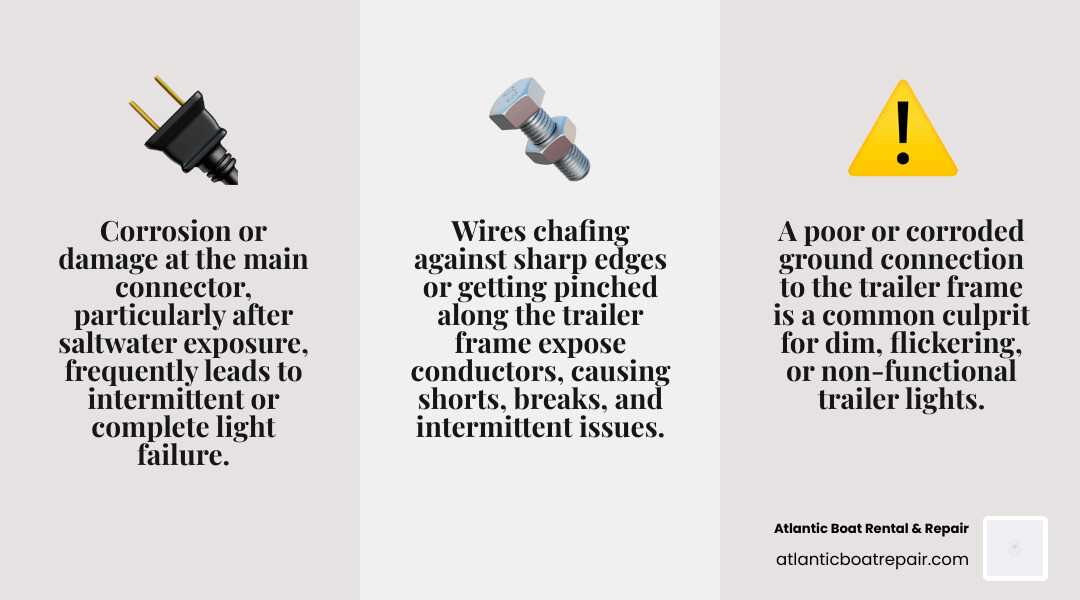
The most common culprit for trailer light issues, especially for those of us trailering boats in saltwater, is corrosion. Saltwater is incredibly harsh on electrical connections, leading to rust and degradation over time.
Other frequent problems include:
- Corroded connectors: These are especially common where the trailer plug connects to your tow vehicle.
- Bad or loose ground connections: A poor ground can cause all sorts of intermittent electrical gremlins.
- Frayed, pinched, or chewed wires: Wires can get damaged along the trailer frame, especially if not secured properly.
- Blown fuses: These usually occur in the tow vehicle's fuse box or sometimes in an inline fuse on the trailer.
- Lights that flicker or only work when you move the plug: This is a classic sign of a loose connection or corrosion at the main connector.

Before you dive into a full rewire, it's worth doing a few quick checks. Using a 12V test light or a multimeter, you can check for power at the trailer plug. Simply probe each pin while a helper cycles through the vehicle's lights and turn signals. Don't forget to check the tow vehicle's socket for any debris, corrosion, or bent pins that might be preventing a good connection.
How to Pinpoint the Wiring Issue on Your Boat Trailer
Identifying the exact spot of a wiring problem usually starts with a systematic approach. We've seen countless boat owners around Plymouth and the South Shore spend hours chasing their tails because they didn't follow a logical troubleshooting path.
Here’s how we typically approach it:
- Visual inspection from plug to taillight: Start at the tow vehicle's plug and follow the wiring harness along the trailer frame. Look for any obvious signs of damage: cuts, chafing, bare wires, or heavily corroded connections. Pay close attention to areas where wires might rub against the frame or axle.
- “Wiggle test” at the connector and along the harness: Sometimes a connection is just loose. Gently wiggle the main connector where it plugs into the tow vehicle. If the lights flicker on or off, you've found a likely culprit. Repeat this along the harness, especially at junction points or where wires connect to individual lights.
- Isolating whether the problem is on the trailer or the tow vehicle: This is a crucial step. If you have access to another tow vehicle or another trailer, try swapping them. If your trailer lights work with a different vehicle, the problem is with your original tow vehicle. If they still don't work, the issue is on your trailer. A common troubleshooting method involves hooking a female receptacle to a battery and connecting the male trailer plug into it. If the problem persists, it's on the trailer; if everything works, it's the vehicle or adapter.
- Checking continuity with a multimeter: For more precise diagnosis, a multimeter can tell you if there's a break in the wire (no continuity) or if power is reaching a specific point. This helps you narrow down exactly where the circuit is failing.
- Common mistakes we see on South Shore trailers after winter storage: After a long winter, especially if your trailer sat outside, corrosion can set in. Many owners forget to clean and dielectric grease their connections before storage, leading to issues come spring. We also frequently find wires that have been chewed by rodents or chafed by winter winds causing them to rub against the frame.
Typical Boat Trailer Wiring Symptoms
The symptoms of faulty trailer wiring can vary, but they all point to one thing: an unreliable and potentially unsafe towing experience.
Here are some common signs you might encounter:
- No lights at all: This could indicate a blown fuse in the tow vehicle, a completely disconnected ground wire, or a major break in the main power wire.
- Only one side out: Often, this means a break in the specific wire for that side's running lights or turn signal, or a bad ground connection for that particular light assembly.
- Dim or inconsistent lights: This is frequently a sign of poor grounding or partial corrosion that's restricting the flow of electricity.
- Brake and turn signals not working as intended: If your turn signal lights up but doesn't flash, or your brake lights are always on, it's usually a wiring mix-up or a grounding issue.
- Fuses blowing as soon as the trailer is plugged in: This is a strong indicator of a direct short circuit somewhere in the trailer's wiring, often caused by bare wires touching the trailer frame.
Boat Trailer Wiring Components: What You’re Working With
Understanding the basic components of your boat trailer's electrical system makes troubleshooting and repair much simpler. A typical boat trailer light wiring system isn't overly complex, but each part plays a critical role.
At its core, a boat trailer's electrical system consists of a plug that connects to your tow vehicle, a matching trailer light connector on the trailer's wiring harness, a wiring harness that runs the length of the trailer frame, and various lights around the trailer’s perimeter.
Most trailer wiring harnesses use standard color codes to simplify connections:
- White: Ground
- Brown: Taillights and running lights
- Yellow: Left turn signal and brake light
- Green: Right turn signal and brake light
- Blue: (On 5-pin or 7-pin) Typically for surge brake lockout or auxiliary power
When dealing with boat trailers, especially in New England, you'll encounter submersible vs. non-submersible lights. Submersible lights are designed to be fully immersed in water without damage, making them essential for boat trailers that are frequently backed into the water. Non-submersible lights, while cheaper, will quickly fail when exposed to water, a lesson many boat owners learn the hard way.
We also see a lot of discussion about LED vs. incandescent lights. LED lights are far more durable, draw less power, and last significantly longer than traditional incandescent bulbs. While the upfront cost might be higher, their resilience to vibration and water intrusion makes them a superior choice for saltwater boat trailers. Incandescent bulbs are prone to failure from filament breakage due to road vibration and are less sealed against moisture.
Types of Boat Trailer Wiring Connectors
The type of connector your boat trailer uses dictates its capabilities and how many functions it can support. Matching the connector to your trailer's needs is crucial for safety and functionality.
- 4-pin flat: This is the most common and simplest connector, typically found on smaller boat trailers without brakes or auxiliary functions. It provides basic running lights, left turn/brake, right turn/brake, and a ground. If your trailer is older or smaller, this is likely what you have.
- 5-pin flat: This connector adds an extra wire, usually blue, which is specifically for trailers with surge brakes. This blue wire allows your tow vehicle to send a signal to deactivate the surge brake actuator when you put your vehicle in reverse. This is essential for backing up without the trailer brakes engaging. Many trailers around Plymouth with disc brakes use this setup.
- 7-pin round: For larger boat trailers or those with more complex electrical needs, the 7-pin round connector is standard. It provides all the functions of a 4-pin or 5-pin, plus additional circuits for things like electric brakes, auxiliary power (for charging a battery on the trailer), or reverse lights. If your trailer has electric brakes or a breakaway system, you'll need a 7-pin connector.
Understanding what each pin does and ensuring your tow vehicle's connector matches your trailer's is the first step in a reliable electrical system. An adapter can sometimes bridge the gap, but a direct match is always best for consistent performance.
DIY Repairs: Tools and Steps for Basic Trailer Wiring Fixes
For those mechanically inclined, tackling basic trailer wiring repairs can be a rewarding task. However, going into it without the right tools and materials can quickly turn a simple fix into a frustrating ordeal. For saltwater applications, marine-grade components are non-negotiable.
Here are the essential tools you'll need for a proper job:
- Wire strippers and crimpers: Essential for making clean, secure electrical connections.
- Heat gun: For shrinking heat-shrink connectors, creating a waterproof seal.
- Multimeter: Invaluable for diagnosing electrical issues, checking voltage, and continuity.
- Marine-grade heat-shrink connectors: These are crucial. Standard automotive connectors won't hold up to saltwater and New England weather.
- Zip ties and loom for securing harnesses: To protect wires from chafing and keep them tidy along the frame.
- Dielectric grease: Apply this to all connections to prevent corrosion.
When choosing a complete wiring kit, look for quality. We recommend kits that feature tinned copper wire, which resists corrosion far better than untinned copper. Ensure the kit includes waterproof connectors and clear instructions. Brands like Grote offer complete wire-harness packages that come with everything you need, including no-splice connectors for easier installation. The Grote 68540 Wiring Kit, for example, comes with a 25' trailer harness, a 4' trunk harness, and 6 no-splice connectors, and is designed for durable re-wiring of various trailer types.
Step-by-Step: Simple Wiring Repair
If your trailer is more than five years old and you're constantly chasing light issues, it's often more efficient to replace the entire wire harness. This is a common situation we see with trailers around Plymouth and the South Shore.
Here's a simplified step-by-step process for a basic wiring repair or harness replacement:
- Disconnect power at the vehicle: Always disconnect the trailer from the tow vehicle before starting any electrical work. You don't want any unexpected shocks or blown fuses.
- Remove old, corroded, or damaged wires: Carefully remove the old harness. If you're replacing the entire harness, you can often use the old wires to pull the new ones through enclosed frame members. Note how the old wires were secured.
- Run new harness along the frame, avoiding pinch points: Route the new wiring harness along the inside of the trailer frame. Be meticulous about avoiding areas where wires could be pinched, chafed, or come into contact with moving parts like axles or suspension components.
- Make waterproof connections (heat-shrink, not just tape): This is where marine-grade materials shine. For saltwater environments, always use crimp connectors with heat-shrink collars for all light connections. Connect the yellow and brown wires along the left-side frame, and the green and brown wires along the right side. The white ground wire should be connected to any clean, unpainted bolt behind the coupler, ensuring a good metal-to-metal connection to the trailer frame. If you have a flat-five plug, connect the blue wire to the solenoid on the surge actuator.
- Secure harness away from moving parts and sharp edges: Use galvanized wire clips or zip ties to tightly secure the wires along the frame. Ensure they are snug but not pinched. This prevents them from flapping, getting pulled loose, or chafing while towing. Leave enough slack at the plug end for vehicle connection and turning without strain.
- Test all light functions before towing: Plug the trailer into your tow vehicle and carefully test every light function: running lights, brake lights, left turn signal, and right turn signal. If you have a 5-pin or 7-pin, test any auxiliary functions like reverse lockout.
When It’s Time to Call a Pro for Boat Trailer Wiring Repair Near You
While some basic repairs can be handled DIY, there are times when calling a professional for boat trailer wiring repair near me is the smarter, safer, and ultimately more cost-effective choice. This is especially true for boat owners in Plymouth, Kingston, Duxbury, Bourne, and Sandwich, where marine expertise is critical.
You should consider professional help if you're experiencing:
- Electrical issues you can’t trace after basic checks: If you've done your due diligence with a multimeter and visual inspections but still can't pinpoint the problem, it's time for an expert. We have specialized diagnostic tools that can quickly identify complex shorts or open circuits.
- Shorts or blown fuses that keep coming back: A recurring blown fuse indicates a persistent short circuit that needs professional attention. Patching it will only lead to more frustration down the road.
- Full rewire needed after years of patch jobs: If your trailer's wiring harness looks like a spiderweb of electrical tape and various colored wires, a full professional rewire will ensure reliability and safety for years to come.
- Upgrading to new lights or adding brake circuits: Installing new LED lights, converting to a 5-pin for surge brakes, or adding electric brakes requires specific knowledge to ensure proper function and integration with your tow vehicle.
- Ensuring everything is legal and safe for Massachusetts roads: We understand the local regulations and ensure your trailer's lighting meets all safety and legal requirements, giving you peace of mind on the highway.
Why Use a Local Marine Technician for Trailer Wiring?
Choosing a local marine technician, especially one familiar with the New England boating scene, offers distinct advantages for your boat trailer wiring.
- Experience with saltwater and New England conditions: We understand how quickly saltwater and our harsh winters can degrade standard electrical components. We know what materials and techniques will last in this environment.
- Access to proper diagnostic tools and marine-grade parts: We invest in the right equipment to accurately diagnose problems and stock high-quality, marine-grade wiring, connectors, and lights that are built to withstand the elements.
- Work done right the first time—no “temporary fixes”: Our goal is to provide a lasting repair, not a band-aid solution. We focus on proper crimping, heat-shrinking, and routing to ensure reliability.
- Warranty on parts and labor: Professional shops typically offer a warranty on their work and the parts they install, giving you added assurance.
- Local reputation and long-term service relationships: As a local business, our reputation is built on trust and quality service. We value long-term relationships with boat owners in our community.
If you want to talk through your options or need a second opinion, we’re happy to take a look. Around Plymouth and the South Shore, we see these issues all the time—especially after winter. You can learn more about our comprehensive services here.
What Does Professional Trailer Wiring Repair Cost?
The cost of professional boat trailer wiring repair can vary significantly depending on the extent of the damage, the type of trailer, and the specific components needed. It's rarely a one-size-fits-all price.
Here's what typically goes into the cost:
- Diagnostic fees: Most reputable shops will charge a diagnostic fee to accurately pinpoint the problem. This covers the technician's time and expertise using specialized tools. This fee is often applied towards the repair cost if you proceed with the work.
- Hourly labor rates for marine electrical work: Marine electrical work requires specialized skills. Labor rates will reflect this expertise. A simple repair might take an hour or two, while a full rewire could take several hours. As an example, Boating Mag estimates a full rewire can take 4-5 hours for a DIYer, so expect professional time to be efficient but thorough.
- Parts cost: basic repair vs. full rewire: A basic repair might only require a few connectors and a short length of wire. A full rewire, however, will involve a complete harness, new lights (if needed), and all new connectors. Marine-grade components, while more durable, are also generally more expensive than standard automotive parts.
- Why a clear estimate up front matters: Always ask for a detailed estimate before any work begins. This should break down parts, labor, and any diagnostic fees. A trustworthy shop will provide this transparently.
- What’s included in a professional job: When you pay for professional service, you're paying for more than just fixing a wire. You're getting expert diagnosis, the use of high-quality marine-grade materials, proper installation techniques (like waterproof heat-shrink connections), thorough testing of all light functions, and assurance of legal compliance.
How to Find a Reliable Boat Trailer Wiring Service in Massachusetts
Finding a reliable service for boat trailer wiring repair near me in Massachusetts means looking beyond the nearest auto shop. Your boat trailer faces unique challenges, especially with saltwater exposure and seasonal storage, so you need a specialist.
Here's how to ensure you find a competent technician:
- Look for marine-specific experience, not just general auto shops: While an auto shop can fix a car, they might not understand the nuances of submersible lights, saltwater corrosion, or marine-grade wiring standards. Seek out shops that specialize in marine repair.
- Ask about experience with saltwater trailers and seasonal storage: This is crucial for boaters in our area. A shop that understands the impact of New England winters and saltwater launches will use the right materials and techniques to ensure a lasting repair.
- Check local reviews and word-of-mouth: Ask fellow boaters at your local ramp or marina in Plymouth, Kingston, or Duxbury. Online reviews can also provide insight into a shop's reputation for quality and customer service.
- Make sure they use tinned copper wire and marine-grade connectors: This is a hallmark of a quality marine electrical repair. Untinned wire will corrode quickly in our environment, leading to repeat issues.
- Don’t hesitate to ask for photos of previous work: A professional shop should be proud to show examples of their clean and properly routed wiring jobs.
If you’re in Plymouth or the South Shore and want it done right, we’re always happy to walk you through what’s involved. Feel free to contact us to discuss your trailer's needs.
Conclusion: Get Your Trailer Ready for the Road and the Water
Reliable boat trailer wiring is not just about convenience; it's about safety, legality, and peace of mind. The risks of driving with faulty trailer lights—from traffic citations to serious accidents on busy Massachusetts roads—far outweigh the cost of proper repair. Patch jobs and shortcuts might offer a temporary fix, but they rarely stand up to the rigors of frequent towing, especially in our coastal environment.
Investing in a professional repair or a complete rewire ensures your trailer is equipped with durable, marine-grade components installed by experienced technicians. This means your lights will work when you need them to, keeping you and others safe on the road, and allowing you to focus on enjoying your time on the water.
If you want your trailer wiring sorted out before the season, give us a call. We’ll make sure you’re safe, legal, and ready for the water. Explore our full range of services here.
Comments
Be the first to comment on this article!