
Go Faster, Go Further: Exploring Performance Outboards
Why High-Performance Outboards Matter for Speed and Reliability
High performance outboards are a specialized category of outboard motors designed to deliver maximum speed, acceleration, and reliability through advanced engineering and specialized components. They differ from standard outboards through higher horsepower ratings, optimized power-to-weight ratios, improved throttle response, and cutting-edge technologies like digital controls and performance-tuned gearcases.
Key characteristics that define high-performance outboards:
- Power density - More horsepower in a lighter, more compact package
- Rapid acceleration - Quick "hole shot" to get on plane fast
- High-winding operation - Sustained performance at liftd RPM ranges
- Advanced engine technology - V8 and V10 powerheads, quad-cam valve designs, optimized fuel systems
- Specialized components - Performance gearcases, high-output alternators, digital throttle control
- Premium materials - Lightweight engineering for maximum efficiency
The pursuit of speed on the water isn't just about horsepower numbers. True performance comes from how an engine translates power into acceleration, maintains control at high speeds, and delivers consistent reliability under demanding conditions. Whether you're a competitive tournament angler racing to your next spot, a performance boater seeking thrilling speed, or simply someone who needs dependable power for a heavy center console, understanding what makes an outboard "high-performance" helps you make the right choice.
Modern high-performance outboards represent decades of racing heritage and engineering refinement. Brands like Mercury Racing emphasize that "the truth of speed is revealed on the water, not just on a computer screen"—a philosophy built on fifty years of racing experience. These engines feature innovations like naturally aspirated V10 powerheads generating 400+ horsepower, boostd V8 engines producing 500 horsepower, and sophisticated digital systems that optimize everything from fuel efficiency to throttle response.
I'm Ron Cribbie, and through decades of hands-on experience in marine service and repair, I've worked extensively with high performance outboards across every application from racing to commercial fishing. At Atlantic Boat Repair, we understand these engines inside and out—from their advanced engineering to their real-world performance characteristics.
Beyond Horsepower: What Defines a High-Performance Outboard?
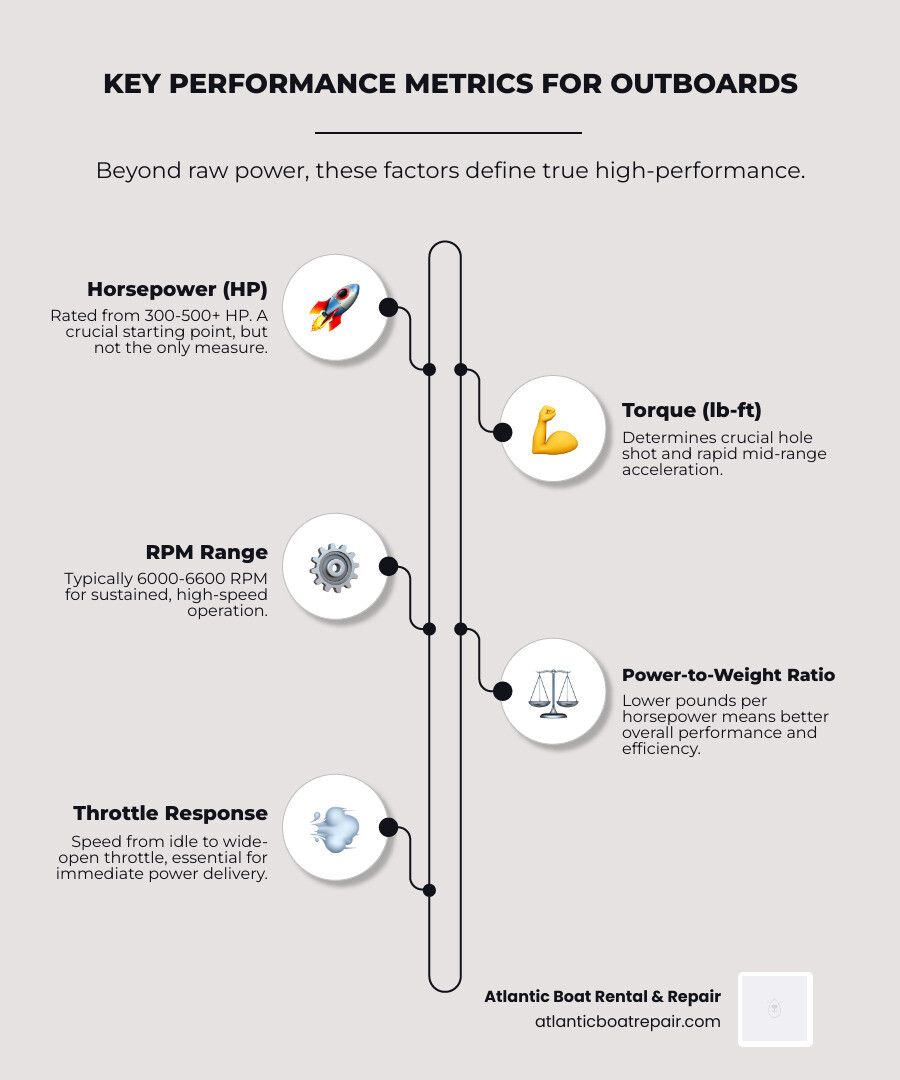
When we talk about high performance outboards, it's easy to get fixated on the horsepower number printed on the cowling. But as any seasoned boater from Plymouth to Sandwich, Massachusetts, will tell you, true performance is a symphony of several key elements working in harmony. It’s about how an engine performs across the entire speed range, not just at wide-open throttle.
Key Performance Metrics
Let's explore what truly defines a high-performance outboard beyond just its rated horsepower:
- Hole Shot: This is how quickly your boat gets "on plane" from a dead stop. A strong hole shot means instant torque and rapid acceleration, crucial for watersports, getting through choppy inlets, or, for our fishing friends, beating the competition to that prime fishing spot in Cape Cod Bay. Mercury Racing outboards, for example, are "tuned to fly" with "high-displacement powerheads [that] generate the torque to get out of the hole quickly." Similarly, Mercury Pro XS engines boast going "from zero to wide-open throttle as fast as" any other outboard.
- Mid-Range Acceleration: Once you're on plane, how quickly can you accelerate from, say, 30 mph to 50 mph? This is vital for passing other boats, making quick adjustments to avoid obstacles, or just enjoying that exhilarating surge of power. It's not always about top speed; often, it's about the responsiveness when you need it most.
- Top-End Speed: Ah, the thrill of open water! While not every boater needs to break speed records, a high top-end speed is a hallmark of a high-performance outboard. It signifies an engine's ability to sustain maximum power output efficiently.
- Power Density: This refers to the horsepower an engine produces relative to its weight. A lighter engine with high horsepower means less weight on the transom, which can improve overall boat handling, fuel efficiency, and, of course, speed. Mercury Racing R-Series outboards are designed for "best power density."
- High-Winding Operation: Performance engines are often designed to operate effectively at higher RPM ranges, allowing them to extract more power from their displacement. This requires robust internal components and precise engineering to handle the increased stress.
- Throttle Response: How quickly does the engine react to your command at the helm? Instant throttle response is a major characteristic of performance outboards, making for a more engaging and controlled driving experience. Mercury Racing outboards are lauded for delivering "instant throttle response at any speed."

The Sound of Power
For many, the engine's sound is an integral part of the high-performance experience. It's the roar of power, the growl of a well-tuned machine.
- Engine Acoustics: High-performance outboards often feature specific engine acoustics, designed not just for power but also for an exhilarating auditory experience.
- Tuned Exhaust: Some engines, like the Mercury Racing 400R, feature a dual muffler system, allowing for a customizable "deep sport tone with a growl." This isn't just for show; it's part of the engineering that optimizes exhaust flow for performance.
- Deep Sport Tone vs. Quiet Cruising: While the growl is thrilling, modern high-performance outboards also incorporate technology for quieter operation at idle and cruising speeds, offering the best of both worlds.
- Advanced Sound Control: This technology allows manufacturers to manage engine noise levels, providing a more refined experience when desired, and letting the engine sing when it’s time to open up the throttle.
The Anatomy of Speed: Key Technologies in Performance Outboards
The heart of any high performance outboard lies in its advanced engineering and the specialized technologies that bring raw power to life on the water. We've seen countless examples of this intricate craftsmanship come through our shop in Kingston, Massachusetts, over the years.
Power-Dense Powerheads: V8, V10, and Advanced Engineering
At the core of these mighty machines are their powerheads, designed for maximum output and durability.
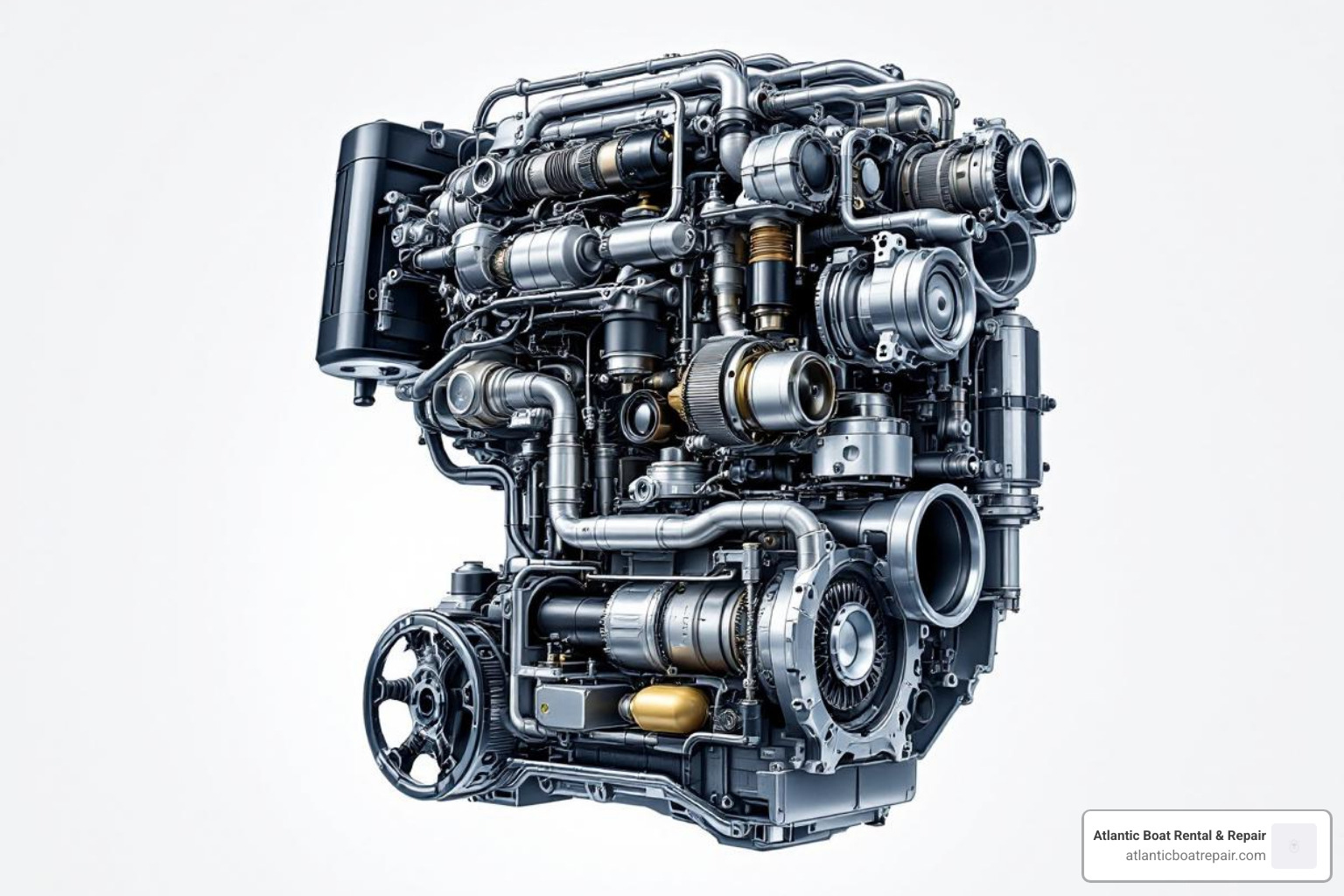
- High-Displacement Powerheads: These engines boast larger displacements, meaning more air and fuel can be burned with each stroke, leading to greater power and torque. This is evident in engines like the Mercury Racing V10 400R (5.7L V10) and the Mercury Racing V8 500R (boostd V8).
- V-Block Configurations: The V-block engine design (V8, V10) is favored for its compact size relative to its power output, contributing to better power density and balance.
- Naturally Aspirated and Advanced Power Technologies: While some engines are naturally aspirated (like the Mercury Racing V10 400R), others use boostrs (like the Mercury Racing V8 500R) to force more air into the engine, significantly boosting horsepower.
- Quad Cam Four Valve (QC4) Design: This sophisticated valve train design, seen in engines like the Mercury Racing 400R, uses dual overhead camshafts and four valves per cylinder. This allows for optimized airflow into and out of the combustion chamber, enhancing engine breathing and overall efficiency at high RPMs.
- Lightweight Materials: To achieve that crucial power-to-weight ratio, manufacturers extensively use lightweight, yet incredibly strong, materials in engine components and structural elements. This reduces overall weight without compromising durability, a balance we appreciate when performing intricate repairs.
Intelligent Power: Digital Controls and Efficiency
It's not just brute force; it's smart force. Modern high-performance outboards integrate cutting-edge digital systems for unparalleled control and efficiency.
- Digital Throttle & Shift (DTS): This system replaces traditional mechanical cables with electronic signals, providing silky-smooth shifting and instant, precise throttle response. It's like comparing a manual typewriter to a laptop – the precision is just in another league. For engines 175hp and up, DTS controls offer a seamless experience.
- Adaptive Speed Control (ASC): Imagine maintaining a constant RPM regardless of changing load conditions (like hitting a wave or making a turn). ASC automatically adjusts throttle settings to achieve this, making for a smoother, more consistent ride. The Mercury Racing 400R features this technology.
- Advanced Range Optimization (ARO): This technology fine-tunes fuel delivery at cruising speeds to maximize fuel efficiency, helping you go further on a tank of gas. This is particularly beneficial for longer runs in the waters off Duxbury or during extended fishing trips.
- Integrated Smart Engine Technology: Systems like Mercury's SmartCraft integrate engine data with displays, allowing you to monitor vital information at a glance. The Mercury Marine app can even turn your mobile device into a boating companion, monitoring data and connecting you with a dealer if needed.
- Balancing Power with Fuel Economy: While "high performance" might suggest a thirst for fuel, modern engineering strives for efficiency. Technologies like ARO and precise fuel injection systems help these powerful engines deliver impressive fuel economy, especially at cruising speeds. The Mercury Racing 400R, for instance, is designed for "best-possible efficiency" and can run on readily available 87 octane fuel.
- Environmental Impact: Manufacturers are increasingly aware of their environmental footprint. Modern engines are designed to meet stringent emissions standards, ensuring that our beautiful Massachusetts waterways remain clean for generations to come.
From Prop to Midsection: Specialized High-Performance Outboard Components
The powerhead is just one piece of the puzzle. The entire powertrain, from the engine block down to the propeller, is optimized for performance.
- Performance Gearcases: These are the unsung heroes, designed to transfer massive power to the propeller efficiently and withstand the extreme forces of high-speed operation. Examples include Mercury Racing's Sport Master gearcase, optimized for speeds over 85 mph, and the 5.44 HD gearcase for heavier boats needing stern lift. The new R-Drive and R-Drive Sport gearcases are also engineered to complement powerful outboards like the Mercury Racing V8 500R.
- Surface-Piercing Propellers: Specialized propellers, like Mercury Racing's Ventera, are designed to partially operate in the air and partially in the water. This reduces drag and increases efficiency at very high speeds, helping the boat plane higher on the water.
- Heavy-Duty Midsections: The midsection connects the powerhead to the gearcase and is crucial for stability and durability. The Mercury Racing Advanced Racing Core (ARC) midsection, exclusive to the Mercury Racing V8 500R, is a testament to the robust engineering required for extreme demands.
- High-Output Alternators: With modern boats packed with electronics—navigation, fish finders, audio systems, and more—a robust charging system is essential. High-performance outboards often feature high-output alternators (e.g., 150 amps in the Mercury Racing 400R) to keep all those batteries charged, ensuring you never run out of juice, whether you're fishing off Nantucket or cruising the Plymouth coast.
- Performance-Tuned Engines for Anglers and Enthusiasts: Even engines not specifically "racing" models, like the Mercury Pro XS line, are performance-tuned for specific applications. They are engineered with "exclusive components and tuning to amplify speed and performance," focusing on "quick hole shots and instant throttle response" for competitive anglers and boaters who crave speed.
Who Uses High-Performance Outboards? Key Applications
From the quiet coves of Bourne to the busy harbors of Duxbury, high performance outboards serve a diverse range of boaters with specific needs. Their power and precision are indispensable in various marine applications.
The Racing Circuit
This is perhaps the most obvious application. High performance outboards are born and bred for competition.
- Official Racing: From offshore powerboat racing to smaller, specialized classes, these engines are pushed to their absolute limits. The continuous development and refinement in racing directly feed into the technology available to recreational boaters.
- Poker Runs: These organized events combine high-speed cruising with a social element, demanding engines that can sustain thrilling speeds over long distances.
- Extreme Speed Focus: In racing, every fraction of a second counts. The durability, precise handling, and raw power of these outboards are paramount to victory.
The Competitive Angler
For those who chase fish and glory, high performance outboards are a competitive advantage.
- Bass Boats and Flats Skiffs: In competitive bass fishing or shallow-water flats fishing, getting to the prime fishing spot first can make all the difference. The "hole shot" advantage provided by engines like the Mercury Pro XS is critical.
- Holeshot Advantage: As mentioned, the ability to rapidly accelerate and get on plane is a non-negotiable for tournament anglers. It's not just about speed, but about saving precious time.
- Getting to Fishing Spots First: Imagine the adrenaline of a tournament takeoff on a large body of water. The power and acceleration of these engines ensure you're not left behind.
- Reliability for Tournaments: Beyond speed, competitive anglers rely on their engines to perform flawlessly, hour after hour, under demanding conditions. An engine failure can mean the difference between a podium finish and going home empty-handed.
Performance Center Consoles and Cruisers
The rise of larger, more luxurious center console boats, popular along the coastlines of Massachusetts, has also fueled the demand for high performance outboards.
- Large, Heavy Hulls: Modern center consoles are often substantial vessels, packed with amenities. They require serious horsepower to move efficiently and perform well. Multi-engine setups are common to achieve the desired power.
- Multi-Engine Setups: Many performance center consoles and even some larger day cruisers feature twin, triple, or even quad outboard configurations. This provides not only immense power but also redundancy and improved maneuverability. The Mercury Racing V10 400R is designed to power "fast center consoles, day cruisers, and bay boats."
- High-Speed Cruising: Whether it's a quick run out to Stellwagen Bank or a day trip to Martha's Vineyard, these boats are designed to cover distances quickly and comfortably.
- Stern Lift: For heavier boats, a specific type of gearcase or propeller that provides "stern lift" is crucial. This helps raise the stern of the boat, reducing drag and improving efficiency at speed. The Mercury Racing 5.44 HD gearcase is an example designed for this purpose.
- Powering Modern Electronics: With sophisticated navigation, sonar, entertainment systems, and even galley appliances, these boats are power-hungry. High-output alternators on performance outboards ensure all these systems run smoothly, even during extended periods of use.
Your Guide to Choosing the Right Performance Outboard
Choosing a high performance outboard is a significant investment, and make an informed decision. Here at Atlantic Boat Repair, we've helped countless boaters from Plymouth to Sandwich steer these choices, ensuring they get the right power for their passion.
Matching the Motor to Your Boat and Needs
The perfect outboard isn't just the one with the most horsepower; it's the one that best suits your specific boat and how you intend to use it.
- Boat Hull Design: The design of your boat's hull (e.g., V-hull, catamaran, flat bottom) significantly impacts how an outboard will perform. Some engines and gearcases are better suited for specific hull types.
- Transom Weight Capacity: Every boat has a maximum weight capacity for its transom. Overloading the transom with an engine that's too heavy can compromise safety, handling, and performance. Always check your boat's specifications.
- Single vs. Multi-Engine Rigging: Depending on your boat's size and intended use, you might consider a single, powerful outboard or multiple smaller ones. Multi-engine setups offer increased power, redundancy, and often better maneuverability for larger vessels.
- Dealer Support: Having a reliable local dealer or service center is crucial. We pride ourselves on offering expert support right here in Massachusetts. Our team is always ready to answer your questions and provide top-notch service.
- Expert installation and repair services are paramount. A high-performance engine requires precision installation and regular maintenance to deliver its best. We ensure every engine we touch meets the highest standards.
New vs. Remanufactured: Finding the Best Value
When it comes to high performance outboards, you have options beyond just buying brand new. We specialize in providing exceptional value through our remanufactured engines.
- New Engine Warranties & Latest Features: New engines come with factory warranties and the very latest technological advancements. They offer peace of mind and access to cutting-edge features.
- Remanufactured Engine Value: This is where we shine! A remanufactured engine from Atlantic Boat Repair offers an incredible opportunity to get "new-like" performance at a fraction of the cost of a brand new unit. Our "0" time rebuilt outboard engines are carefully disassembled, inspected, and rebuilt to our exacting standards.
- Rigorous Testing Standards: We don't just put them back together. Our USP is superior precision, often exceeding manufacturer specifications. Every remanufactured engine undergoes rigorous testing to ensure it performs with the reliability and power you expect from a high-performance unit. We're talking about extensive bench testing and dyno runs, making sure that when you put that engine on your boat, it's ready to go.
- "Like-New" Performance: Our goal is to deliver an engine that performs as if it just rolled off the factory floor, offering the same thrilling acceleration, top-end speed, and reliability. This is an excellent way for boaters in Kingston, Duxbury, and beyond to access high-performance power without the premium price tag.
- View available remanufactured engines on our website. You might be surprised at the quality and value we offer.
What's Next? Future Trends in Outboard Performance
The marine industry is constantly evolving, and the future of high performance outboards promises even more exciting innovations.
- Electric Propulsion: While still in nascent stages for truly high-performance applications, electric outboards like Mercury's Avator series are gaining traction for smaller boats and specialized uses. As battery technology advances, we may see more powerful electric options emerge, offering quiet, emission-free performance.
- Greater Power Density: Engineers will continue to push the boundaries of power-to-weight ratios, aiming for even more horsepower from lighter, more compact packages. This means better performance and efficiency for a wider range of boats.
- Increased Integration: Expect even deeper integration between engines, helm controls, navigation systems, and mobile devices. Smart systems will offer more comprehensive data, predictive maintenance alerts, and seamless control, making boating easier and safer.
- Smarter Engine Management: Future outboards will likely feature even more advanced AI and machine learning in their engine control units (ECUs), constantly optimizing performance, efficiency, and reliability based on real-time conditions. This could lead to outboards that "learn" your boating style and adapt accordingly.
Conclusion
The world of high performance outboards is a thrilling blend of raw power, cutting-edge technology, and meticulous engineering. We've explored what truly defines these remarkable engines: from their blistering hole shots and mid-range acceleration to their sophisticated V8 and V10 powerheads, intelligent digital controls, and specialized performance components. These engines cater to a diverse audience, from competitive racers and tournament anglers to owners of large center consoles who demand speed, reliability, and the ability to go further.
At Atlantic Boat Repair, we understand that for boaters in Plymouth, Kingston, Duxbury, Bourne, and Sandwich, Massachusetts, your engine is the heart of your vessel. Whether you're looking to upgrade to a more powerful engine or need expert service for your existing high performance outboard, we're here to help. Our commitment to superior precision and rigorous testing ensures that our remanufactured engines deliver "new-like" performance and reliability. Making the right choice means considering your boat's needs, your boating style, and the long-term value and support you expect.
Contact us for expert advice on your next outboard engine – we're always ready to share our expertise and help you make the best decision for your time on the water.
Comments
Be the first to comment on this article!