
Is Your Carburetor Choking? The Benefits of a Good Cleaning Service
Why Marine Carburetors Need Professional Attention
A carburetor cleaning service removes fuel varnish, debris, and deposits that block internal passages and jets—restoring proper fuel delivery, throttle response, and engine performance. Most carburetor problems stem from ethanol fuel, stagnant gasoline, and seasonal storage, which create blockages that manual spraying and wire brushing simply can't reach.
What a Professional Carburetor Cleaning Service Includes:
- Complete disassembly of carburetor body, bowl, and jets
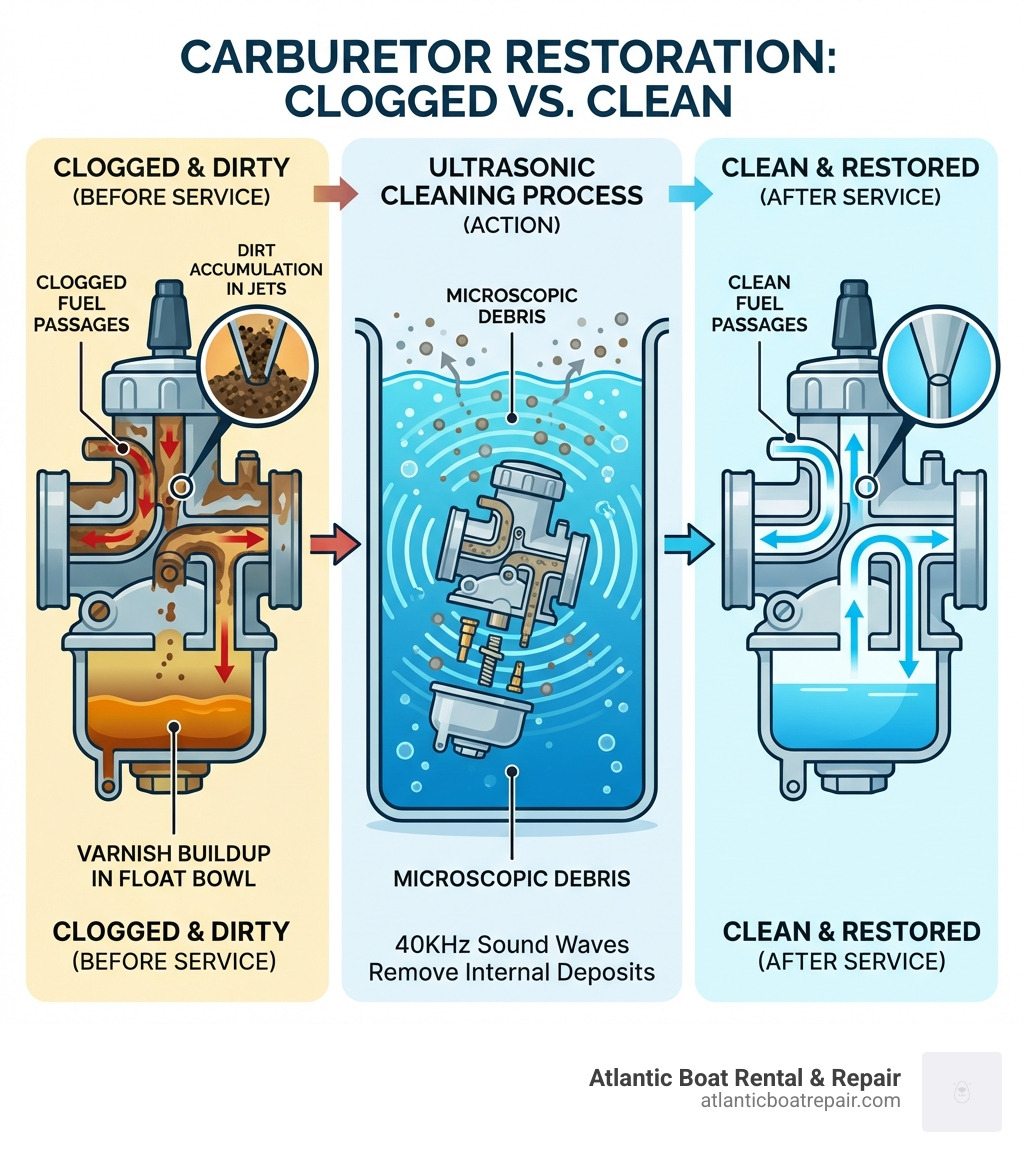
- Ultrasonic immersion cleaning (40KHz sound waves remove 100% of internal deposits)
- Inspection and replacement of gaskets, seals, and diaphragms
- Float level adjustment and pressure testing
- Mechanical synchronization for multi-cylinder setups
- Reinstallation and performance verification
Common Signs You Need Service:
- Hard starting or engine won't start
- Rough idling or stalling
- Black smoke from exhaust
- Poor throttle response
- Excessive fuel consumption
If your outboard is hesitating, idling rough, or burning fuel faster than it should, there's a good chance varnish and debris have clogged the carburetor's internal passages. Most owners try carb cleaner spray first—but that often pushes gunk into the engine rather than removing it. Professional cleaning uses ultrasonic technology to reach every internal surface, restoring precise fuel delivery without risking further damage.
I'm Ron Cribbie, and I've been rebuilding and servicing marine engines for decades here on the South Shore. At Atlantic Boat Repair, carburetor cleaning service is part of our routine spring commissioning and engine reconditioning work—especially for carbureted outboards that sit through New England winters.
Recognizing the Signs Your Engine Needs a Carburetor Cleaning Service
Your boat's outboard engine is a complex piece of machinery, and the carburetor plays a crucial role in its smooth operation. It's the "respiratory system" of your engine, blending air and fuel for combustion. When this system gets dirty, your engine will let you know. Recognizing these signs early can save you from more significant problems down the line.
Here are the common indicators that your carburetor might be struggling and needs attention:
- Hard Starting or Failure to Start: If your engine cranks but struggles to catch, or simply won't start, a clogged carburetor is a prime suspect. Deposits can prevent fuel from reaching the combustion chamber effectively.
- Rough Idling: Does your engine cough, sputter, or vibrate excessively when running at low RPMs? This "rough idling" often points to an inconsistent air-fuel mixture caused by partially blocked idle passages in the carburetor.
- Reduced Power or Acceleration: When you hit the throttle, does your boat feel sluggish? A dirty carburetor can restrict fuel flow, leading to a noticeable drop in power and poor acceleration.
- Excessive Fuel Consumption: If you're burning through fuel faster than usual, your carburetor might be delivering an overly rich mixture due to clogged air passages, or an inconsistent one that wastes fuel.
- Black Smoke from Exhaust: Black smoke indicates an overly rich fuel mixture, meaning too much fuel and not enough air. This is a classic sign of a carburetor issue, often caused by gummed-up jets.
- Engine Stalling: An engine that suddenly dies, especially at idle or low speeds, can be due to fuel delivery problems from a dirty or poorly adjusted carburetor.
Ignoring these symptoms won't make them go away. In fact, it can lead to more severe engine damage or leave you stranded on the water. Taking action when you notice these signs is crucial for maintaining your outboard's health and your peace of mind. For more general information on carburetor maintenance, you can review guides like this one from Briggs and Stratton.
How a carburetor cleaning service Restores Performance
A professional carburetor cleaning service isn't just about making things look shiny; it's about restoring the precise functions that ensure your engine runs optimally. When we clean a carburetor, we're targeting several key areas that directly impact performance:
- Fuel Atomization: The carburetor's job is to break fuel into a fine mist, allowing it to mix properly with air for efficient combustion. Clogs disrupt this process, leading to incomplete burning. A clean carburetor ensures proper atomization, maximizing power and efficiency.
- Throttle Response: A clean carburetor allows for smooth and immediate fuel delivery as you adjust the throttle. You'll notice a crisp response and consistent power delivery, which is essential for maneuvering your boat safely and effectively.
- Idle Stability: By clearing out the tiny idle circuits, a professional cleaning stabilizes your engine's idle. No more sputtering, stalling, or constant adjustments just to keep it running at the dock or in a no-wake zone.
- Precise Air-Fuel Mixture: Every engine has an ideal air-fuel ratio for optimal performance. Deposits throw this ratio off, leading to poor performance, increased emissions, and fuel waste. A thorough cleaning restores the carburetor's ability to meter the air and fuel accurately, ensuring your engine runs as the manufacturer intended.
A good carburetor cleaning service brings your engine back to life, improving its reliability and extending its lifespan. You can find more information about our marine engine services and how we ensure peak performance for your outboard on our services page.
Common Causes of Fuel System Blockages
Understanding what causes carburetor blockages can help you take preventative measures. For marine engines, especially those used seasonally in New England waters, there are a few primary culprits:
- Ethanol Fuel: Modern gasoline often contains ethanol, which is hygroscopic, meaning it attracts and absorbs water. This water can separate from the fuel, causing corrosion in metal components and deteriorating rubber and plastic parts within the fuel system and carburetor.
- Stagnant Gasoline: If your boat sits for extended periods, especially during winter storage without proper fuel stabilization, the gasoline can degrade. It oxidizes and forms varnish-like deposits that coat the internal passages of the carburetor.
- Debris and Contaminants: Over time, dirt, rust, and other foreign particles can enter the fuel tank and make their way to the carburetor, physically blocking jets and passages.
- Varnish and Gummed-Up Jets: As gasoline evaporates, it leaves behind sticky residues. These "varnish" and "gum" deposits are particularly problematic in the tiny, precision-drilled passages and jets of a carburetor, leading to the symptoms we discussed earlier.
These issues are common, but they are also preventable and treatable with the right approach.
Cleaning vs. Rebuilding: Choosing the Right Level of Care
When your carburetor is acting up, you might hear terms like "cleaning" and "rebuilding." While both aim to restore function, they represent different levels of service. Understanding the distinction is key to choosing the right care for your outboard.
Carburetor Cleaning typically involves:
- Disassembling the carburetor to access internal components.
- Thoroughly cleaning all passages, jets, and surfaces to remove dirt, varnish, and fuel deposits.
- Inspecting key components for wear.
- Reassembling with new gaskets and seals where necessary.
This process is usually sufficient for carburetors that are primarily suffering from fuel-related blockages and deposits but are otherwise in good mechanical condition.
Carburetor Rebuilding, on the other hand, is a more extensive process that includes:
- Complete disassembly of the carburetor.
- A comprehensive cleaning, often using advanced methods like ultrasonic cleaning.
- Detailed inspection of every component for wear, damage, or corrosion. This includes checking throttle shafts for play, inspecting floats, needles, and seats, and assessing the condition of diaphragms and springs.
- Replacing worn or damaged parts with new ones, often using a "rebuild kit" that includes new gaskets, O-rings, needles, and sometimes jets.
- Reassembling the carburetor and performing precise adjustments, such as float level settings.
You might need a rebuild if your carburetor has significant wear, corrosion, or damaged components beyond simple clogging. For example, if the throttle shaft is worn and creating an air leak, or if internal components are corroded from water contamination, a cleaning alone won't solve the problem.

At Atlantic Boat Repair, we assess the condition of your carburetor to recommend the most appropriate service. Our goal is always to provide the most effective and economical solution to get your outboard running reliably. If you're unsure whether your carburetor needs a cleaning or a more extensive rebuild, we're happy to take a look and provide an honest recommendation. You can reach out for a service estimate on our quote page.
What to Expect from a Professional carburetor cleaning service
When you bring your carburetor to us for a professional carburetor cleaning service, you can expect a comprehensive process designed to restore its original functionality. Our approach goes far beyond simply spraying a can of cleaner:
- Removal and Disassembly: The carburetor is carefully removed from your engine and completely disassembled. Every component—the body, float bowl, jets, needles, floats, and linkages—is separated. This allows us to access all internal passages.
- Ultrasonic Immersion Cleaning: This is where the magic happens. The disassembled parts are placed in a specialized ultrasonic cleaner. This process uses high-frequency sound waves to create millions of microscopic bubbles that implode, forming tiny jets. These jets reach into every nook, cranny, and hidden passage, effectively stripping away varnish, carbon, debris, and rust from all surfaces, inside and out. This method is far superior to manual cleaning, which often misses critical areas.
- Soda Blasting (as needed): For stubborn external stains or deeper internal deposits, we may use soda blasting. This gentle abrasive cleaning method effectively removes tough grime without damaging delicate carburetor surfaces.
- Component Inspection and Replacement: Each part is carefully inspected for wear, damage, or corrosion. This includes checking for play in throttle shafts, assessing the integrity of seals and gaskets, and examining the condition of diaphragms. Worn gaskets, O-rings, and other critical seals are replaced to ensure proper function and prevent leaks.
- Jet Cleaning and Replacement: The tiny jets are crucial for fuel metering. They are thoroughly cleaned, and if they show signs of damage or irreparable clogging, they are replaced.
- Float Level Adjustment: The float system regulates the fuel level in the carburetor bowl. We accurately adjust the float level according to manufacturer specifications to ensure the correct air-fuel mixture.
- Pressure Testing and Leak Detection: After reassembly, the carburetor undergoes pressure testing to verify its integrity and ensure there are no leaks. This step is vital for reliability and safety.
- Mechanical Synchronization (for multi-cylinder units): For outboards with multiple carburetors, precise synchronization is critical for smooth engine operation. We carefully adjust them to work in harmony, ensuring consistent performance across all cylinders.
- Reinstallation and Performance Verification: Finally, the reconditioned carburetor is reinstalled on your engine, and the engine is tested to confirm proper operation, throttle response, and idle stability.
This meticulous process ensures that your carburetor is not just "clean" but fully reconditioned to perform like new, leading to improved engine performance, better fuel efficiency, and a more enjoyable boating experience.
The Science of Ultrasonic Cleaning for Marine Engines
When it comes to thoroughly cleaning a carburetor, especially the intricate passages of a marine outboard, traditional methods often fall short. This is where ultrasonic cleaning truly shines, offering a level of cleanliness that manual scrubbing simply cannot match.
How does ultrasonic cleaning work for carburetors?
Ultrasonic cleaning uses a phenomenon called cavitation. Here's a breakdown of how it works:
- Sound Waves: The carburetor parts are submerged in a specialized, non-corrosive heated cleaning solution within an ultrasonic cleaner. Transducers in the cleaner generate high-frequency sound waves, typically at 40KHz.
- Microscopic Bubbles: These sound waves create millions of microscopic bubbles (cavities) within the cleaning solution.
- Implosion and Jets: As these bubbles rapidly form and then collapse (implode) near the surface of the carburetor parts, they generate tiny, powerful jets of liquid.
- Thorough Cleaning: These microscopic jets are strong enough to dislodge and remove varnish, carbon deposits, debris, rust, and other contaminants from every surface, including the hardest-to-reach internal passages, blind holes, and intricate galleries that are impossible to clean manually. The energy released from the collapse cleans 100% of all inner and outer surfaces and carb passages.
The result is a carburetor that is immaculately clean, both inside and out, ensuring unrestricted fuel flow and precise operation. This method far exceeds normal carb cleaning with carb cleaner and wires, which simply can't remove all the debris and residue as effectively. For more technical details on carburetor cleaning and maintenance, you can look at resources like those provided by Briggs & Stratton.
Why Manual Scrubbing Often Fails
Many boat owners try to clean their carburetors themselves, often with a can of spray carb cleaner and some wire. While this might address visible grime, it's rarely effective for the precision required by a marine engine's carburetor. Here's why manual scrubbing often fails:
- Hidden Galleries and Passages: Carburetors have incredibly complex internal architecture, including tiny fuel and air passages, emulsion tubes, and idle circuits that are not visible or accessible without specialized equipment. Manual cleaning can't reach these areas.
- Microscopic Debris: Varnish and fuel deposits aren't always large chunks. They can be microscopic, yet still enough to restrict the flow in a critical jet. Ultrasonic cleaning's cavitation acts on this microscopic level.
- Wire Damage: Attempting to clear passages with small wires can actually enlarge or scratch the precision-machined orifices, altering fuel flow and permanently damaging the carburetor's calibration.
- Chemical Residue: While carb cleaner sprays dissolve some deposits, they can also leave behind a residue that attracts new contaminants or even corrodes components if not thoroughly rinsed and dried. Sometimes, spraying cleaner can even push loosened debris deeper into the engine.
For these reasons, professional ultrasonic cleaning is the most effective way to ensure your marine carburetor is truly clean and functioning correctly, without risking damage to its delicate internal workings.
Professional Reconditioning Process and Maintenance Intervals
Our professional reconditioning process for carburetors is thorough and systematic, ensuring that every unit we service meets our high standards for performance and reliability. This goes beyond a simple cleaning to a full restoration of function.
The process typically follows a comprehensive 7-point service:
- Removal from Engine: The carburetor is carefully detached from your outboard. This step ensures we can work on it safely and thoroughly without affecting other engine components.
- Disassembly: The carburetor is completely taken apart, separating the body, float bowl, jets, needles, floats, and any other removable components. This allows for full access to all internal areas.
- Cleaning of Body, Bowl, Jets, and Passages: All disassembled parts undergo our advanced cleaning process, primarily ultrasonic immersion, to remove all traces of fuel varnish, carbon, and debris from every surface and passage.
- Inspection of Choke/Throttle Shafts, Seals, and Springs: Each component is carefully inspected. We look for wear on shafts, assess the integrity of all gaskets and O-rings, and check the tension and condition of springs. Worn or damaged parts are identified for replacement.
- Reassembly: The carburetor is carefully reassembled with new gaskets and seals, ensuring that all components are correctly seated and functioning.
- Reinstallation onto Engine: The reconditioned carburetor is precisely reinstalled on your outboard.
- Performance Verification: Finally, the engine is started and run through various RPMs to verify proper idle, throttle response, and overall performance. Adjustments are made as needed to ensure peak operation.
For carburetors that require more extensive work, we offer different levels of reconditioning. While specific pricing varies based on carburetor type and condition, these levels typically involve:
- Stage 1 (Cleaning): Focuses on thorough cleaning of partially disassembled units, addressing fuel blockages and deposits.
- Stage 2 (Cleaning & Minor Component Replacement): Includes full disassembly, comprehensive cleaning, and replacement of basic wear items like gaskets and O-rings. This also includes float adjustment and leak testing.
- Stage 3 (Full Reconditioning/Rebuild): This is the most comprehensive service, including full disassembly, advanced cleaning (ultrasonic and soda blasting), replacement of all necessary wear components (jets, needles, diaphragms, etc.), float adjustment, pressure testing, and mechanical synchronization for multi-cylinder units. This stage aims to restore the carburetor to "like new" condition.
Throughout this process, we also lubricate pivot points and linkages to ensure smooth operation.
Seasonal Realities for New England Boaters
Living and boating in Massachusetts, especially around Plymouth, Kingston, Duxbury, Bourne, and Sandwich, means dealing with distinct seasons. These seasonal realities heavily influence how often your marine carburetor should be serviced.
- Winterization: Proper winterization is your first line of defense. Stabilizing your fuel and running the engine to circulate the treated fuel helps prevent varnish and gum from forming during months of storage. However, even the best winterization isn't foolproof.
- Spring Commissioning: As part of your spring commissioning routine, an annual inspection of your carburetor is highly recommended. After sitting idle for months, even properly stored fuel can leave behind minor deposits. A quick check can spot potential issues before they become problems on your first trip out.
- Fuel Quality: The quality of fuel, especially the prevalence of ethanol, is a constant concern for boaters on the South Shore. Ethanol can cause issues over time, making regular cleaning more critical.
- Storage Habits: Whether your boat is trailered, on a mooring, or in dry storage, the environment and duration of storage impact carburetor health. Boats on moorings, for instance, are exposed to more fluctuating temperatures and humidity, which can accelerate fuel degradation.
We often see issues arise in early spring during commissioning, or after the first few runs of the season when residual deposits finally dislodge and cause clogs. Regular maintenance, including a professional carburetor cleaning service every few years, or annually if you experience consistent issues or use ethanol-heavy fuels, can prevent costly repairs and ensure your outboard is always ready for the waters around Cape Cod.
If you're considering an upgrade or need a thorough assessment of your outboard, we encourage you to contact us to discuss your options. We're here to help you steer the unique challenges of marine engine maintenance in our local waters.
Frequently Asked Questions about Carburetor Maintenance
Boat owners often have questions about the care and maintenance of their carburetors. Here are some of the most common ones we encounter:
How often should a marine carburetor be serviced?
The frequency of carburetor cleaning service depends on several factors:
- Seasonal Use: For most recreational boaters in New England, an annual inspection, particularly during spring commissioning, is a good practice. If you experience issues, a cleaning might be needed more frequently.
- Fuel Quality: If you consistently use fuels with ethanol or if your fuel system is older, more frequent checks and cleanings (every 1-3 years) might be beneficial to combat corrosion and deposit buildup.
- Storage Habits: Boats stored for long periods, especially without proper fuel stabilization, are more prone to carburetor issues. If your boat sits for more than a few months, a pre-season cleaning might be a good idea.
- Engine Performance: If you notice any of the signs discussed earlier (rough idle, hard starting, reduced power), it's time for a service, regardless of the last cleaning date.
There's no one-size-fits-all answer, but proactive maintenance beats reactive repairs every time.
What are the risks of DIY carburetor cleaning?
While some minor issues can be addressed with basic knowledge, attempting a full DIY carburetor cleaning service carries several risks:
- Pushed Debris: As mentioned, spraying carb cleaner can push loosened debris deeper into the carburetor's intricate passages or even into the engine, causing more significant blockages or damage.
- Damaged Needles and Jets: The tiny, precision-machined components like jets and needles are easily damaged by improper tools or aggressive cleaning, permanently altering fuel metering.
- Incorrect Float Levels: Setting the float level incorrectly can lead to an overly rich or lean condition, affecting performance, fuel efficiency, and potentially causing engine damage.
- EPA Compliance: Tampering with modern, EPA-regulated carburetors is not only illegal but can also lead to engine problems. These units are factory-set and not designed for user adjustment.
- Missed Problems: A DIY cleaning might only address surface-level issues, missing underlying wear, corrosion, or damaged components that require professional attention. The potential risks of not cleaning or maintaining a carburetor can lead to increased fuel consumption, engine failure, and costly repairs down the line.
For these reasons, we generally recommend professional service for any carburetor issues beyond simple external cleaning.
What is the typical cost for professional cleaning?
The cost associated with a professional carburetor cleaning service can vary depending on several factors:
- Number of Cylinders/Carburetors: Outboards with multiple carburetors will naturally cost more to service than single-carburetor engines due to increased labor and parts. For instance, some shops might charge around $95 for a single-cylinder carburetor cleaning, with costs increasing for 2, 3, or 4-cylinder setups.
- Level of Service: As discussed, a simple cleaning (Stage 1) will be less expensive than a full reconditioning (Stage 3) that includes extensive component replacement and synchronization.
- Disassembly Labor: If the carburetor needs to be removed from the engine, additional labor costs will apply. Some services are quoted as "off-of-unit," meaning the carburetor must be delivered disassembled.
- Parts Additional: While cleaning covers labor, any replacement parts like new gaskets, O-rings, diaphragms, or jets will add to the overall cost.
- Shipping: If you're shipping your carburetor to a specialist service, you'll need to factor in shipping costs and insurance. For local services like ours, this is typically not a concern.
While specific pricing varies, the investment in a professional cleaning is often far less than the cost of a new carburetor or the extensive engine repairs that can result from persistent carburetor issues. It's a cost-effective way to extend the life and improve the performance of your outboard.
Conclusion
A well-maintained carburetor is the heart of a reliable outboard engine, especially for the seasoned boaters navigating the waters around Plymouth, Kingston, Duxbury, Bourne, and Sandwich. Ignoring the signs of a struggling carburetor—rough idling, hard starting, or reduced power—will only lead to frustration on the water and potentially more expensive repairs down the line. A professional carburetor cleaning service is not just a quick fix; it's a meticulous process that restores your engine's precision, efficiency, and dependability.
At Atlantic Boat Repair, we understand the unique demands of marine engines and the expectations of boat owners in our local New England community. We pride ourselves on delivering "0" time rebuilt outboards, adhering to precision specifications that are twice as stringent as manufacturer standards, backed by rigorous testing for new-like performance and reliability. Our approach to carburetor service reflects this commitment to excellence.
If your outboard isn't running as smoothly as it should, or if you're due for seasonal maintenance, don't hesitate to reach out. We're here to provide honest recommendations and expert service, ensuring your time on the South Shore waters is nothing short of exceptional.
Comments
Be the first to comment on this article!