
New Life for Your Ride: Exploring Factory Remanufactured Engines
Why Factory Remanufactured Engines Are Your Best Replacement Option
Factory remanufactured engines offer a cost-effective alternative to buying new, delivering like-new performance for 40-50% less while meeting or exceeding original manufacturer specifications.
Quick Answer: What You Need to Know
- What They Are: Engines completely disassembled, cleaned, inspected, and rebuilt to original factory specifications with new critical components
- Cost: $3,000-$9,000 for most applications (vs. $8,000+ for new engines)
- Warranty: Typically 3-5 years with unlimited mileage coverage
- Performance: Meets or exceeds OEM standards with rigorous testing
- Best For: Boat owners, truck operators, and anyone needing reliable, long-term engine replacement
Key Differences from Other Options:
| Engine Type | Process | Warranty | Cost |
|---|---|---|---|
| Remanufactured | Complete teardown, precision machining, new parts | 3-5 years unlimited | $5,000-$9,000 |
| Rebuilt | Selective part replacement | 12 months/12,000 miles | $3,500-$6,000 |
| Used/Salvage | Minimal inspection | Limited or none | $1,000-$3,000 |
| New OEM | Factory new | Varies | $8,000+ |
When your marine engine fails, you face a tough decision. Do you spend thousands on a brand-new replacement, gamble on a used engine from a salvage yard, or explore something in between? Factory remanufactured engines bridge this gap by offering factory-level quality at a fraction of the new engine cost.
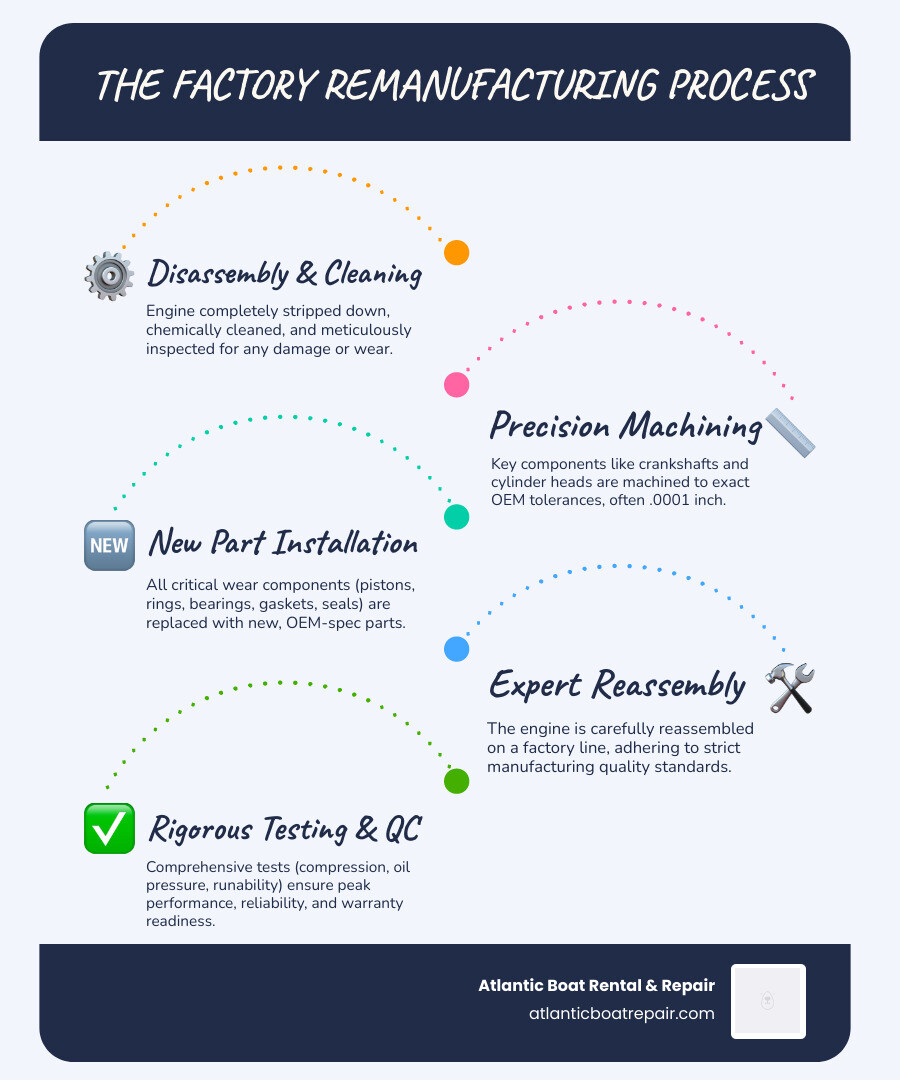
The remanufacturing process goes far beyond a simple rebuild. Every engine is completely disassembled, precision-machined to tight tolerances (often .0001 of an inch), and rebuilt with new critical components including pistons, rings, bearings, and gaskets. Major remanufacturers perform extensive runability testing, sometimes for up to 50 hours, before releasing engines, while companies specializing in marine applications test engines to twice manufacturer specifications.
I'm Ron Cribbie, owner of Atlantic Boat Rental & Repair, and I've worked with factory remanufactured engines throughout my decades in the marine service industry, helping boat owners make informed decisions about engine replacement that balance cost, reliability, and long-term performance. My experience has shown me that quality remanufactured engines, when properly installed and maintained, deliver exceptional value for both recreational and commercial marine applications.
Remanufactured vs. Used: A Head-to-Head Comparison
Choosing the right replacement engine can feel like navigating a maze. For many in Plymouth, Kingston, Duxbury, Bourne, and Sandwich, Massachusetts, the choice often comes down to balancing budget with reliability. Should you opt for a used engine, hoping for a bargain, or invest in a factory remanufactured engine for peace of mind? Let's break it down.
The decision factors for us and our customers typically revolve around budget, desired longevity, and the level of risk we're willing to accept. A failing engine is already a headache, so we want to ensure the solution doesn't create more problems down the line. To help you make an informed choice, we encourage you to consider the insights shared in resources like "Should I Get a Rebuilt or Remanufactured Engine?" which can be found at Should I Get a Rebuilt or Remanufactured Engine?.
Used Engines: The Salvage Yard Approach
When we talk about used engines, we're essentially looking at what some might call the "salvage yard approach." These are engines pulled directly from other vehicles, often from junkyards or wrecked cars. While the initial cost might seem appealing, the reality is often far less rosy.
Here’s why we approach used engines with caution:
- Unknown History and Minimal Inspection: These engines receive little to no inspection beyond a visual check. Their true history—maintenance records, actual mileage, or why the original vehicle was salvaged—is a complete mystery, making them a significant gamble.
- No Replacement of Internal Parts: A used engine's internal wear components (pistons, rings, bearings) are not replaced. You get the engine as-is, with all its existing wear, meaning critical parts could be on the verge of failure.
- Variable Quality: Quality is unpredictable. You might get a decent engine or a "lemon" that fails quickly, leading to more costs in labor and frustration.
- Lower Cost (Initially): The low upfront price, often $1,000 to $3,000, is appealing but frequently proves to be a false economy when future repairs are needed.
- Limited or No Warranty: Warranties are typically very short (30-90 days) or nonexistent, offering little protection if the engine fails after installation.
For our customers in the marine industry, where reliability on the water is not just about convenience but about safety, the risks associated with used engines are often too great. Imagine being miles offshore in Massachusetts Bay, and your "bargain" used engine gives up the ghost. That's a scenario we'd rather avoid.
Why Choose Factory Remanufactured Engines Over Used Options?
Now, let's contrast that with the compelling advantages of choosing a factory remanufactured engine. This is where we see the true value for our customers, offering a reliable, long-term solution that makes financial and practical sense.
- Significant Cost Savings: A remanufactured engine costs about 50% less than a new one. While a new engine can be $8,000+, a remanufactured unit typically runs $5,000-$9,000, offering substantial savings without sacrificing quality.
- Superior Performance and Reliability: Remanufactured engines are restored to factory specs, often with design updates. At Atlantic Boat Rental & Repair, we test our marine engines to twice manufacturer specifications, ensuring performance that is as good as or better than new.
- Meets or Exceeds OEM Standards: Unlike a used engine, a remanufactured engine is completely re-machined and rebuilt. All critical wear components are replaced with new, OEM-quality parts. This process ensures the engine meets or exceeds original equipment manufacturer (OEM) standards.
- Comprehensive Warranty: Reputable remanufacturers stand behind their products with robust warranties, often for multiple years with unlimited miles (e.g., 3-year/unlimited or 5-year/unlimited). This coverage typically includes parts and labor, providing peace of mind that a used engine cannot match.
- Sustainability: Choosing a remanufactured engine is an environmentally conscious decision. It supports a circular economy by reusing existing materials, reducing the need for new raw materials, and keeping old engines out of landfills. It's a smart choice for your wallet and the planet.
The Factory Remanufacturing Process: From Old Core to New Life
Have you ever wondered what happens to your old engine when it's traded in for a factory remanufactured engine? It doesn't just disappear. It starts a remarkable journey back to life, transformed through a meticulous process designed to restore it to peak performance. This isn't just a repair; it's a rebirth.
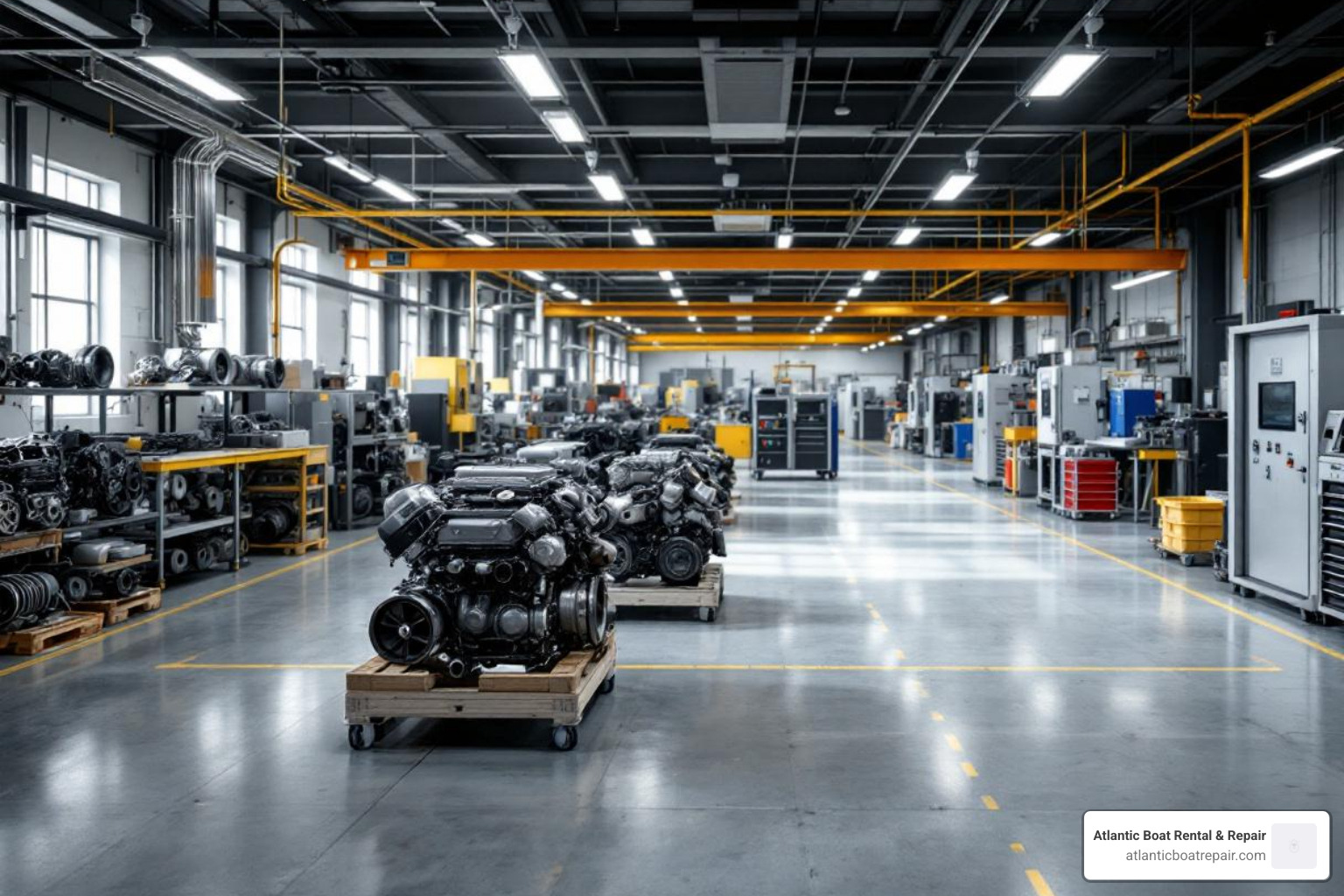
The journey of a factory remanufactured engine begins with a "core" – your old, worn-out engine. This core is the foundation upon which a new, reliable engine will be built. The process involves several rigorous steps:
- Complete Disassembly: The engine is completely torn down to its individual components. Every bolt, piston, and bearing is removed, leaving only the bare block and cylinder heads for inspection.
- Thorough Cleaning: All parts are intensively cleaned using chemical baths, shot blasting, and high-pressure washing to remove all grime, carbon, and rust, preparing them for inspection.
- Detailed Crack Inspection: Cleaned components, especially the block and heads, are inspected for cracks or damage using methods like magnetic particle testing. Any flawed parts are discarded.
- Precision Machining: Components that pass inspection are re-machined to restore them to original factory standards, often even tighter. This includes:
- Cylinder Boring and Honing: Cylinders are bored and honed to precise tolerances (as tight as .0001 of an inch) for a perfect fit with new pistons.
- Crankshaft Grinding: Crankshafts are ground and polished with CNC grinders for perfect balance and smooth operation.
- Decking and Line Boring: Blocks are decked (machined flat) and line bored to ensure perfect alignment for the crankshaft and camshaft.
- Valve Seat and Guide Work: Valve seats and guides are re-cut, resized, or replaced for optimal sealing and performance.
- New Components: All critical wear components are replaced with new, OEM-quality parts, including:
- Pistons and rings
- All main, rod, and camshaft bearings
- Every gasket, seal, and O-ring
- Timing chains, gears, and tensioners
- Assembly Line Process: Components are reassembled on a dedicated line, similar to new engine manufacturing. Technicians follow strict procedures to ensure consistency and build the engine to original or improved specs.
This detailed, factory-level process is what gives a factory remanufactured engine its reputation for quality and reliability, offering a dependable solution for drivers and boaters throughout Plymouth, Kingston, Duxbury, Bourne, and Sandwich.
Quality Control: The Key to Reliability
The meticulous remanufacturing process would be incomplete without an equally rigorous quality control system. This is the stage where the engine's new life is thoroughly tested and verified. For us at Atlantic Boat Rental & Repair, this phase is paramount, especially for marine engines where reliability on the water is non-negotiable.
Our commitment to quality control is unwavering. We perform comprehensive testing procedures, including:
- Compression Test: Checks the sealing integrity of cylinders, rings, and valves, which is critical for efficient power.
- Oil Pressure Test: Ensures the oil pump and passages provide adequate lubrication to all moving parts for engine longevity.
- Leak-Down Test: Measures air leakage past rings, gaskets, and valves to pinpoint potential issues.
- Hot Testing: Engines are often run on a dynamometer under load to simulate real-world conditions. This "hot testing" verifies oil pressure, coolant flow, and fuel delivery while checking for leaks or noises. Some remanufacturers perform up to 50-hour runability tests.
- Sim-Testing: Electronically simulates engine operation to verify sensors, ECU communication, and system functions before installation.
Here at Atlantic Boat Rental & Repair, we pride ourselves on a level of quality control that sets our marine engines apart. Our specialty is "0" time rebuilt outboard engines, meaning that through our rigorous remanufacturing process, the engine's operational life is reset to zero, just like a brand-new unit. This isn't just a claim; it's backed by our commitment to superior precision (twice manufacturer specs). Yes, you read that right – our testing for new-like performance and reliability goes above and beyond, ensuring that when you get an engine from us, it's ready to tackle the waters of the Massachusetts coast with unwavering dependability.
Understanding Core Charges and Returns
When you purchase a factory remanufactured engine, you'll encounter a "core charge." This is a standard, refundable deposit that encourages the return of your old engine (the "core") so it can be remanufactured.
Here's how it generally works:
- Core Deposit: A refundable core charge, typically a few hundred to over a thousand dollars, is added to the purchase price.
- Old Engine Return: After installation, you return your old engine to the supplier, usually within 15-30 days. Suppliers provide instructions and may arrange pickup.
- Refundable Charge: The core charge is refunded after the supplier receives and inspects your old engine. The core must be in a rebuildable condition (e.g., no cracked block) to receive a full refund.
- Shipping Policies: Check the core return shipping policy, as some companies offer free pickup while others require you to pay. Ensure the core is drained of fluids and secured for transport.
The core charge system is vital to the sustainability of the remanufacturing industry. It ensures a steady supply of old engines that can be brought back to life, reducing waste and the need for new manufacturing. If you have questions about core charges, don't hesitate to Get a Quote for your specific needs.
The Ultimate Guide to Factory Remanufactured Engines
So, you've learned about the meticulous process and the rigorous quality control that goes into creating a factory remanufactured engine. Now, let's explore what you can expect from these engines in terms of longevity and warranty, their widespread applications, and how to ensure you're choosing a reputable provider for your needs here in Massachusetts.
The Lifespan and Warranty of Factory Remanufactured Engines
How long will a factory remanufactured engine last? A properly remanufactured engine can last as long as a new one, often exceeding 100,000 miles of driving or countless hours on the water. The comprehensive overhaul and replacement of critical components ensure long-term performance.
The quality of these engines is backed by warranties far superior to those for rebuilt or used engines, which often include:
- Multi-year Unlimited Mileage Warranties: It's common for these engines to come with a 3-year/100,000-mile warranty or even a 5-year unlimited mile warranty.
- Parts & Labor Coverage: A comprehensive warranty will cover both the engine parts and the labor for installation, protecting you from unexpected costs.
- Nationwide Warranty: Many major remanufacturers offer nationwide warranties, providing peace of mind if you travel or relocate.
This level of warranty protection underscores that a factory remanufactured engine is a serious investment in your vehicle or boat's future, designed to deliver performance and reliability akin to a brand-new unit.
Common Applications and Industry Trends
The versatility of factory remanufactured engines means they are found in a vast array of applications, from daily commutes to heavy-duty industrial work.
- Passenger Cars and Light Trucks: This is the most common application, providing a cost-effective way to get a vehicle back on the road.
- Heavy-Duty Diesel Engines: For commercial trucks and construction equipment, diesel engine remanufacturing is a huge industry that keeps fleets running economically.
- Marine Engines: This is our specialty! From recreational boats to commercial fishing vessels, factory remanufactured marine engines are a vital solution. We understand the specific needs of marine applications, ensuring our engines withstand the harsh saltwater environment. Check out our selection of Marine engines.
- Performance Engines: Enthusiasts can find remanufactured options, often built with upgraded components for more power and durability.
Beyond specific applications, the remanufacturing industry is also a leader in sustainability and technology.
- Sustainability and the Circular Economy: Remanufacturing is a green practice that supports the circular economy. By restoring existing engines, we reduce waste, conserve resources, and minimize environmental impact—a contribution we're proud to make in our Massachusetts communities.
- Technology Advancements: The industry constantly evolves, incorporating the latest engineering updates. Remanufacturers often correct original design flaws (such as offering a DFM-delete option) and use advanced techniques like flame spray technology to improve durability. This means a factory remanufactured engine is often an improved version of the original.
How to Find a Reputable Remanufacturer
Choosing a factory remanufactured engine is a significant investment, so working with a reputable company is paramount. Here's how to identify a trustworthy provider:
- Industry Associations: Look for members of recognized groups like the AERA (Automotive Engine Rebuilders Association), which indicates a commitment to industry standards.
- Better Business Bureau (BBB): Check for accreditation and a good rating with the BBB for an independent assessment of a company's reliability.
- Customer Reviews and Testimonials: Online reviews and local recommendations offer invaluable insights into quality and customer service.
- Detailed Warranty Information: A reputable company will be transparent about their warranty. Ask for full details on what's covered (parts, labor) and for how long.
- Technical Support and Expertise: A good company will have knowledgeable staff to answer technical questions and provide post-purchase support.
Here are key questions to ask any potential remanufacturer:
- What is your exact remanufacturing process?
- What specific quality control and testing procedures do you use?
- What is the full scope of your warranty (parts, labor, duration)?
- Do you address common factory flaws in your process?
- What are your core charge and return policies?
- How long have you been in business?
- Do you offer technical support for installation?
Conclusion: Is a Remanufactured Engine Right for You?
When faced with engine failure, the decision can feel overwhelming. However, as we've explored, factory remanufactured engines present a compelling and often superior alternative to both gambling on a used engine and the significant expense of a brand-new one. For vehicle owners and boaters across Plymouth, Kingston, Duxbury, Bourne, and Sandwich, Massachusetts, this option offers a smart balance of quality, cost, and peace of mind.
To recap, the benefits are clear:
- Cost-effectiveness: You get like-new performance at a fraction of the cost of a new engine, saving you thousands of dollars.
- Reliability and Performance: Through meticulous disassembly, precision machining, replacement of critical components, and rigorous testing (including our own twice manufacturer specs for marine engines), factory remanufactured engines meet or exceed OEM standards, delivering dependable performance.
- Environmental Advantage: By choosing remanufactured, you're participating in a circular economy, reducing waste, and conserving valuable resources – a win for your wallet and the planet.
If you're looking for a durable, high-quality engine replacement that won't break the bank and comes with a solid warranty, a factory remanufactured engine is an exceptional choice. It's a testament to ingenuity and engineering that a component once deemed "dead" can be brought back to life, performing as reliably as new.
Don't let engine troubles keep you off the road or out on the beautiful waters of Massachusetts. Make the smart choice for your ride's new life. We're here to help you steer your options and find the perfect solution.
Comments
Be the first to comment on this article!