
Is Your Outboard Powerhead Ready for a Rebuild? What You Need to Know
Why Understanding Powerhead Rebuilds Matters
Outboard powerhead rebuild is the process of disassembling, inspecting, machining, and reassembling the core combustion components of your outboard motor—restoring it to original performance at a fraction of the cost of a new engine.
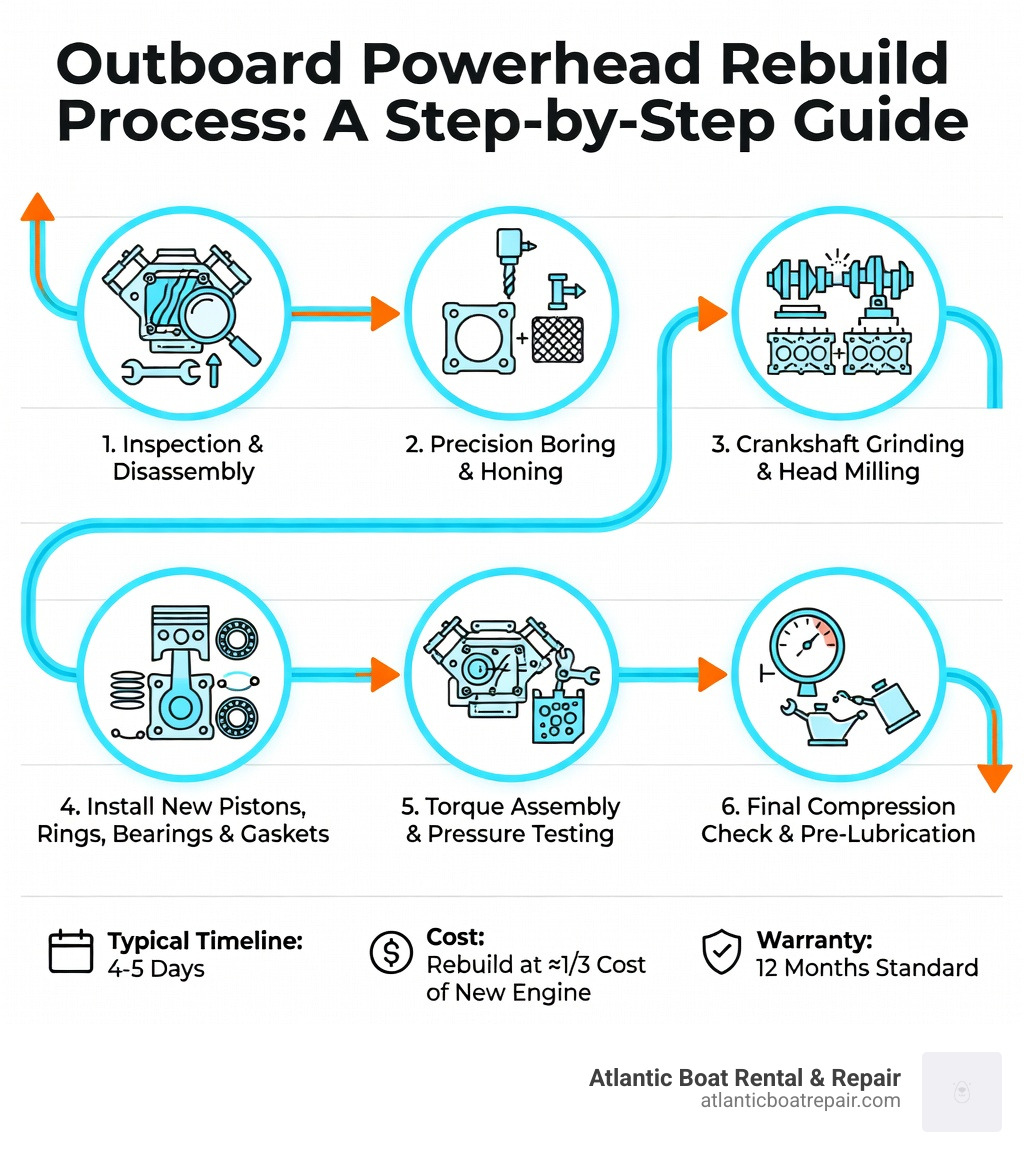
Quick Answer: The Outboard Powerhead Rebuild Process
- Assessment — Inspect block for damage, scoring, and compression loss
- Disassembly — Remove all external components and accessories
- Machine Work — Bore cylinders (.015–.030 over), hone for cross-hatch, mill heads flat
- Component Replacement — Install new pistons, rings, bearings, gaskets, and seals
- Reassembly — Torque to spec, pressure test, pre-lubricate
- Testing — Verify compression, timing, and cooling system integrity
Typical Cost: 2/3 less than new engine replacement
Turnaround Time: 4–5 business days (professional shop)
Warranty: 12 months standard, lifetime options available
If your outboard is losing power, knocking, smoking excessively, or failing compression tests, the powerhead is likely the culprit. It's the heart of your engine—the block, crankshaft, pistons, and cylinder heads that handle combustion and drive the propeller shaft.
Rebuilding a powerhead isn't a weekend project. It requires precision machining, clean assembly conditions, and strict attention to tolerances. Most boat owners who've owned multiple engines know this work is best left to a shop with the right tools and experience.
Around Plymouth and the South Shore, we see a lot of powerhead failures tied to saltwater mooring conditions, poor winterization, and ethanol fuel issues. These engines take a beating in New England, and when they fail, you've got three options: professional rebuild, remanufactured powerhead, or replacement.
I'm Ron Cribbie, and I've been rebuilding outboard powerheads for boat owners in Massachusetts for decades. At Atlantic Boat Repair, we handle everything from machine work to final assembly—outboard powerhead rebuild work done right, with no middlemen or surprises.
Understanding the Outboard Powerhead and When to Rebuild

The powerhead is the "top half" of your outboard. While the lower unit handles gear shifting and propulsion, the powerhead is where the combustion happens. It consists of the engine block, crankshaft, connecting rods, pistons, and cylinder heads. If this core fails, your boat isn't going anywhere.
Signs Your Outboard Powerhead May Need a Rebuild
We see this a lot with boats that sit on moorings around Plymouth and Duxbury. The salt air and constant humidity can lead to internal issues that aren't always obvious until you're out on the water. Keep an ear out for these symptoms:
- Noticeable Compression Loss: If the engine struggles to start or feels sluggish, a compression test is the first step.
- Metallic Knocking: Unusual noises often indicate a bearing failure or a piston slapping against the cylinder wall.
- Excessive Smoke: While 2-strokes are naturally smoky, a sudden increase or blue smoke in a 4-stroke indicates oil is bypassing the rings.
- Spark Plug Fouling: If you’re cleaning your plugs every other trip, your cylinders might be running "wet" due to poor ring sealing.
- Overheating History: A single bad overheat can warp a head or score a cylinder, necessitating an outboard powerhead rebuild.
Why Powerheads Fail in New England Waters
Our local conditions are tough on machinery. In places like Kingston and Sandwich, the combination of short boating seasons and harsh winters creates a perfect storm for engine wear.
- Saltwater Intrusion: Salt air can corrode internal components even when the boat is just sitting.
- Ethanol Fuel Issues: Modern fuel with ethanol attracts moisture. If left in the system for more than eight weeks, it begins to break down, forming a lacquer that clogs jets and causes "lean" conditions that melt pistons.
- Improper Winterization: If water isn't fully drained or the engine isn't fogged, internal rust can form on the cylinder walls over the winter.
- Carbon Buildup: Constant idling or short runs (common in local harbors) prevents the engine from reaching operating temperatures, leading to carbon deposits that stick rings and score walls.
Your Options: Rebuilding Your Outboard Powerhead
When your powerhead gives up the ghost, you don't necessarily need a new boat or even a brand-new motor. Rebuilding or choosing a remanufactured unit can save you up to 2/3 the cost of a new outboard.
| Option | Best For | Cost Range | Technical Risk |
|---|---|---|---|
| In-House Rebuild | Keeping your original block; custom specs | Moderate | Low (if professional) |
| Remanufactured Unit | Faster turnaround; "0" time engine | Moderate | Very Low |
| DIY Kit | Experienced mechanics with a full shop | Low (Parts only) | High |
| New Engine | Maximum budget; latest technology | Very High | None |
If you want to talk through these options for your specific motor, check out our services page.
What’s Involved in a Professional Outboard Powerhead Rebuild
A proper rebuild is a surgical process. It requires specialty tools like micrometers for measuring tolerances to within a half-thousandth of an inch, flywheel pullers, and torque wrenches.
Shop realities are simple: if you don’t have a clean, organized space, you’re asking for trouble. A single grain of sand or a misplaced bolt can ruin a $3,000 job in seconds. This is why most owners in the South Shore area choose a professional shop. We ensure every surface is "hospital clean" before reassembly.
2-Stroke vs. 4-Stroke Rebuild Considerations
- 2-Stroke: These are generally simpler and lighter. However, for older OMC (Johnson/Evinrude) models, sourcing high-quality parts is becoming more of a specialized task. Many "cracked cap" connecting rods require precise alignment fixtures that many general mechanics don't own.
- 4-Stroke: These are more complex due to the valve train and pressurized oiling systems. They are heavier but often more reliable long-term if the maintenance is kept up.
- Brand Factors: Yamaha and Mercury are the most common candidates for rebuilding in our area due to excellent parts availability.
The Professional Remanufacturing Process
At Atlantic Boat Repair, we don't just "fix" engines; we remanufacture them. This means the engine is returned to a "0" hour state.
- Boring and Honing: We bore the cylinders to .015 or .030 over to remove scoring. We never go beyond .030 if we can help it, as it maintains wall thickness and cooling efficiency. We then hone the cylinders to create a specific cross-hatch pattern, which is essential for oil retention and ring seating.
- Milling: We mill the cylinder heads to ensure they are perfectly flat. This prevents gasket failure and ensures a perfect seal.
- Crankshaft and Rods: The crankshaft is inspected for straightness and the journals are polished. Connecting rods are gauged and machined to meet or exceed OEM specifications.
- Assembly: We use new pistons, rings, bearings, and gaskets. Every bolt is torqued in the correct sequence to ensure even pressure across the block.
Why In-House Machine Shop Work Matters
Many shops act as "middlemen"—they pull your engine and ship it off to a mass-production factory. We do our machine work in-house. This gives us quality control at every step. We’ve seen too many "factory" rebuilds come back with issues, like improperly seated valves or mismatched tolerances, that could have been caught if the builder was also the machinist.
Best Brands and Models for Rebuilding
Yamaha HPDI, Mercury Optimax, and the older Johnson/Evinrude "Loopers" are excellent candidates for an outboard powerhead rebuild. These blocks are robust and can handle being bored over. As long as the block isn't "ventilated" (meaning a rod hasn't come through the side), it can usually be saved.
If you’re looking for a motor that’s already been through this process, you can see what we have ready to go on our pre-owned inventory page.
Logistics, Costs, and Warranties
Typical Costs and Core Charges
A remanufactured powerhead typically costs about 1/3 of what you'd pay for a brand-new engine of the same horsepower. For example, while a new 150hp motor might run you $15,000+, a high-quality rebuild can often be completed for significantly less.
Most professional rebuilds involve a "core charge." This is a deposit you pay that is refunded once we receive your old powerhead. We inspect every core before issuing credit to ensure the block and crankshaft are reusable.
Preparing Your Powerhead for Drop-Off
If you're in the Plymouth or Bourne area, you can drop your powerhead off directly at our shop. If you're shipping it, follow these steps:
- Strip it down: Remove the starter, alternator, carburetors/injectors, and ignition components. We generally only need the bare block and heads.
- Take Photos: Document the condition of your engine before it leaves your sight.
- Drain Fluids: Ensure all oil and fuel are drained to prevent environmental issues during transit.
- Crate it: Use a sturdy plywood base. Smaller 2-cylinder motors can sometimes go via UPS, but V6 models must be crated and shipped via truck freight.
Maintenance Tips to Prevent Powerhead Failure
The best way to handle a powerhead rebuild is to avoid needing one.
- Install a Water-Separating Fuel Filter: This is the single best defense against the "lean sneeze" that destroys pistons.
- Flush After Every Use: Especially if you're boating in the saltier waters around Cape Cod and the South Shore.
- Stabilize Your Fuel: If your boat is going to sit for more than two weeks, use a high-quality stabilizer.
- Monitor Your Tell-Tale: Always check that your water pump is peeing strongly. Heat is the enemy of the powerhead.
Frequently Asked Questions about Powerhead Rebuilds
Is it better to rebuild or buy a new outboard?
If your mid-section and lower unit are in good shape, an outboard powerhead rebuild is almost always the more economical choice. You get a "0" time engine for a fraction of the cost. However, if the entire motor is corroded and the lower unit is shot, it might be time to look at a full repower.
How long does a professional powerhead rebuild take?
In our shop, a standard overhaul typically takes 4 to 5 business days once we have the parts. During the busy spring season, this can stretch to two weeks, so we always recommend bringing engines in during the late fall or winter.
Can any outboard block be rebuilt?
Most can, provided there isn't catastrophic damage to the block itself. If a cylinder is badly scarred, we can often "sleeve" it, returning it to standard size. We can usually bore up to .040 over, but we prefer staying within .015 to .030 for longevity.
Conclusion
At Atlantic Boat Rental & Repair, we take pride in serving the boating community from Plymouth to Sandwich. We understand that your boat is more than just a machine—it's your gateway to the water. Our "0" time rebuilt engines are crafted with superior precision, often exceeding manufacturer specs, to ensure you don't have to worry when you're miles offshore.
We believe in honest recommendations. If your engine is worth saving, we’ll tell you. If it’s time to move on, we’ll tell you that too.
If you’re considering this upgrade, we can walk you through it.
Comments
Be the first to comment on this article!