
The Heart of Your Car: What Engine Repair Services Can Do For You
Why Understanding Marine Engine Repair Services Matters
Engine repair services are the lifeline of boat ownership—whether you're dealing with a check engine light, rough idling, or a complete loss of power, knowing what's involved in professional diagnostics, repair, and potential replacement helps you make confident decisions about your boat's future.
What Engine Repair Services Include
Core diagnostic and repair services:
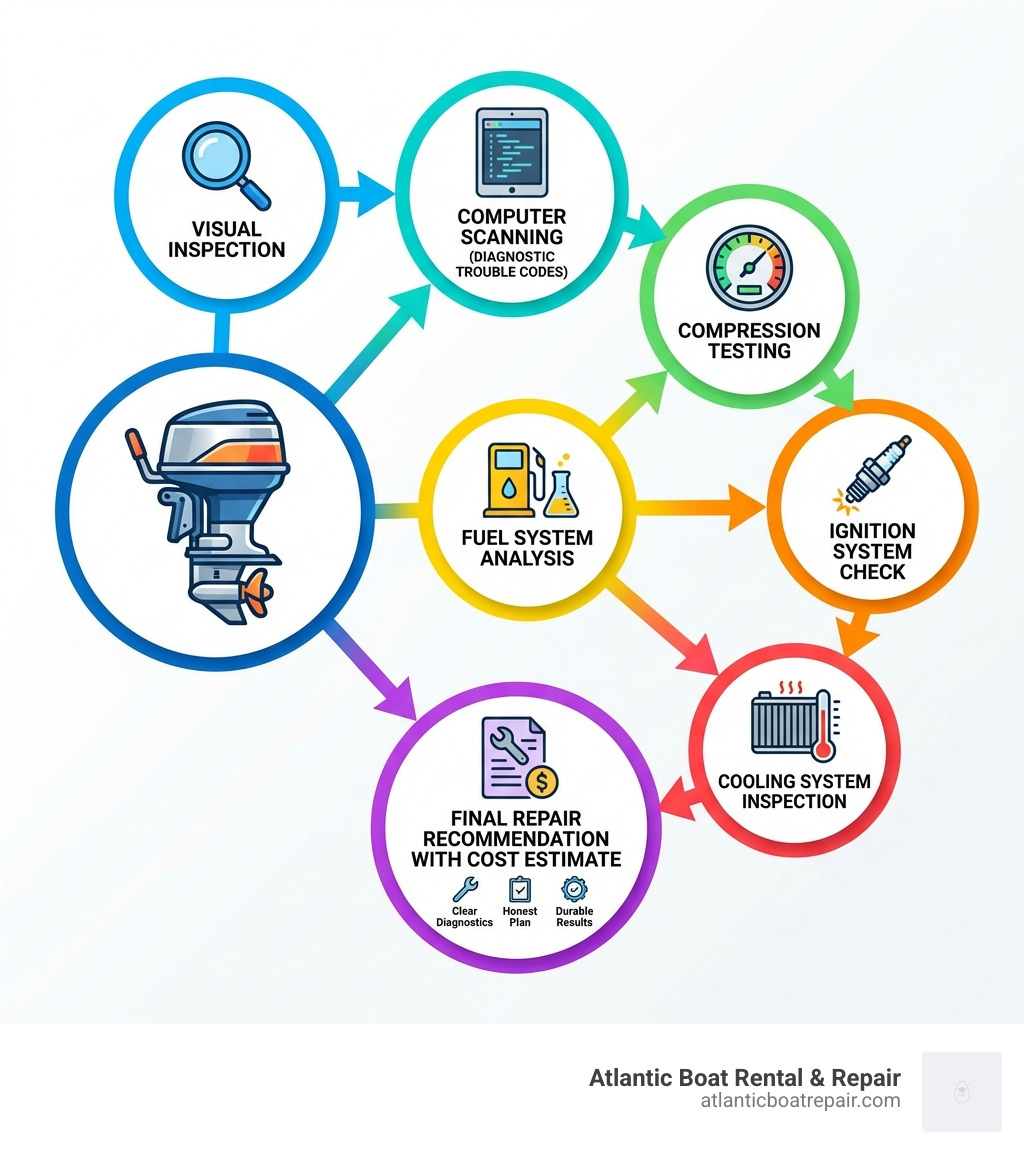
- Engine diagnostics – Computer scanning for trouble codes, compression testing, fuel system analysis
- Component repair – Fuel injectors, ignition systems, sensors, alternators, water pumps
- System cleaning – Fuel system cleaning, carbon buildup removal, cooling system flushing
- Major repairs – Head gasket replacement, timing belt/chain service, crankshaft work
- Rebuild vs. replacement – Full engine overhauls, short/long block replacement, or complete repower
Common signs you need service:
- Persistent check engine light
- Loss of power or acceleration
- Hard starting or frequent stalling
- Excessive smoke or unusual exhaust
- Decreased fuel efficiency
- Knocking, rattling, or grinding noises
Typical costs and timelines:
- Basic diagnostics: $110–150 with labor warranty
- Minor repairs: Same-day to 2–3 days
- Major repairs or replacement: 3–5 days depending on parts availability
- Warranties: 90 days to 24 months on labor and parts, depending on scope
The reality is this: most engine problems start small—a sensor issue, a clogged fuel filter, a worn ignition component—but left unchecked, they escalate into expensive failures. Professional engine repair services give you clarity on what's wrong, what it'll cost to fix, and whether repair or replacement makes more sense for your boat.
I'm Ron Cribbie, owner of Atlantic Boat Repair, and over decades in the marine industry, I've diagnosed and repaired everything from minor sensor faults to catastrophic engine failures—engine repair services done right mean transparent diagnostics, honest recommendations, and durable results that keep boats running season after season. Whether you're dealing with a check engine light or considering a full repower, understanding what's involved helps you make the call that's right for your boat.
Recognizing Early Signs of Engine Trouble

In the waters around Plymouth and the South Shore, an engine failure isn't just an inconvenience—it's a safety concern. Your outboard usually tries to tell you when something is wrong long before it leaves you stranded. Recognizing these symptoms early can be the difference between a simple sensor replacement and a total engine overhaul.
The most obvious sign is the check engine light or a warning buzzer on your dash. Modern outboards use on-board computers to monitor everything from oil pressure to cooling temperature. When a Diagnostic Trouble Code (DTC) is triggered, it's a signal that the system has detected a parameter outside of its normal operating range.
Other common red flags include:
- Loss of Power: If your boat struggles to get on plane or feels sluggish at wide-open throttle, you might be dealing with a fuel delivery issue or a cylinder misfire.
- Rough Running: Shaking at idle or "hunting" for RPMs often points to fouled spark plugs or a clogged fuel system.
- Unusual Noises: Knocking, rattling, or metallic grinding are serious. These often indicate mechanical wear in the rotating assembly, such as bearings or the crankshaft.
- Excessive Smoke: While older two-strokes are naturally smoky, excessive blue or white smoke in a modern four-stroke can indicate burning oil or a head gasket leak.
- Increased Fuel Use: If you're visiting the fuel dock more often than usual, your engine isn't running at peak efficiency, likely due to a faulty oxygen sensor or clogged injectors.
If you notice any of these signs, it's time for professional engine repair services. Addressing a minor vibration in the spring can prevent a catastrophic failure during the height of the summer season in Duxbury or Bourne.
What’s Included in Professional Marine Engine Repair Services
When we talk about engine repair services, we aren't just talking about turning wrenches. It’s a systematic approach to restoring the reliability of your vessel. Marine environments are harsh—saltwater corrosion and humidity are constant threats to your engine's internal components.
A professional service usually involves several key procedures:
- Fuel System Cleaning: We clear buildup from the injectors and fuel lines to restore power and improve efficiency.
- Ignition Troubleshooting: Testing coil packs, spark plug wires, and the stator to ensure a consistent, strong spark.
- Compression Testing: This tells us the health of your pistons, rings, and valves. Low compression in one cylinder is a clear indicator of internal mechanical trouble.
- Sensor Checks: Modern engines rely on MAP sensors, TPS sensors, and O2 sensors. We verify they are sending accurate data to the engine's computer.
- Cooling System Inspection: We check the water pump impeller, thermostats, and passages for salt buildup or blockages.
What to Expect When You Bring Your Boat In
We believe in a "no-surprises" approach. When you bring your boat to us, the process begins with a thorough diagnostic phase. We don't guess; we use advanced computer scanning tools to pull data directly from your engine's ECM.
Our engine repair process includes:
- Initial Computer Scan: Retrieving any stored trouble codes.
- Hands-on Inspection: Checking for physical leaks, worn belts, or corroded wiring.
- Performance Testing: Running the engine under load to replicate the issue you've described.
- Written Estimate: We provide a clear breakdown of what needs to be fixed and why.
Common repairs we handle daily include:
- Replacing faulty ignition coils or spark plugs.
- Cleaning or replacing fuel injectors.
- Replacing failed oxygen or temperature sensors.
- Water pump and impeller replacements.
Repair, Rebuild, or Repower: Making the Right Call for Your Boat
One of the most difficult decisions for a boat owner is deciding whether to fix an old engine or start fresh. This usually comes up when a major component fails—like a cracked block, a seized piston, or a failed crankshaft.
Here is a breakdown of your options:
- Repair: Best for specific, isolated issues like a failed sensor, a bad starter, or a leaking gasket. It’s the most cost-effective way to get back on the water if the core of the engine is still healthy.
- Rebuild/Overhaul: This involves taking the engine apart and replacing worn internal parts like rings, bearings, and seals while keeping the original block. It’s a middle-ground option that adds years of life to a trusted motor.
- Repower (Replacement): If the cost of repair exceeds 50-60% of the engine's value, or if the block itself is damaged beyond repair, a full replacement is often the smartest long-term investment.
| Factor | Repair | Rebuild | Repower (Replacement) |
|---|---|---|---|
| Typical Cost | Low to Moderate | Moderate to High | High |
| Downtime | 1–3 Days | 1–2 Weeks | 3–5 Days |
| Reliability | Good (fixes specific issue) | Excellent (like new internals) | Maximum (new technology/warranty) |
| Warranty | Part-specific | Labor & Parts (90 days - 24 mo) | Full Manufacturer Warranty |
In Massachusetts, where our season is short, downtime is a major factor. Sometimes, choosing a remanufactured "0" time engine is faster than waiting for a complex rebuild of your existing unit.
How the Engine Repair Process Works in Our Shop
Efficiency and precision are the standards we live by. When a boat enters our shop, we treat it with the same care we give our own. We understand that in towns like Kingston and Sandwich, your boat is your escape, and every day it’s in the shop is a day lost on the water.
Our standard diagnostic service is typically priced around $110.00. This covers the initial scan and physical inspection. From there, we source only genuine OEM parts and premium lubricants. We don't cut corners with "will-fit" parts that aren't designed for the rigors of saltwater use.
Typical turnaround for most engine repair services is 3 to 5 days, depending on part availability. We also provide a labor warranty on our work because we stand behind the expertise of our technicians. For more extensive work, like a marine engine overhaul, we follow a rigorous protocol that ensures the engine meets or exceeds original specifications.
Precision Outboard Engine Repair and Rebuilds
At Atlantic Boat Rental & Repair, we specialize in something a bit different than your average shop. We remanufacture and sell "0" time rebuilt outboard engines. Our Unique Selling Proposition (USP) is rooted in superior precision. We often work to tolerances that are twice as strict as the original manufacturer specs.
Why do we do this? Because a marine engine works harder than a car engine ever will. It’s like driving your car up a steep hill while pulling a trailer—all day long. Our rebuilt engines undergo:
- Complete disassembly and steam cleaning.
- Precision honing and boring of cylinders.
- Crankshaft grinding and micro-polishing.
- Rigorous testing to ensure "new-like" performance and reliability.
If you’re in the Plymouth area and your engine isn't performing the way it should, if you want to talk through your options, give us a call.
Frequently Asked Questions About Marine Engine Services
How long does a typical outboard engine replacement take?
A full engine replacement or "repower" typically takes 3 to 5 business days. This includes removing the old engine, inspecting the transom and rigging, mounting the new unit, and performing a sea trial to ensure everything is dialed in correctly.
What’s included in a standard marine engine diagnostic?
A standard diagnostic includes a computer scan for trouble codes (DTCs), a compression test of all cylinders, an inspection of the spark plugs and ignition system, and a check of the fuel pressure. We also look for physical signs of trouble like salt crusting, oil leaks, or worn belts.
How does regular maintenance help prevent major engine failure?
Regular maintenance is the best insurance against expensive engine repair services. Simple tasks like changing the gear lube, replacing the water pump impeller every two seasons, and using fuel stabilizers can prevent 90% of the common failures we see. For example, a $25 fuel filter can prevent a $1,500 fuel injector repair.
Conclusion
Your engine is the heart of your boating experience. Whether you’re fishing off the coast of Duxbury or cruising the Cape Cod Canal, you need to know that your motor will start every time you turn the key.
At Atlantic Boat Rental & Repair, we don't believe in "band-aid" fixes. We focus on long-term performance and honest recommendations. We serve the South Shore—from Plymouth and Kingston to Bourne and Sandwich—with a commitment to mechanical excellence and local trust.
If your engine is acting up, or if you’re considering a rebuild to get more years out of your favorite boat, we’re happy to take a look and give you an honest recommendation. Let’s make sure your time on the water is spent enjoying the view, not worrying about what’s under the cowling.
Comments
Be the first to comment on this article!