
Revitalize Your Ride: Finding the Best Remanufactured & Performance Boat Engines
Why Remanufactured Boat Engines Are the Smart Alternative to Buying New
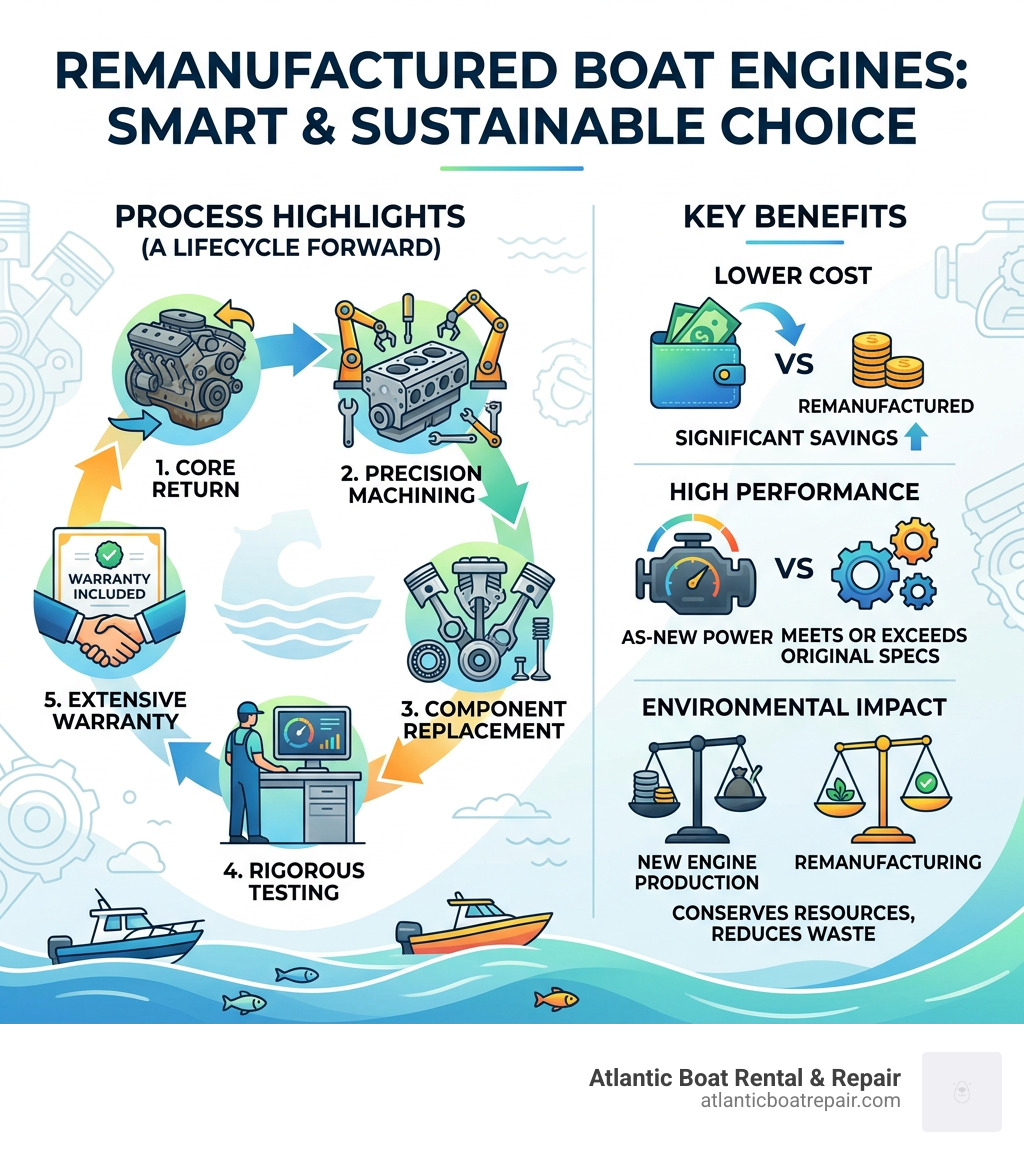
Remanufactured boat engines offer factory-level reliability at a fraction of the cost of new engines, with professional rebuilds that include updated components, rigorous testing, and comprehensive warranties. They're built to original equipment manufacturer (OEM) specifications, produce up to 56% less CO2 than new engine production, and reuse up to 60% of materials.
What You Need to Know:
- Cost: 40–60% less than a new marine engine
- Warranty: Typically 12–24 months with unlimited hours
- Performance: Factory specifications with latest technical updates
- Components: New pistons, rings, bearings, gaskets, oil pumps, and refurbished blocks, crankshafts, and heads
- Testing: Hot-run tested and precision-balanced before shipping
- Core Exchange: Some suppliers require your old engine; others don't
When your outboard or inboard fails, you're facing a hard choice. A new engine can run $8,000 to $15,000 or more, depending on displacement and brand. A remanufactured engine gets you back on the water with the same power and reliability for far less money. These aren't just rebuilt engines—they're factory-refurbished units brought back to OEM specs using precision machining, updated components, and the latest technology. You get improved power, modern updates, and a clean warranty, all while keeping a ton of material out of the scrap pile.
I'm Ron Cribbie, and I've spent decades working on marine engines across the South Shore, from center consoles to cruisers, and I've seen how a quality remanufactured engine can outlast a poorly maintained new one. Remanufactured boat engines are a proven solution when you need reliability without the new-engine price tag.
Understanding Remanufactured Boat Engines vs. Rebuilt Options
When your boat's engine starts to show its age, you'll hear a lot of terms thrown around: "new," "rebuilt," and "remanufactured." It matters, because these labels can mean very different things for reliability and what you actually get for your money.
A "new" engine is fresh off the assembly line. You get a full factory warranty and the latest design updates. You also pay for it.
"Rebuilt" usually means the engine was repaired back to running condition. The scope can be anything from a basic refresh to a decent overhaul, but it's often based on replacing only what looks worn or failed. Quality varies a lot depending on who did the work and what was replaced.
Remanufactured boat engines are closer to factory-level restoration. The engine is fully disassembled, cleaned, and inspected against original equipment manufacturer (OEM) specifications. Wear parts like pistons, rings, bearings, gaskets, and oil pumps are replaced. Major components like the block, crankshaft, and cylinder heads are machined and refurbished to meet OEM tolerances.
In many cases, remanufacturing also includes technical updates that weren't on the original version of that engine. Done right, you end up with "new-like" performance and a warranty that actually means something.
You will also hear engines described as longblocks and turnkey units:
- Longblock: The assembled core (block, rotating assembly, heads, cam/valvetrain). No external accessories.
- Turnkey: A more complete package with many external components installed, often hot-run tested.
Getting the right fit comes down to details like year range, horsepower, displacement, and the casting numbers on the block and heads. Those numbers are the quickest way to confirm what you have and avoid ordering the wrong setup.
If you want to see what's currently available, you can check here:
More info about our current inventory
Why Remanufactured Boat Engines Outperform Standard Rebuilds
The difference between a basic rebuild and true remanufacturing is process control. A quality reman unit is built to a standard, not just "good enough to run." Here is what typically separates remanufactured boat engines from standard rebuilds:
- Critical wear parts are replaced as a rule: Pistons, rings, bearings, gaskets, and oil pumps are replaced, not reused because they "look OK."
- OEM-spec machining and inspection: Proper boring/honing, decking, crack detection (like magnafluxing), and tolerance checks are what bring the engine back to spec.
- "0" time status: The goal is to reset wear surfaces and clearances to new-engine condition, not just patch a problem.
- Real testing: Hot-run testing (when included) catches issues before the engine ever goes in your boat.
Around Plymouth and the South Shore, we see engines that live hard lives: salt exposure, long periods on a mooring, and spring starts after storage. That is why we put so much emphasis on precision work and verifying results before an engine goes back out.
If you want background on how we approach this work and what we do day to day, this page lays it out:
More info about our team and experience
The Benefits of Choosing Remanufactured Boat Engines
Choosing a remanufactured boat engine isn't just a compromise; it's often the smartest decision for boat owners in Massachusetts looking for reliability, performance, and value. The advantages extend beyond just saving money, touching on environmental responsibility and often offering performance upgrades.
Significant Cost Savings
This is usually the first thing that catches a boat owner's eye, and for good reason. Remanufactured marine engines can be a fraction of the cost of a new marine engine—often 40-60% less. When you consider the price of a new engine, especially for popular models like a 4.3L Alpha® 4V or a 350 MPI Alpha®, those savings are substantial. You get virtually the same quality and durability as a new engine, but without the hefty price tag. This means more money in your pocket for fuel, maintenance, or other boating adventures around Cape Cod.
Environmental Impact
As boaters, we all appreciate the natural beauty of our coastal waters. Opting for a remanufactured engine is a tangible way to contribute to environmental sustainability. Consider these facts:
- Our engine remanufacturing process produces up to 56% less CO2 emissions compared to new engine production.
- Up to 60% of materials are reused in the remanufacturing process.
This commitment to recycling and reusing major components brought back to OEM specifications reduces wasteful scrapping and lowers the energy and resources required to manufacture new parts. It's a greener solution that aligns with responsible boating practices.
Improved Performance and Reliability
Many modern remanufacturing processes involve more than just a repair. They often include updating components with the latest specifications and technology. For instance, a Mercury remanufactured engine might be factory refurbished with new components featuring the latest specifications, allowing you to benefit from improved power and reliability. This means you could end up with an engine that performs better than the original unit it's replacing, designed to minimize maintenance requirements.
Comprehensive Warranty Coverage
One of the biggest assurances when investing in a remanufactured engine is the warranty. While coverage can vary, many reputable suppliers offer substantial warranties. We've seen warranties ranging from 12 months to 2 years, often with unlimited hours. This shows confidence in the quality and durability of the remanufactured product, giving you peace of mind as you steer the waters from Bourne to Sandwich.
Repowering Regulations
When considering a repower, it's also important to be aware of exhaust regulations, especially for sterndrive and inboard engines. These regulations can impact your choice of engine and installation process, ensuring your vessel remains compliant.
Sterndrive & Inboard Repower Exhaust Regulations
Choosing a remanufactured boat engine provides a powerful combination of affordability, environmental responsibility, and dependable performance, all backed by solid warranties. It's a practical choice for the discerning boat owner.
The Precision Process Behind a High-Quality Repower
Understanding what goes into a remanufactured boat engine helps you judge quality. This is not a quick patch. It's a measured process with a lot of inspection and machine work, because clearances and surface finish are what determine oil control, compression, and long-term bearing life.
At Atlantic Boat Rental & Repair, we build this work around two things that matter on the water: superior precision and rigorous testing. New England use is unforgiving, especially with saltwater corrosion, short seasons, and long storage cycles.
Here is what a proper remanufacturing process looks like:
- Disassembly and inspection
The engine is fully stripped. Components are cleaned and inspected for wear, cracks, and damage. We use methods like magnafluxing where appropriate to find defects you cannot see.
- Precision machining to OEM specifications (or better)
This is where most "rebuilds" fall short.
- Block work: Cylinders are bored and diamond honed for correct geometry and ring seal. Deck surfaces are machined flat for head gasket sealing.
- Crankshaft work: Journals are measured, machined as needed, then finished for proper bearing clearance.
- Rods: Resized and balanced as a set.
- Heads: Valve seats and sealing surfaces are restored; a 3-angle valve job is used to improve airflow and ensure consistent compression.
- Line honing: Main bores are aligned so the crank runs true and bearings live.
- Replacement of critical wear components
We replace the parts that control reliability in a marine engine:
- Pistons and rings
- Main/rod/cam bearings
- Hydraulic lifters
- Timing components (application-dependent)
- Intake and exhaust valves
- Oil pump
- Marine gasket sets
- Brass freeze plugs for corrosion resistance
- Assembly by experienced technicians
Everything is measured on the way in and torqued correctly on the way together. This is where good machine work gets protected (or ruined) depending on the build discipline.
- Rigorous testing
When the package calls for it, engines are hot-run tested to verify oil pressure, compression behavior, temperatures, and leak-free operation before they ever reach your boat.
If you fish off Duxbury, run out of Plymouth, or keep your boat on a mooring through the season, you already know the difference between an engine that is "fixed" and one that is truly right. The goal here is simple: new-like performance and reliability you can trust offshore and in the chop.
Key Factors for Selecting Your Next Marine Engine
Choosing the right remanufactured boat engine for your vessel is a critical decision that impacts performance, reliability, and your overall boating experience. It's not just about finding any engine; it's about finding the right engine that perfectly matches your boat's needs and your usage patterns.
Here are the key factors you should consider:
- Application and Power Needs (Horsepower and Displacement):
- What kind of boating do you do? Are you repowering an 18-to 20-foot runabout that needs a spirited 225hp 4.3L Alpha® 4V for watersports? Or perhaps a larger cruiser that requires the robust power of a 383 Mag Stroker 350hp engine, ideal for replacing older 350ci or 7.4L units?
- Consider your boat's hull design, typical load, and desired cruising or top speeds. More horsepower isn't always better; sometimes, a well-matched engine with excellent torque characteristics is more suitable.
- For example, the Product Data Sheet 4.3L Alpha 4V highlights how a 4.3L Alpha® 4V can offer more power and better fuel economy than a 5.0L V8 for certain applications.
- Compatibility (Year, Make, Model, Casting Numbers):
- This is paramount. Marine engines, even from the same manufacturer, can have subtle but critical differences across model years. You need to ensure the remanufactured engine is a direct fit for your boat's existing drivetrain and mounting points.
- Always verify the engine's year range, make (e.g., Mercruiser, Volvo Penta, Crusader), and specific model.
- Block and head casting numbers are your best friends here. These unique identifiers, typically found on specific ledges or pads on the engine block and cylinder heads, confirm the exact engine configuration. We often guide customers through locating these numbers, sometimes even suggesting cleaning off grime or using a mirror to find them.
- Understanding whether your engine needs a 1-piece or 2-piece rear main seal, or a flat tappet versus roller camshaft, can prevent costly mistakes.
- Engine Rotation:
- Marine engines can have either standard or reverse rotation.
- Standard rotation typically means the flywheel turns counter-clockwise and the pulleys turn clockwise (when viewed from the rear of the engine).
- Reverse rotation means the flywheel turns clockwise and the pulleys turn counter-clockwise.
- This is a non-negotiable factor for sterndrive and inboard applications, especially in twin-engine setups. Get this wrong, and your boat won't move correctly!
- Fuel System (Carbureted vs. Fuel Injected):
- Are you replacing an older carbureted engine or a more modern Electronic Fuel Injection (EFI) or Multi-Port Injection (MPI) unit? While it's sometimes possible to convert, it often adds significant cost and complexity. It's usually best to stick with the original fuel system type for compatibility and ease of installation.
- Cooling System:
- Most marine engines use either raw water cooling or a closed cooling system (like a car's radiator system, but with a heat exchanger). Ensure your replacement engine is compatible with your boat's existing cooling setup.
- Longblock vs. Turnkey Configuration:
- Knowing what you're buying is key. A longblock engine includes the core components like the block, heads, crankshaft, and internal parts. It does not include external accessories such as manifolds, carburetors/injectors, electrical components, or alternators. You'll reuse these from your old engine or purchase new ones.
- A turnkey engine is a more complete unit, often fired up and hot-run tested. It includes many of the external components, making installation quicker. Your choice depends on the condition of your existing accessories and your budget.
| Feature | Longblock Engine | Turnkey Engine |
|---|---|---|
| Included | Block, heads, crankshaft, rods, pistons, camshaft, valvetrain, oil pump, internal timing, gaskets | Longblock components PLUS manifolds, carb/injectors, electrical, fuel pump, starter, alternator, etc. |
| Accessories | Not included; reuse from old engine or purchase new | Included; ready to install and run |
| Cost | Generally lower upfront | Higher upfront, but potentially lower total installation cost |
| Installation | More involved; requires transferring many components | Less involved; often "drop-in" ready |
| Testing | Internal components checked | Fired up and hot-run tested on a stand |
| Core Charge | Often applies | Often applies |
By carefully considering these factors, you can ensure you select a remanufactured boat engine that provides years of reliable service on the waters of Massachusetts. If you're unsure, that's what we're here for. We've helped countless boat owners in the Plymouth, Sandwich, and Bourne areas make the right choice.
Warranty and Long-Term Maintenance for Your Repower
Investing in a remanufactured boat engine is a smart move, and understanding the warranty and ongoing maintenance requirements is crucial for protecting that investment. A good warranty provides peace of mind, and proper maintenance ensures your engine delivers reliable performance for years to come, especially in the unique marine environment of New England.
Warranty Coverage
The typical warranty coverage for remanufactured boat engines is robust, reflecting the confidence manufacturers and suppliers have in their detailed remanufacturing process. While specific terms can vary, you generally see:
- Duration: Warranties commonly range from 12 months to 2 years. Some providers, like Mercury, offer a one-year limited factory warranty with options for extended coverage (e.g., up to an additional two years through Mercury Product Protection).
- Unlimited Hours: Many marine engine warranties, including those for remanufactured units, specify "unlimited hours." This is a significant benefit for boaters, as it means you're covered regardless of how much time you spend on the water during the warranty period.
- Coverage Scope: Warranties typically cover defects in materials and workmanship, ensuring that if an issue arises due to the remanufacturing process, it will be addressed. It's important to understand what is covered (e.g., internal engine components) and what might be excluded (e.g., external accessories, damage from improper installation or maintenance).
Always review the specific warranty details with your supplier. A clear, comprehensive warranty is a strong indicator of a high-quality remanufactured engine.
Initial Break-in and First Maintenance
Just like a brand-new engine, a remanufactured unit requires a proper break-in period. This allows the internal components, especially the piston rings, to seat correctly. Following the manufacturer's break-in procedure is critical for the engine's long-term health and performance. This typically involves varying RPMs and avoiding sustained high loads for the first several hours of operation.
After the break-in, a crucial step is the first oil change and filter replacement. This removes any microscopic debris generated during the initial seating of components.
Maintaining Your Remanufactured Boat Engines for Maximum Lifespan
The lifespan and expected performance of a remanufactured boat engine compared to a new one can be very similar, assuming it was remanufactured to OEM specifications and maintained correctly. A well-maintained remanufactured engine can provide many years of dependable service.
Here are specific maintenance requirements to maximize the lifespan of your remanufactured marine engine:
- Regular Oil Changes: This is perhaps the most critical maintenance item. Marine engines operate under consistent high loads, similar to a truck hauling uphill all day. This creates heat and stress on the oil. Adhere strictly to the manufacturer's recommended oil type and change intervals, often more frequently than a car engine.
- Fuel System Care: Especially in Massachusetts, where ethanol-blended fuels are common, maintaining a clean fuel system is paramount. Use high-quality fuel filters and consider fuel stabilizers, especially during periods of storage. Water in the fuel is a common culprit for engine issues.
- Cooling System Checks: Marine engines face unique cooling challenges. Regularly inspect your raw water pump impeller, check for blockages in the seawater strainer, and ensure all cooling hoses are in good condition. For closed cooling systems, monitor coolant levels and condition.
- Winterization: For boaters on the South Shore, from Duxbury to Sandwich, proper winterization is non-negotiable. This involves stabilizing the fuel, flushing and draining the cooling system (or filling with antifreeze), changing the oil, and fogging the cylinders to prevent corrosion during cold storage. We see this a lot with boats that spend their time on moorings around Plymouth; neglecting winterization can lead to cracked blocks and heads when the temperatures drop.
- Ignition System: Inspect spark plugs, wires, and ignition components regularly. A healthy ignition system ensures efficient combustion and prevents undue stress on engine components.
- Belt and Hose Inspection: Check all belts for proper tension and cracks, and all hoses for signs of wear, leaks, or hardening.
- Anode Replacement: For saltwater boats, checking and replacing sacrificial anodes (zincs) is vital to protect your engine's metal components from galvanic corrosion.
By diligently following these maintenance practices, you're not just extending the life of your engine; you're ensuring reliable performance every time you head out on the water. We've seen how consistent, proactive maintenance makes all the difference for boat owners in our local waters.
More info about our marine services
Frequently Asked Questions about Remanufactured Engines
We understand that investing in a remanufactured boat engine comes with questions. Here are some of the most common ones we hear from boat owners around Plymouth and the South Shore:
What is the difference between a longblock and a turnkey engine?
This is a common point of confusion. Think of it this way:
- Longblock Engine: This is the core of the engine assembly. It typically includes the engine block, crankshaft, connecting rods, pistons, cylinder heads, camshaft, valvetrain, oil pump, and internal timing components, fully assembled. What it does not include are the external accessories like the intake manifold, carburetor or fuel injection system, exhaust manifolds, alternator, starter, power steering pump, or other electrical components. When you buy a longblock, you'll need to transfer these components from your old engine or purchase new ones. It's a great option if your external accessories are still in good shape.
- Turnkey Engine: This is a much more complete package. A turnkey engine includes all the components of a longblock, plus many or most of the external accessories needed to make it run. These engines are often "hot-run tested" on a dynamometer, meaning they've been started and run under load before they even leave the factory. This makes them much closer to a "drop-in" solution, reducing installation time and complexity. While more expensive upfront than a longblock, a turnkey engine can save you time and labor during installation.
Your choice depends on the condition of your existing components and your budget for installation.
How long can I expect a remanufactured engine to last?
When properly remanufactured to OEM specifications using high-quality parts and rigorous testing, a remanufactured boat engine can be expected to last just as long as a new engine. The goal of remanufacturing is to restore the engine to "new-like" condition, with tolerances and performance characteristics equivalent to a brand-new unit.
The key factors influencing its lifespan are the quality of the remanufacturing process itself (which is why we emphasize superior precision and rigorous testing) and, crucially, consistent maintenance. Just like a new engine, a remanufactured engine requires proper break-in, regular oil changes, diligent cooling system care, and appropriate winterization for New England conditions. If you take care of it, it will take care of you for many years on the water.
Do I need to provide my old engine as a core?
In many cases, yes, a "core exchange" is part of the process when purchasing a remanufactured boat engine. The "core" is your old, worn-out engine. Suppliers often rely on these cores to maintain their inventory for remanufacturing. You'll typically pay a core charge upfront, which is then refunded to you once you return your old engine to the supplier.
However, policies vary. Some suppliers might not require a core, or they may offer different pricing options if you don't have a core to return. It's essential to clarify the core exchange policy and any associated charges with your supplier before making a purchase. Also, ensure your core meets the supplier's acceptance criteria (e.g., not severely damaged beyond repair).
Conclusion
Choosing a remanufactured boat engine is a practical, intelligent decision for boat owners who value performance, reliability, and cost-effectiveness. These aren't just patched-up engines; they are carefully restored units, often to specifications exceeding the original, incorporating the latest technical updates, and backed by solid warranties. From the significant cost savings and reduced environmental impact to the peace of mind that comes with rigorous testing and quality components, the benefits are clear.
For us, serving the boating community around Plymouth, Kingston, Duxbury, Bourne, and Sandwich, Massachusetts, means understanding the unique challenges our local waters and seasons present. We know you need an engine you can depend on, whether you're heading out for a day of fishing or enjoying a quiet cruise. Our commitment to superior precision and rigorous testing ensures that any engine we touch delivers new-like performance and reliability, giving you confidence every time you leave the dock.
If you are considering a repower, we can walk you through the best options for your boat. We're here to provide honest recommendations and expert guidance, ensuring your vessel is ready for many more seasons of adventure.
If you are considering a repower, we can walk you through the best options for your boat
Comments
Be the first to comment on this article!