
Don’t Get Stuck: Essential Lube Tips for Throttle, Shift, and Steering
Why Proper Cable Maintenance Keeps You in Control
Throttle cable lubrication is essential for safe boat operation and smooth control response. Here's what you need to know:
Quick Answer: How to Lubricate Boat Throttle Cables
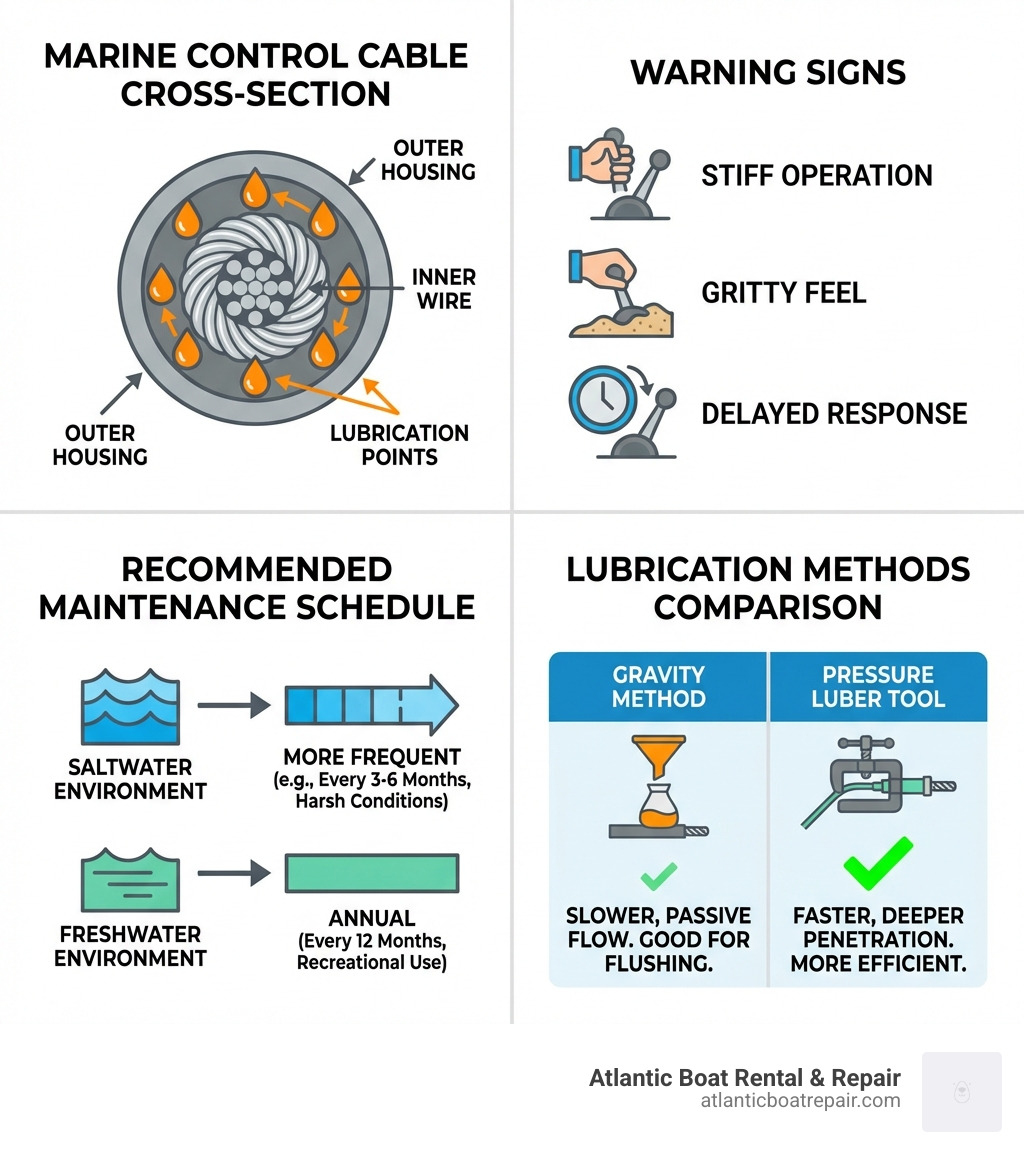
- Frequency: Lubricate annually for recreational boats; more often in saltwater or harsh conditions
- Best Lubricants: Light oil (3-in-One), silicone spray, or marine-grade cable lube—avoid WD-40 as a permanent solution
- Method: Use a cable luber tool or plastic bag funnel to inject lubricant until it flows through
- PTFE/Teflon Cables: Flush with WD-40 periodically; avoid heavy oils that attract dirt
- Warning Signs: Stiff lever, gritty feel, delayed response, or visible corrosion
A sticky throttle isn't just annoying—it's dangerous. When your throttle cable binds up at the worst possible moment, you lose the precise control you need around docks, in tight channels, or when quick maneuvering matters. Out here on the water, especially in New England conditions where salt spray and winter storage take their toll, control cables corrode faster than most boat owners realize.
The fix is straightforward. Regular lubrication reduces friction, prevents corrosion, and extends cable life. Most boats need attention once or twice a year, though saltwater exposure and heavy use call for more frequent maintenance. The job takes fifteen minutes with the right approach—and it pays off every time you touch that throttle.
I'm Ron Cribbie, and over decades of marine repair work around the South Shore, I've seen plenty of throttle cables fail from simple neglect—and I've shown countless boat owners how proper throttle cable lubrication prevents those problems before they start. The techniques we use at Atlantic Boat Repair work just as well in your own slip or garage.
Why Marine Cable Maintenance Matters
Out here in Plymouth and Kingston, we deal with a unique set of challenges. Our boats spend their lives in a salt-rich environment that is essentially a slow-motion wrecking ball for metal components. Control cables are the vital link between your hand at the helm and the engine's response. When that link is compromised by friction or corrosion, your safety is on the line.
The primary enemy is salt spray. It finds its way into the open ends of the cable housing, where it crystallizes and creates a sandpaper-like effect on the inner wire. Over time, this friction leads to fraying. If you've ever tried to dock a boat with a throttle that "jumps" instead of sliding smoothly, you know exactly how stressful that can be.
New England winters add another layer of trouble. During storage in Bourne or Sandwich, moisture trapped inside cable housings can freeze and expand, or simply sit and cause internal rust. By the time you launch in the spring, that cable might be seized solid. Consistent throttle cable lubrication prevents moisture from gaining a foothold in the first place.
At Atlantic Boat Rental & Repair, we focus on superior precision. When we remanufacture an outboard, we test it to ensure it hits "zero time" performance. But even a perfect engine won't help you if the cables are dragging. Keeping your cables clean and slick ensures the engine responds exactly when and how you expect it to.
More info about boat repair services
Signs Your Boat Needs Throttle Cable Lubrication
You don't always need to wait for a total failure to know your cables need help. In fact, if you wait until the lever won't move, you're already looking at a replacement rather than simple maintenance. Watch for these red flags:
- The Stiff Lever: If you feel like you're fighting the control box to get into gear or increase RPMs, the internal friction has reached a critical point.
- The Gritty Feel: A "crunchy" or gritty sensation when moving the lever usually means salt crystals or dirt have made their way into the housing.
- Delayed Response: If the engine doesn't react immediately to small adjustments, you might have excessive slack or a cable that is sticking and then "popping" forward.
- Salt Crusting: Visible white powder or green corrosion at the cable ends near the engine or helm is a dead giveaway that the internal wire is under attack.
We recommend checking for "free play" regularly. Most marine manuals suggest about 2-3mm of free play. If your throttle feels loose or unresponsive within that range, it’s time to inspect the rigging.
Choosing the Right Throttle Cable Lubrication Products

Not all lubricants are created equal. In the marine world, using the wrong product can actually make things worse. You want something that displaces moisture, reduces friction, and—most importantly—doesn't attract dirt or turn into a gummy mess over time.
For standard cables, a light machine oil or a dedicated marine cable lubricant is best. Products like CHAIN AND CABLE LUBRICANT - B'laster Products are formulated to shed contaminants like mud and salt water while providing a long-lasting protective film.
If you have modern cables with PTFE (Teflon) liners, your needs are different. These liners are designed to be self-lubricating. However, they can still get clogged with grit. In these cases, we often use a very thin silicone spray or simply flush them with a cleaner to keep the inner wire moving freely without damaging the plastic liner.
Avoiding Common Mistakes in Throttle Cable Lubrication
The biggest mistake we see boaters make is reaching for the wrong can on the shelf. Here are the "do-not-use" items for your control cables:
- WD-40 (as a permanent lube): We love WD-40 for breaking stuck bolts, but it is primarily a solvent and moisture displacer. It evaporates quickly and leaves very little actual lubrication behind. Worse, it can wash away the existing grease inside the cable.
- Heavy Grease: It seems logical to use thick grease for "extra" protection, but heavy grease acts like a magnet for salt, sand, and dust. Eventually, it turns into a thick paste that can seize the cable.
- Chain Wax: This is great for motorcycle chains but a nightmare for control cables. It solidifies as it dries, which can significantly hinder the movement of a cable inside its housing.
Step-by-Step Guide to Throttle Cable Lubrication
Lubricating your cables doesn't require pulling them all the way out of the boat. You just need access to the ends. Here is the process we follow at our shop in Duxbury to ensure a clean, effective job.
- Gain Access: Start at the helm. You’ll usually need to open the control box or remove the cover to expose where the cables attach to the lever.
- Disconnect the Cable: Remove the clevis pin or retaining nut that holds the cable eyelet to the throttle arm. This allows you to move the cable independently of the lever.
- Clean the Exposed Wire: Use a clean rag and some contact cleaner to wipe down the exposed inner wire. You want to remove any old, crusty grease or salt before you start pushing new lube into the housing.
- Apply the Lubricant: You can use the gravity method (dripping oil in and working the cable) or a pressure tool. We highly recommend the pressure tool for marine applications because it forces the lube through the entire length of the cable, which can be 15 to 20 feet on some center consoles.
- Work the Cable: Slide the inner wire back and forth manually. This helps distribute the lubricant and break up any small deposits of salt or rust inside.
- Repeat at the Engine: Go to the outboard and repeat the cleaning and lubrication process at the throttle and shift linkages.
| Method | Pros | Cons |
|---|---|---|
| Gravity Method | No special tools required; cheap. | Takes a long time; lube rarely reaches the middle of long cables. |
| Pressure Tool | Fast; ensures full coverage; flushes out dirt. | Requires purchasing a specific tool. |
Preparing the Cable for Lubrication
Before you start squirting oil, take a minute to inspect the overall condition. Check for any sharp bends or kinks in the cable routing. A kinked cable will never feel smooth, no matter how much lube you use.
Adjust the slack according to your engine's service manual. If you’re working on an engine we’ve rebuilt, you’ll notice we set everything to exact tolerances. Maintaining that "snap" in the throttle response requires keeping that 2-3mm of free play consistent.
Advanced Techniques: The Plastic Bag and Pressure Luber Methods
If you want to do this like a pro, you need to get the lubricant inside the housing, not just on the ends.
The Pressure Luber Tool We often use the Motion Pro Cable Luber V3. This tool clamps onto the end of the cable housing and creates a seal. You then insert the straw from your lubricant can into a port on the tool. When you spray, the pressure forces the oil down the length of the cable. It’s messy, so keep a rag at the other end, but it’s the most effective way to maintain long marine cables.
The Ziplock Bag Hack If you don't have a pressure tool, you can use the "baggie method."
- Cut a tiny hole in the corner of a small plastic bag.
- Slip the cable end through the hole and use a rubber band to seal the bag tightly around the cable housing.
- Invert the bag so it forms a funnel.
- Pour a small amount of lubricant into the bag.
- Work the inner wire up and down. The vacuum created by the wire moving will pull the oil down into the housing.
When to Replace vs. Lubricate
We’re all for saving money through maintenance, but there comes a point where throttle cable lubrication is just putting a bandage on a broken leg. In the interest of safety, you must replace the cable if:
- The inner wire is frayed: If you see even one single strand of wire sticking out, the cable is compromised. It will eventually catch and snap or seize.
- The outer housing is cracked: Once the plastic jacket is cracked, salt water will enter the steel reinforcement of the housing. It will rust from the inside out, and no amount of oil will stop it.
- The cable is seized: If you can't move the inner wire by hand after disconnecting it from both ends, it's finished. Don't try to "force" it loose with a hammer or pliers.
For boats on moorings in Plymouth or Kingston, we generally see a 5-to-7-year lifespan for standard cables. If you’re beyond that, it’s worth having us take a look during your spring commissioning.
Frequently Asked Questions about Cable Maintenance
How often should I lubricate my boat cables?
For most boaters in the South Shore area, once a year during winterization or spring commissioning is sufficient. However, if you are a commercial fisherman or someone who puts 200+ hours a season on the water in heavy salt, we recommend a mid-season check.
Should I lubricate PTFE or Teflon-lined cables?
Most manufacturers say these should be run dry because the liner is slippery enough on its own. However, salt and grit don't care about liners. If a Teflon cable starts to feel stiff, we recommend flushing it with a very light, non-gumming cleaner like WD-40 just to remove the grit, then leaving it dry or using a tiny amount of specialized PTFE-safe lube.
Can I use WD-40 as a permanent lubricant?
No. While it's great for cleaning the cable and displacing water after a wash-down, it doesn't have the "body" to provide long-term lubrication. It will dry out, and you'll be right back where you started within a few weeks. Use it to clean, then follow up with a proper cable oil.
Conclusion
Taking care of your throttle, shift, and steering cables is one of those small tasks that makes a massive difference in your boating experience. There's nothing like the feeling of a smooth, responsive throttle when you're backing into a tight slip on a windy day in Plymouth Harbor.
At Atlantic Boat Rental & Repair, we pride ourselves on precision. Whether we are providing a "zero time" rebuilt engine or performing seasonal maintenance, we treat every boat as if our own families were heading out on it. If your controls are feeling a bit sluggish or you’re worried about the state of your rigging after a long winter, we’re here to help.
Comments
Be the first to comment on this article!