
From Rough Seas to Smooth Sailing: Your Boat Engine Inspection & Diagnostics Handbook
Why Boat Engine Diagnostics Matter for Every Boat Owner
Boat engine diagnostics help you identify engine problems before they leave you stranded. Here's what you need to know:
Quick Diagnostic Checklist:
- Won't Start – Check battery connections, fuel supply, kill switch, and ECU error codes
- Overheating – Inspect raw water intake, impeller, thermostat, and cooling system blockages
- Loss of Power – Test fuel filters, air intake, spark plugs, and compression
- Unusual Noises – Listen for knocking (fuel combustion), grinding (transmission), or squealing (belt issues)
- Smoke Issues – Black = rich fuel mixture, White = water intrusion, Blue = oil burning
- Vibration – Check propeller for damage, debris, or shaft alignment problems
Marine engines work up to twice as hard as automobile engines and face brutal conditions—especially around Plymouth and the South Shore. Reading through marine insurance claim files, you get the uneasy sense that most skippers didn't have a clue their engines were developing a serious problem until the minute they sputtered and died. That's the reality: most engine failures show warning signs well before catastrophic failure, but those signs get missed or ignored.
Modern diagnostic tools—from PC-based software like M.E.D.S. and Diacom to handheld scanners—give you direct access to your engine's Electronic Control Module (ECM). These tools read fault codes, verify actual engine hours, track RPM history, and record real-time performance data during sea trials. For outboards like Mercury Optimax, Honda, or Yamaha, the right diagnostic cable and software can save you a dealer trip and help you understand exactly what's happening inside your engine.
But diagnostics aren't just about plugging in a laptop. Your senses—hearing, touch, smell, and sight—are your first line of defense. A gravelly noise from the alternator, excessive heat from the heat exchanger, the smell of burning rubber, or black smoke from the exhaust all tell a story about what's failing and why.
I'm Ron Cribbie, and I've spent decades diagnosing and repairing marine engines for boat owners across New England. At Atlantic Boat Repair, we use boat engine diagnostics to pinpoint problems quickly and recommend solutions that make sense for your boat and your budget—whether that's a simple repair or a full repower with a "0" time rebuilt engine.
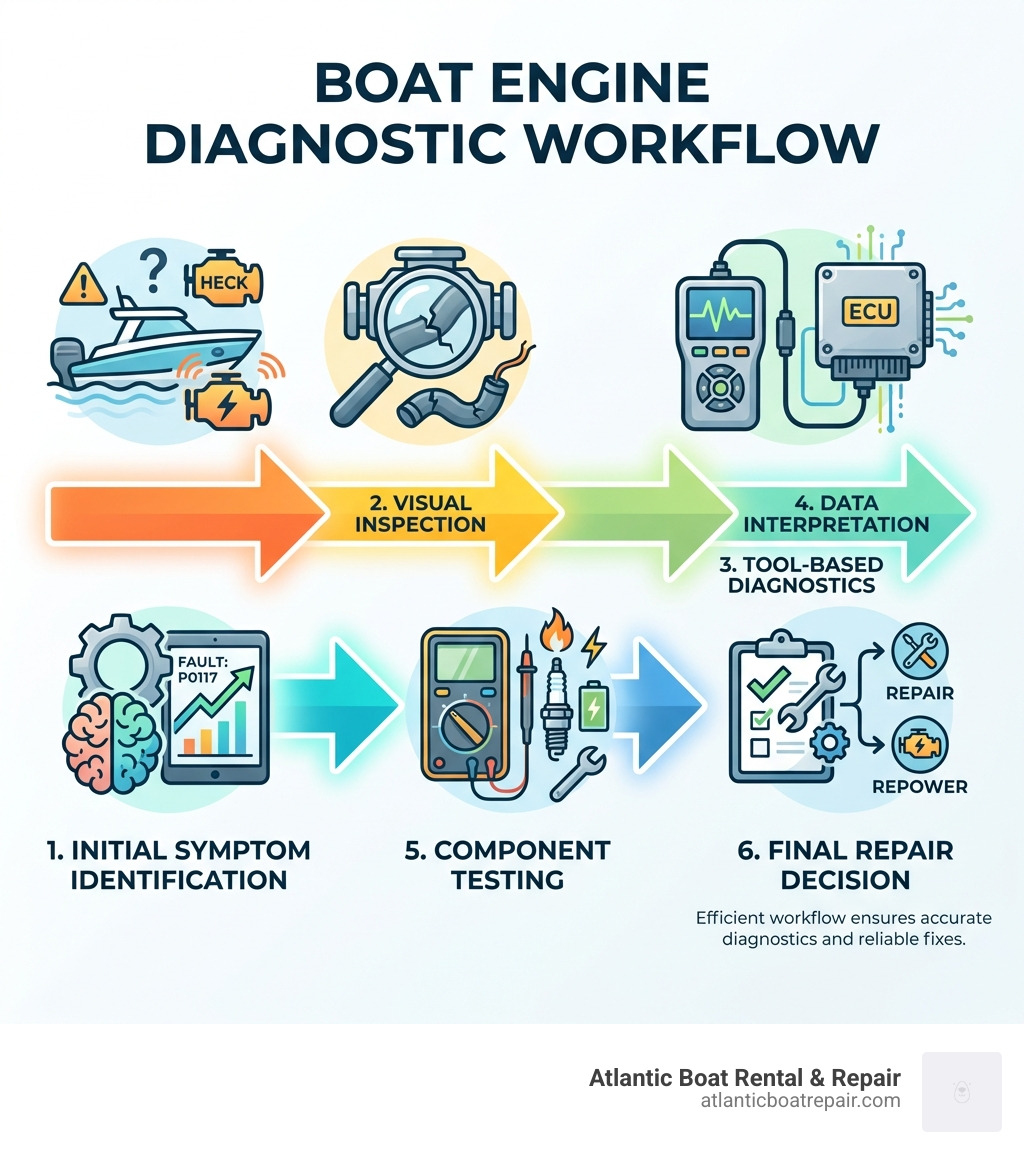
Recognizing Common Symptoms and Their Root Causes
When you’re out on the water in Duxbury or Plymouth, the last thing you want is a sputter that turns into a dead engine. Recognizing the early warning signs of engine trouble is the hallmark of an experienced skipper. Most marine engine problems don't happen in a vacuum; they provide clues through sound, smell, and performance changes.
One of the most frequent issues we see on the South Shore is engine overheating. In our saltwater environment, exhaust manifolds and risers may need replacement after only three years due to internal corrosion. If your temperature gauge starts creeping up, it’s rarely a fluke. It’s usually a restricted flow in the cooling system—often a worn impeller or a blockage in the raw water intake.
Loss of power is another common symptom. If your engine feels sluggish or won't reach its rated RPM (typically 4,200-4,600 for max horsepower in gasoline engines), you’re likely looking at a fuel delivery issue or a ignition problem. In diesel engines, 99% of starting or no-revving issues are caused by the primary fuel filter.

Interpreting Exhaust Smoke and Fluid Changes
Your engine's fluids and exhaust are like a window into its internal health. We always recommend checking the oil condition before every trip. Beyond just the level, look at the color and smell. If the oil smells like gasoline or spreads quickly when you drip it onto a paper napkin, you likely have fuel dilution—a sign of worn rings or a leaking injector.
Exhaust smoke is equally telling. While a little steam on a cold morning in Kingston is normal, persistent smoke indicates a mechanical failure.
| Smoke Color | Likely Cause | Mechanical Indication |
|---|---|---|
| Black | Rich Fuel Mixture | Clogged air filter, failing injectors, or incorrect fuel-to-air ratio. |
| White | Water Intrusion | Blown head gasket, cracked head, or water in the fuel. |
| Blue | Oil Burning | Worn piston rings, valve seals, or internal engine wear. |
For a deeper dive into what these symptoms mean for your specific setup, you can check out this guide on Inspecting Marine Gasoline Engines.
Sensory-Based Boat Engine Diagnostics
Before you reach for a scan tool, use your own senses. We call this "sensory diagnostics," and it’s how the best mechanics start every job.
- Hearing: A gravelly noise often points to failing bearings in an alternator or water pump. A "thunk" when you hit the starter could indicate a hydraulic lock—water sitting on top of a piston.
- Touch: Use an infrared temperature gun to check your risers. If one is significantly hotter than the other, you have a restriction. You can also feel for excessive vibration in the steering or hull, which often indicates a fouled propeller or a misaligned shaft.
- Smell: Never ignore the smell of fuel; it’s a fire risk that needs immediate attention. The smell of burning rubber usually indicates a slipping V-belt or a freezing component like an alternator. A musty bilge smell might just be stagnant water, but it could also indicate a leaking AC condensate line or a failing shower sump.
Essential Tools for Professional and DIY Boat Engine Diagnostics
Modern marine engines are essentially computers that happen to move a boat. To truly understand what's happening, you need to connect to the engine’s Electronic Control Module (ECM). This is where boat engine diagnostics move from guesswork to precision.
For the DIY-inclined boat owner in Massachusetts, there are several levels of tools available. A basic multimeter is essential for testing battery voltage and electrical circuits. A compression tester is another "old school" but vital tool for checking the mechanical health of your cylinders. However, for modern EFI (Electronic Fuel Injection) engines, you really need a digital interface.
Interpreting Data from Boat Engine Diagnostics
When we plug into an engine, we aren't just looking for "Check Engine" lights. We're looking at the engine’s life story. High-end diagnostic software allows us to extract:
- Fault Codes: Both current and historic codes that tell us exactly which sensor or component failed.
- Freeze Frames: A snapshot of all engine parameters (RPM, temperature, oil pressure) at the exact moment a fault occurred.
- RPM History: This shows how the boat was run. Was it babied at trolling speeds, or did it spend 90% of its life at wide-open throttle?
- Engine Hours: Diagnostics provide the true hour count from the ECM, which is often more accurate than the dash gauge.
If you’re considering buying a used boat in the Plymouth area, a diagnostic scan is a non-negotiable part of the survey. It verifies the engine's history and can record performance during a sea trial to ensure the helm gauges are accurate. You can find more info about diagnostic services on our service page.
Software Solutions for Modern Marine Systems
There are several software packages used by professionals and advanced owners. Each has its strengths:
- M.E.D.S. (Marine Engine Diagnostic Software): This is a portable, plug-and-play interface that works on standard Windows laptops. It’s known for its "Live 3D Dashboard" and its ability to auto-detect engine details without manual input. It supports major brands like Honda, Mercury, Yamaha, and Suzuki.
- Diacom Marine: A powerful PC-based tool used by many independent dealers. A standard Rinda Diacom kit costs around $579 and includes the software and connectors for multiple brands. It’s excellent for MerCruiser, Volvo Penta, and Indmar engines.
- Jaltest Marine: This is often considered the most comprehensive multi-brand diagnostic tool. It’s a handheld tablet that covers inboards, outboards, and even personal watercraft (PWC) like Jet Skis. It provides interactive wiring diagrams and troubleshooting guides.
- TEXA: Another high-end professional kit that offers dealer-level access for a wide range of marine engines, including heavy-duty diesel inboards.
Step-by-Step Troubleshooting for Critical Systems
When a system fails, we follow a logical progression. We start with the simplest, most likely causes before moving to complex electronic failures.
Fuel System Checks
If your engine is "hunting" or idling roughly, the fuel system is the first suspect.
- The Filter: 99% of the time, a fuel issue is the filter. Don't just check it—replace it. Keep spares on board; it’s a cheap fix that prevents expensive downtime.
- The Lines: Inspect for leaks or cracks. In older boats, ethanol in the fuel can degrade lines from the inside out.
- The Pump: Verify the fuel lift pump is operating. On many engines, you can manually operate the pump to check for flow.
Cooling System Maintenance
A Beta 35 engine, for example, should output about 16 liters of cooling water per minute at 1500 RPM. If that flow is reduced, you have a problem.
- The Intake: Check the seacock and the raw water strainer for weed or debris. We’ve seen boats in the Cape Cod Canal get fouled with eelgrass in minutes.
- The Impeller: This is a wear item. If you haven't changed it in a season, it’s time. A damaged impeller can send pieces of rubber into your heat exchanger, causing a nightmare of a blockage.
- The Thermostat: If the engine is overheating but the flow looks good, the thermostat might be stuck closed.
For those running diesel setups, this Guide to Troubleshooting Boat Diesel Engine Problems offers excellent step-by-step advice for keeping your yacht or workboat in peak condition.
Diagnosing Fuel and Cooling Failures in Outboard Engines
Outboards face unique challenges, particularly with saltwater corrosion and vapor lock. In the summer heat around Bourne and Sandwich, fuel can actually boil in the lines of some older outboards, leading to a "no-start" condition after a short rest.
We also pay close attention to manifold and riser temperatures. A simple trick is to flick a few drops of water onto the risers after the engine has reached operating temperature. If the water sizzles and evaporates instantly on one side but stays liquid on the other, you have a restriction in the hotter riser that needs immediate attention.
When to Call a Professional for Advanced Diagnostics
While many boat owners in Massachusetts are handy with a wrench, there comes a point where DIY troubleshooting reaches its limit. Modern outboards and inboards have complex electrical systems that require specialized tooling to diagnose without damaging the ECU.
You should consider calling us if:
- The Fault Code Persists: If you’ve replaced a sensor and the code won't clear, there may be a deeper wiring harness issue or a failing ECM.
- Internal Mechanical Noise: If you hear a deep knocking or a heavy vibration that doesn't go away after checking the prop, you may have internal failure like a spun bearing or a cracked piston.
- Warranty Requirements: Many manufacturers, like Suzuki, require authorized dealer diagnostics to maintain your warranty coverage.
- Complex Repowers: If your engine is beyond repair, choosing a "0" time rebuilt engine requires precision alignment and rigging that is best handled in a professional shop.
At Atlantic Boat Repair, we specialize in South Shore boating. We understand the seasonal realities of New England—from the spring rush to get in the water to the winterization needs of boats stored in Plymouth or Duxbury. If you’re noticing a fault code you can’t clear or a performance drop that doesn't make sense, we’re happy to take a look and give you an honest recommendation.
Frequently Asked Questions about Marine Diagnostics
How often should I run a diagnostic scan?
We recommend a full diagnostic scan at least once a year during your annual service. It’s also wise to run one before any long trip or if you notice any change in fuel economy or top-end speed. If you are buying or selling a boat, a diagnostic report is essential documentation.
Can I clear my own fault codes on a Mercury or Yamaha?
While some basic handheld tools and apps like VesselView Mobile allow you to see codes, many won't allow you to clear them, especially "hard" codes related to critical engine functions. For Mercury Optimax or newer Yamaha outboards, professional software like M.E.D.S. or Diacom is usually required to properly reset the ECM after a repair.
Why is my engine losing RPM at wide-open throttle?
This is a classic symptom that requires boat engine diagnostics to solve. It could be as simple as a fouled spark plug or a clogged fuel filter, but it could also indicate a failing high-pressure fuel pump, an air leak in the fuel lines, or even a propeller that has "spun" its hub. A diagnostic scan can check the fuel pressure and injector performance in real-time to find the culprit.
Conclusion
Effective boat engine diagnostics are the difference between a season spent on the water and a season spent on the trailer. By combining your own senses with modern digital tools, you can catch minor issues before they become catastrophic failures. Boat engines work twice as hard as car engines; they deserve twice the attention.
At Atlantic Boat Rental & Repair, we take pride in our "0" time rebuilt engines. Our remanufacturing process involves superior precision—often twice the manufacturer’s original specs—and rigorous testing to ensure your "new" engine performs with total reliability. Whether you're fishing out of Plymouth or cruising the South Shore, we’re here to keep your vessel running at its peak.
If you want to talk through your options for a repower or a complex diagnostic issue, give us a call. We're happy to provide the local expertise you need to get back to smooth sailing.
Comments
Be the first to comment on this article!