
Investing in Reliability: A Guide to Choosing the Best Rebuilt Engine
Why Rebuilt Marine Engines Matter for New England Boaters
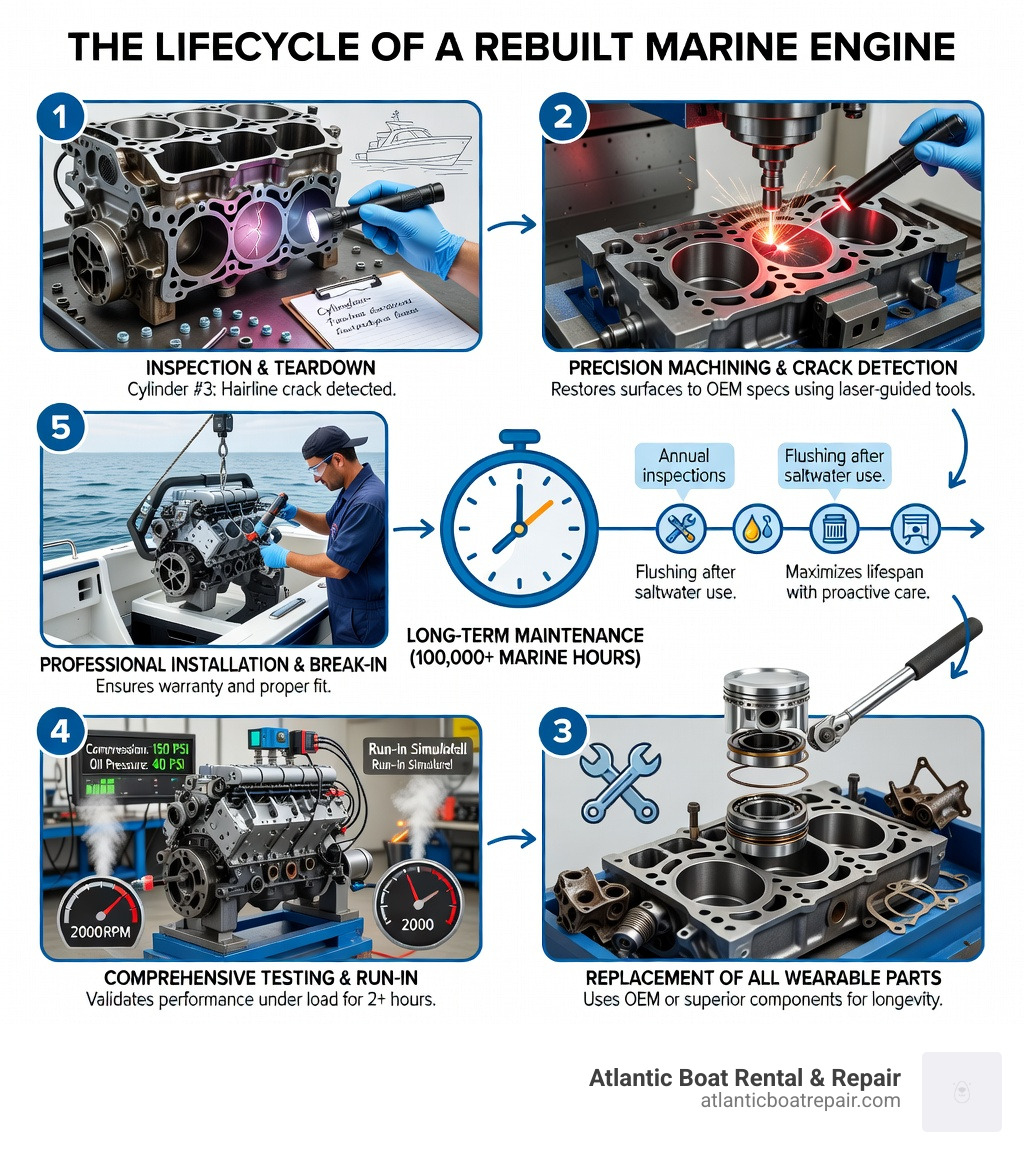
Reliable rebuilt engines offer a proven alternative when your outboard fails—restoring performance at a fraction of the cost of new. Here's what makes one dependable:
- Complete teardown and inspection with crack detection and precision machining
- All wearable parts replaced to OEM or better tolerances
- Comprehensive testing including compression, oil pressure, and run-in procedures
- Professional installation to maintain warranty coverage
- Typical lifespan of 100,000+ miles or equivalent marine hours with proper maintenance
When an outboard quits or starts showing serious issues—low compression, oil pressure problems, persistent overheating—you're facing a choice: buy new, gamble on a used engine, or invest in a proper rebuild. For most boat owners around Plymouth and the South Shore, a reliable rebuilt engine hits the right balance of cost, performance, and longevity.
The problem is that not all rebuilds are equal. Some shops slap in a few gaskets and call it done. Others mix parts from bins with no regard for tolerances or testing. The result is an engine that looks rebuilt but doesn't deliver the reliability you paid for.
A proper marine rebuild restores an engine to factory spec—or better. Every critical wear part gets replaced. Machining brings surfaces back to tight tolerances. Testing validates compression, oil pressure, and leak integrity before the engine ever touches saltwater. Done right, you get performance that matches new at 50–70% of the cost.
Around here, saltwater, moorings, and seasonal storage add their own demands. An engine that wasn't rebuilt correctly won't last through the conditions we deal with. One that was done right can give you years of dependable service.
I'm Ron Cribbie, and over the years at Atlantic Boat Repair, we've seen what works and what doesn't when it comes to rebuilt marine engines—both in our own shop and in the boats that come to us after someone else cut corners. Reliable rebuilt engines aren't just about saving money; they're about getting back on the water with confidence.
When It Makes Sense to Repower an Outboard
Deciding whether to fix your current powerhead or replace the entire engine is one of the toughest calls a boat owner has to make. We see this a lot with boats that spend their time on moorings around the South Shore. The engine might look fine under the cowling, but the internal reality is different.
Common failure points often start with the cooling system. Saltwater is a harsh mistress; if an engine hasn't been flushed religiously, corrosion can eat through internal passages. When you start seeing "milk" in the oil or a sudden drop in compression across two adjacent cylinders, the head gasket or the block itself might be compromised.
Signs your engine is past its prime include:
- Persistent knocking or internal "ticking" sounds.
- Excessive smoke or oil consumption.
- A loss of top-end RPM that tuning can't fix.
- Frequent "nuisance" failures of sensors and electrical components.
For boaters in Plymouth and Kingston, downtime isn't just an inconvenience—it’s a lost season. Our boating window in Massachusetts is short enough as it is. Spending three weeks of July waiting for parts for a 20-year-old motor that’s just going to fail again in August doesn't make sense. Reliability matters in our waters because a breakdown in the Cape Cod Canal or off the Gurnet isn't just a headache; it can be a safety issue.
What Sets a Reliable Rebuilt Engine Apart
The term "rebuilt" gets thrown around loosely in the marine world. To some, it means "fixed what was broken." To us, Reliable rebuilt engines must be "remanufactured." There is a significant difference between a used engine, a basic rebuild, and a professional remanufacture.
A used engine is a gamble. You might find a low-mileage unit from a freshwater lake in the Midwest, but you have no way of knowing its true history or if it was ever overheated. A basic rebuild usually involves a local shop replacing only the parts that failed—leaving 15-year-old bearings or oil pumps in place.
A professional remanufacture involves taking the engine back to a bare block and starting over. This process replaces 95% of wearable parts, whereas a standard rebuild might only replace 60%.
| Feature | Unknown Used Engine | Standard Local Rebuild | Professional Remanufacture |
|---|---|---|---|
| Reliability | High Risk | Moderate | Like-New |
| Wear Parts | Original | Partially Replaced | 100% New |
| Machining | None | Minimal | Precision Blueprinting |
| Warranty | 30-Day Exchange | 6-12 Months | 2-4 Years |
| Cost | Lowest | Moderate | 50-70% of New |
The Value of a Professional Rebuild
A professional rebuild restores OEM-level tolerances. In fact, our approach often involves "blueprinting," which means we bring every component to the exact middle of the factory's allowed tolerance range—or tighter. We aim for superior precision, often twice the manufacturer's specs.
By replacing all wearable parts—pistons, rings, bearings, seals, and the oil pump—we eliminate 90% of the failure points found in high-mileage units. This isn't just about making it run; it's about making it last another 10 years. You can learn more about our specific Services to see how we handle these projects.
The Technical Side: How Reliable Rebuilt Engines Are Made
The process starts with a total teardown. We don't just look at the parts; we scrutinize them. Every cast iron component undergoes Magnaflux testing. This is a non-destructive process that uses magnetic fields and fluorescent powder to find cracks or fissures that the naked eye would miss. If a block or head has a hairline crack, it’s scrap.
Once the core is cleared, we move to machining. We use CNC equipment to ensure mating surfaces are perfectly flat. This is critical for preventing head gasket failures down the road.
Cylinder honing is another area where precision is non-negotiable. We don't just "de-glaze" the bores. We use torque plate honing, which simulates the stress of the head being bolted down. This ensures the cylinders stay perfectly round when the engine is under load, leading to better ring seal and less oil consumption.
Testing and Validation: What Sets a Reliable Rebuild Apart
A rebuilt engine is only as good as the testing it passes. Before any engine leaves our shop, it undergoes a rigorous validation process:
- Compression and Leak-down Checks: We verify that every cylinder is within 2% of each other.
- Oil Pressure Validation: We ensure the pump is providing consistent flow at both idle and simulated high-RPM.
- SIM Testing: We spin the engine at 750 RPM to check for VVT engagement and internal clearances before it’s even fired.
- Run-in Procedures: We follow a specific heat-cycle protocol to ensure rings seat properly.
Mid-Content CTA:
If you’re weighing your options for a reliable rebuilt engine around Plymouth or the South Shore, we’re happy to walk you through what makes sense for your boat.
Cost, Value, and What to Expect Long-Term
When you look at the numbers, Reliable rebuilt engines make a lot of sense for the practical boater. A new 200HP outboard can easily north of $20,000 once you factor in rigging. A properly remanufactured powerhead or long block can cost 35-50% less while offering similar performance and warranty protection.
Core charges are a standard part of this industry. When you buy a rebuilt engine, you're essentially "trading in" your old one. This allows us to keep the cycle going—reusing the heavy iron and aluminum castings while replacing everything else. This makes the process eco-friendly, as remanufacturing reuses about 85% of the original material weight. You can read more about Sustainability in remanufacturing to see the broader impact.
In the long term, a quality rebuild can last over 100,000 additional miles (or the marine equivalent of 2,000+ hours) if maintained. For a recreational boater in Duxbury or Sandwich who puts 50 hours a year on their boat, that’s a lifetime of service.
Warranty and Installation: What Matters Most
A warranty is only as good as the shop behind it. Top-tier suppliers like LKQ offer 4-year unlimited mileage warranties, and we stand behind our work with similar vigor. However, a warranty is often tied to professional installation.
If you try to hang a rebuilt powerhead yourself and forget to prime the oil system or fail to clean the debris out of your old oil cooler, you can kill a fresh engine in minutes. Professional installation ensures that the "peripherals"—the cooling lines, fuel system, and oiling circuits—are as ready as the engine itself. You can check our current Inventory to see what units we have ready for installation.
Getting the Most from Your Rebuilt Engine
The first 20 hours of a rebuilt engine’s life are the most important. Following a strict break-in procedure is mandatory. This usually involves varying your RPMs and avoiding sustained wide-open throttle (WOT) for the first few trips out of Plymouth Harbor.
Maintenance intervals should be tighter on a fresh engine. We recommend an oil and filter change after the first 20 hours to catch any "assembly glitter"—microscopic metal shavings that occur as new rings and bearings settle in.
In New England, the biggest enemy is the off-season. Proper winterization is the difference between an engine that lasts 5 years and one that lasts 20. Saltwater corrosion never sleeps, so zinc anode replacement and freshwater flushing are non-negotiable.
Frequently Asked Questions
How long can you expect a rebuilt engine to last?
With proper maintenance, a remanufactured engine should last just as long as a brand-new one. We typically see 1,500 to 2,500 hours on well-maintained outboards. The keys to longevity are high-quality oil, regular cooling system service, and proper winterization.
Should you use a local shop for your rebuild?
There’s a lot to be said for hands-on accountability. When you work with a shop in the South Shore area, you’re building a relationship. We know the local waters, we know the local mechanics, and we’re here to answer the phone if you have a question. National remanufacturers are great, but they don't know the specific corrosion challenges of a boat moored in Duxbury Bay.
Common Concerns with Rebuilt Engines
The most common "failures" of rebuilt engines are actually failures of the old parts that were bolted back onto them. If you put a fresh powerhead on a boat with a clogged fuel tank or a 10-year-old water pump, the engine will fail, but it wasn't the rebuild's fault. This is why we emphasize replacing the "install kit" items like hoses, pumps, and thermostats.
Conclusion
At Atlantic Boat Rental & Repair, we specialize in "0" time rebuilt outboard engines. Serving the communities of Plymouth, Kingston, Duxbury, Bourne, and Sandwich, we understand that our customers need more than just a running motor—they need a partner in their boating life.
Our commitment to superior precision—machining to twice the manufacturer's specs—and our rigorous testing protocols ensure that every engine we deliver performs like it just came off the factory line. We don't just fix engines; we build Reliable rebuilt engines that you can bet your weekend on.
If you’re ready to see the difference that professional remanufacturing makes, check out our Services or stop by the shop.
Comments
Be the first to comment on this article!