
Don’t Get Stranded: Your Guide to Marine Engine Upkeep
Why Marine Engine Maintenance Can Make or Break Your Season
Marine engine maintenance is the single most important thing you can do to keep your boat running safely and reliably — whether you're running offshore for stripers or just crossing the bay for the weekend.
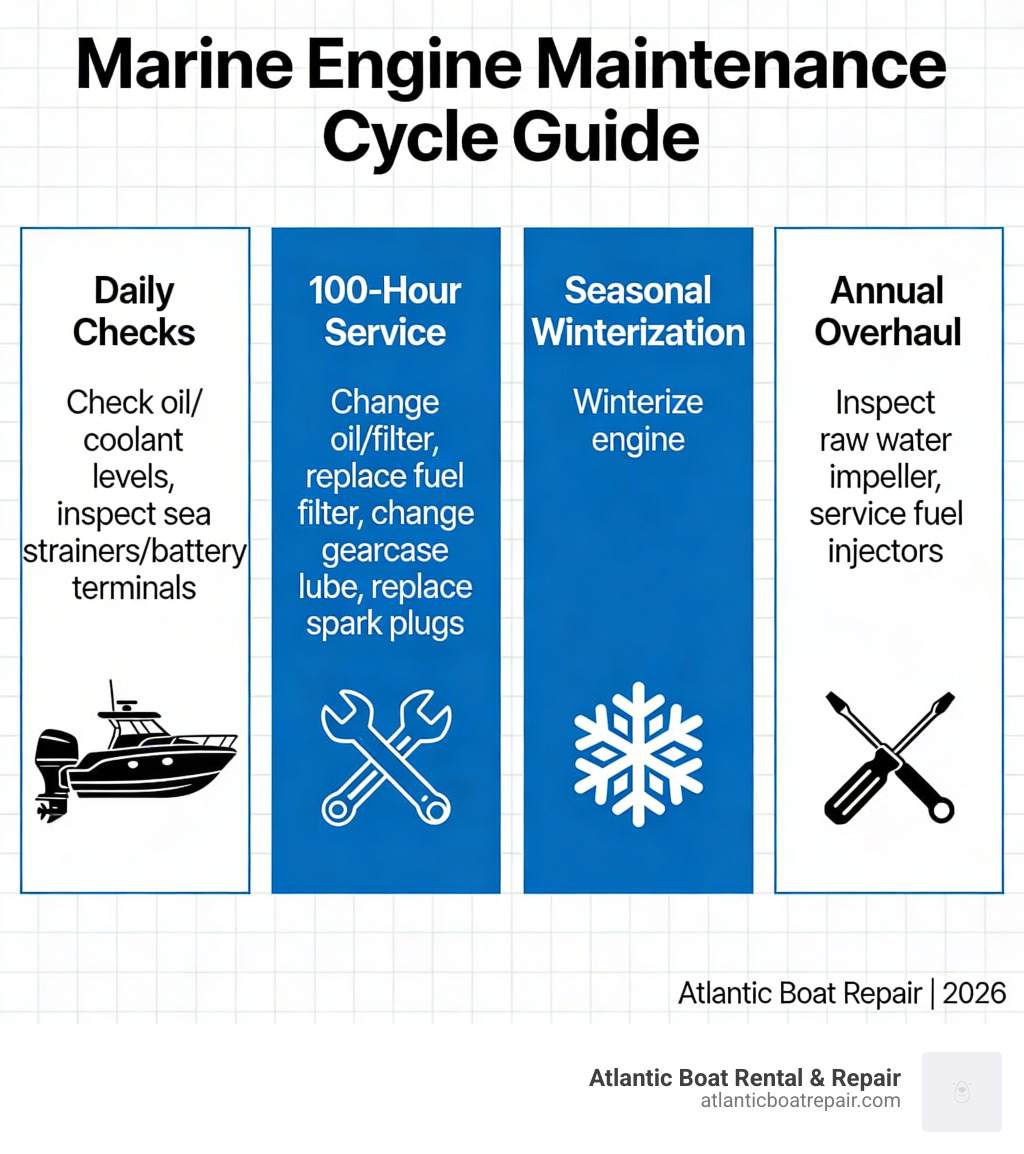
Here's a quick overview of what good marine engine maintenance involves:
| Task | Frequency |
|---|---|
| Check oil and coolant levels | Before every trip |
| Inspect sea strainers and battery terminals | Before every trip |
| Change engine oil and filter | Every 100 hours or annually |
| Replace fuel filter element | Every 100 hours or annually |
| Change gearcase lubricant | Every 100 hours |
| Replace spark plugs | Every 100–300 hours |
| Inspect raw water impeller | Annually or per manufacturer schedule |
| Service fuel injectors (diesel) | Every 250–500 hours |
| Winterize engine | End of season |
Most engine failures aren't random. They're the result of skipped services, stale fuel, ignored warning signs, or the wrong parts used in the wrong places. The good news: the majority of those failures are preventable.
New England boating adds its own layer of demand. Salt air, cold starts, short seasons, and long storage periods all put extra stress on your engine. What works for a boat in Florida doesn't always translate here on the South Shore.
I'm Ron Cribbie, owner of Atlantic Boat Repair, and I've spent decades doing hands-on marine engine maintenance for boat owners across Plymouth, Cape Cod, and the surrounding coastline. In this guide, I'll walk you through everything you need to know — from daily checks to seasonal prep — so you can stay on the water and out of trouble.
Why Regular Marine Engine Maintenance is Non-Negotiable
In our line of work, we see a lot of engines that come in for major repairs that could have been avoided with a simple afternoon of upkeep. Beyond just keeping the motor spinning, regular marine engine maintenance is about safety. When you’re five miles off the coast of Duxbury and the weather turns, you need to know that engine will fire up on the first turn.
Neglecting service leads to more than just a tow bill. It kills your fuel efficiency and shortens the lifespan of the machine. In the harsh salt environments of Massachusetts, corrosion never sleeps. A small salt crust on a hose today is a burst line and an overheated block tomorrow.

Essential Daily and Pre-Trip Inspections
You don't need to be a master mechanic to perform a solid pre-trip check. We recommend a "walk-around" every time you head out. It takes five minutes and saves hours of headaches.
- Check the Oil: Pull the dipstick. The oil should be at the correct level and look clean. If it looks like chocolate milk, you’ve got water intrusion.
- Coolant Levels: For closed-cooling systems, ensure the reservoir is topped up.
- Belt Tension: Give the belts a push. There should be about a half-inch of play. Look for "belt dust" or fraying, which indicates a pulley alignment issue.
- Sea Strainers: This is the number one cause of diesel engine failure. Ensure they are clear of eelgrass and debris.
- Battery Terminals: Give them a wiggle. They should be tight and free of that white or green crusty corrosion.
- Bilge Check: Look for standing water or, worse, oil or fuel sheens.
If you’re looking for more detailed guidance on specific systems, you can explore our services to see how we handle these inspections during a professional tune-up.
Understanding Engine Type Differences
Not all engines are created equal, and their maintenance needs reflect that.
- Gasoline (Inboard & Outboard): These typically require service every 100 hours or annually. They rely heavily on spark plugs and clean fuel.
- Diesel: These are the workhorses. While they don't have spark plugs, they are very sensitive to fuel quality and cooling. They often need oil changes every 100–200 hours. You can read more about maintaining your diesel engine to understand the nuances of compression ignition.
- Hybrid & Electric: These are newer to our local waters. Maintenance focuses on battery management systems, software updates, and cooling for the electrical components rather than oil and filters.
Mastering the Fuel and Cooling Systems
Fuel and cooling issues account for the vast majority of "Engine Won't Start" calls we get in the Plymouth and Bourne areas.
Preventing Contamination in Your Marine Engine Maintenance Routine
Modern fuel is a challenge. Most gas contains up to 10% ethanol (E10). Ethanol is "hygroscopic," meaning it pulls moisture out of the air. In a boat sitting on a mooring in Sandwich, that leads to "phase separation" where water settles at the bottom of your tank.
- 10-Micron Filters: Install a high-quality water-separating fuel filter between the tank and the engine. Carry spares.
- Fresh Fuel: Buy gas from high-volume docks. If fuel sits for more than two weeks, use a stabilizer.
- Tank Management: Keep the tank full to reduce the surface area where condensation can form, especially during the temperature swings we see in the spring and fall.
- Biobor for Diesels: If you run a diesel, use a biocide to prevent "the black slime" (microbial growth) from clogging your injectors.
For a deeper dive into keeping your lines clear, check out these fuel system maintenance best practices.
Cooling System Upkeep and Overheating Prevention
Your engine lives in a constant state of trying to melt itself. The cooling system is all that stands in the way.
- The Impeller: This little rubber star is the heart of your cooling. We see them disintegrate if they’ve sat too long or sucked in a bit of sand. Replace it annually.
- Flushing: If you’re in salt water, flush with fresh water after every trip if possible. It stops salt crystals from narrowing the passages in your heat exchanger.
- Zinc Anodes: These "sacrificial" parts are designed to corrode so your engine doesn't. Check them monthly. If they are 50% gone, replace them.
Seasonal Marine Engine Maintenance and Winterization
In Massachusetts, we don't just park the boat for the winter; we preserve it.
| Feature | Gasoline Maintenance | Diesel Maintenance |
|---|---|---|
| Oil Change | 100 Hours / Annual | 100–200 Hours / Annual |
| Fuel Filters | Annual | 100 Hours / Frequent checks |
| Spark Plugs | 100–300 Hours | N/A |
| Injectors | As needed | 250–500 Hours |
| Impeller | Annual | Annual |
Critical Steps for Winterizing Your Marine Engine Maintenance
Winterization is about two things: preventing freeze damage and stopping corrosion.
- Stabilize Fuel: Add stabilizer and run the engine to ensure it reaches the injectors/carburetor.
- Fog the Engine: Spraying fogging oil into the intake protects the cylinder walls from rust during the damp winter.
- Antifreeze Flush: We drain the raw water side and pump through marine-grade (pink) antifreeze. This prevents the block or heat exchanger from cracking when the temperature hits zero in January.
- Oil Change: Always change the oil before storage. Used oil contains acids and moisture that will pit your bearings if left to sit for six months.
We’ve been doing this for years, and you can learn more about our team and our local experience with New England winters.
Propeller and Lower Unit Care
Don't ignore what's under the water.
- Fishing Line: This is a silent killer. Line gets wrapped behind the prop, melts into the seal, and lets water into your gearcase. Remove the prop a few times a season to check.
- Gear Lube: Change it every 100 hours. If it comes out looking like milk, your seals are shot.
- Grease: Keep the propshaft and all zerk fittings well-greased with high-quality marine grease to prevent everything from seizing up.
Troubleshooting and Professional Care
Sometimes, despite your best marine engine maintenance efforts, things go sideways. Knowing how to read the signs can save you thousands.
Identifying Common Engine Warning Signs
- Smoke Color:
- Black: Too much fuel (clogged air filter or bad injector).
- White: Steam (overheating) or unburned fuel (timing/glow plugs).
- Blue: Burning oil.
- Vibrations: Usually a dinged prop or a misfire.
- Power Loss: Often a clogged fuel filter or "limp mode" triggered by a sensor.
- Milky Oil: A clear sign of water where it shouldn't be. Stop the engine immediately.
When to Call a Professional Marine Specialist
Routine oil changes are great DIY projects, but some things require a specialized touch. At Atlantic Boat Repair, we specialize in "0" time rebuilt outboard engines. When an engine has reached the end of its reliable life, a standard "repair" isn't enough.
Our remanufactured engines are built with precision that is often twice the manufacturer's original specs. We don't just swap parts; we perform rigorous testing to ensure new-like performance. If you're facing a major overhaul or a mysterious loss of compression, it’s time to talk to a specialist.
If you're in the Plymouth area and want an honest assessment, request a service quote.
Frequently Asked Questions about Marine Engine Upkeep
How often should I change my marine engine oil?
For most outboards and gasoline inboards, every 100 hours or once a year — whichever comes first. As an engine gets older, we actually recommend increasing that frequency to every 50–75 hours to help manage the increased blow-by and moisture.
Can I use automotive parts on my boat engine?
Never use automotive electrical parts (alternators, starters, distributors) on a marine engine. Marine versions are "ignition protected." In a confined engine space, a tiny spark from an auto starter can ignite fuel vapors and blow the deck off your boat. It isn't worth the "savings."
Why is my engine losing power at high RPM?
This is usually a fuel delivery issue. Check your fuel-water separator first. If the filter is partially clogged, it might allow enough fuel for idling but starve the engine when you're trying to get on plane.
Conclusion
The secret to a long-lasting engine isn't a magic additive; it's a consistent marine engine maintenance log and a healthy respect for the owner's manual. Keeping a record of every oil change, filter swap, and zinc replacement helps you spot patterns before they become failures.
Whether you're mooring in Kingston or trailering out of Sandwich, taking care of your engine ensures you spend your time catching fish or enjoying the sunset, not waiting for a tow.
If you want to make sure your boat is ready for the season, explore our marine services. We’re happy to take a look and give you an honest recommendation based on what we see working in our local waters every day.
Comments
Be the first to comment on this article!