
Rough Seas Ahead? How to Diagnose and Fix Your Outboard Motor Issues
Introduction: From Frustration to Fix
Outboard motor diagnostics is the process of systematically identifying problems with your engine by checking key systems—fuel delivery, ignition, cooling, and mechanical components—using visual inspections, basic tools, and sometimes electronic scan tools to read fault codes from the engine's computer.
Quick diagnostic steps for common outboard problems:
- Won't start (cranks) - Check fuel supply, pump primer bulb, inspect spark plugs, verify kill switch is engaged
- Won't crank at all - Check kill switch lanyard, battery voltage (should be above 12.6V), clean battery terminals, test starter solenoid
- Overheating - Verify water flow from tell-tale, check for blocked water intake, inspect water pump impeller
- Rough running/stalling - Look for water in fuel, check fuel filter, inspect spark plugs, clean carburetor
- Loss of power - Inspect propeller for damage, check for fuel contamination, test compression (should be 170-220 psi on most four-strokes)
A great day on the water can quickly turn into a frustrating ordeal when your outboard won't start, runs rough, or loses power. The good news is that most outboard motor problems follow predictable patterns. With a basic understanding of your engine and a systematic approach, you can diagnose many issues yourself and avoid expensive repairs.
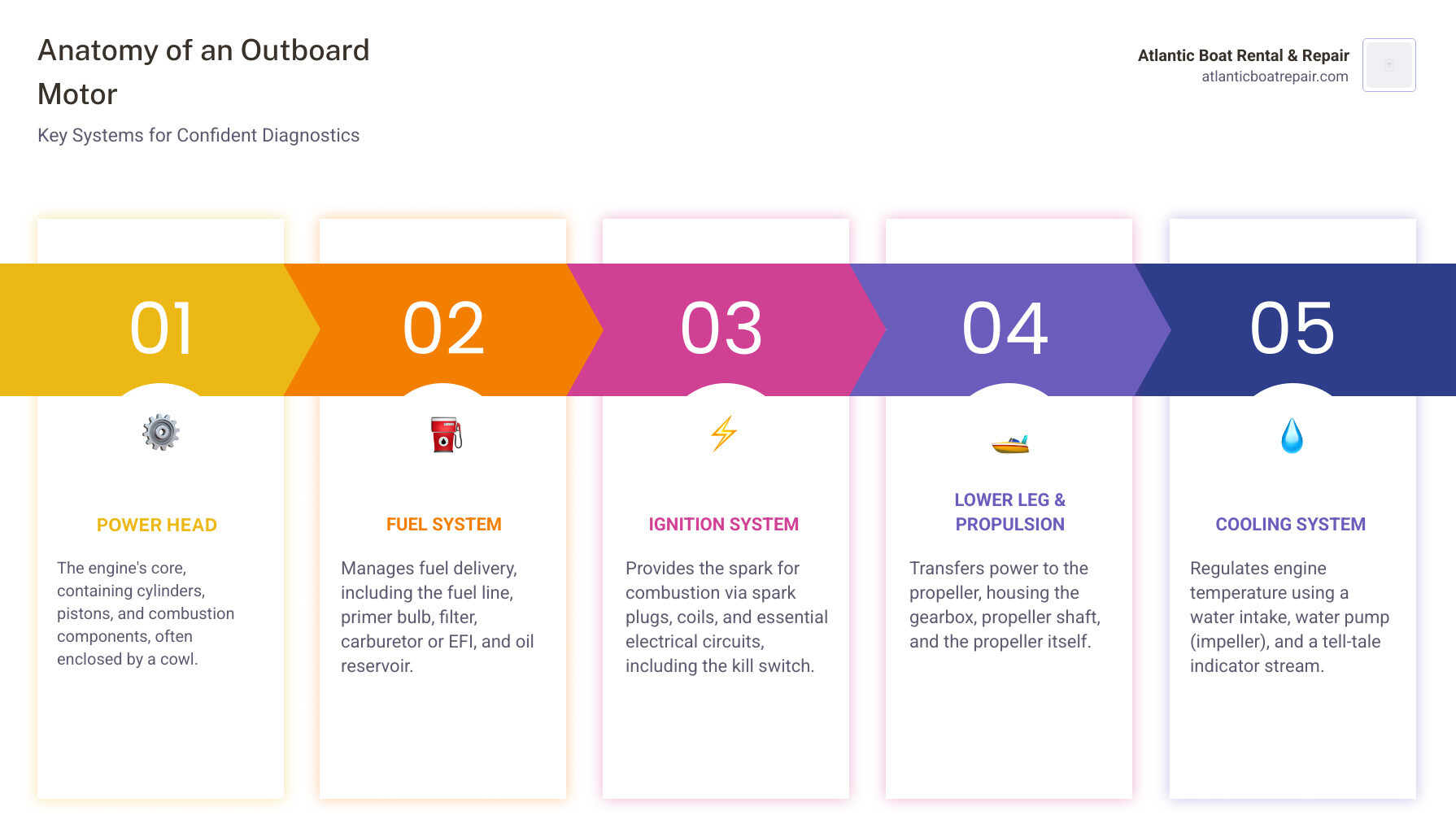
Modern outboards consist of two main parts: the power head (the engine itself) and the lower leg (containing the gearbox, propeller, and water intake). Understanding these components and their common failure points is the first step toward confident diagnostics.
I'm Ron Cribbie, owner of Atlantic Boat Repair, and I've spent decades diagnosing and repairing marine engines across New England. Through proper outboard motor diagnostics and systematic troubleshooting, I've helped countless boat owners get back on the water quickly and avoid costly misdiagnoses.
The Foundation: Understanding Your Outboard Before You Troubleshoot
Before diving into troubleshooting, let's get acquainted with the heart of your vessel: the outboard motor. Knowing its basic anatomy and how it's supposed to operate is crucial for effective outboard motor diagnostics.
An outboard motor is typically divided into two main sections: the power head and the lower leg.
The power head is the engine itself, housed under the cowling. This is where combustion happens. Key components include:
- Engine Block: The core of the motor with cylinders, pistons, and crankshaft.
- Fuel System: Carburetors or fuel injectors, fuel pump, fuel lines, and filters.
- Ignition System: Spark plugs, ignition coils, and wiring.
- Cooling System: Water pump, thermostat, and water passages.
- Exhaust System: Directs exhaust gases away from the engine.
The lower leg (lower unit or gearbox) is the section submerged in water. It translates the engine's power to the propeller. Important components include:
- Gearbox: Transmits power to the propeller shaft.
- Propeller: Pushes water to propel the boat.
- Water Intake Grates: Draw water into the cooling system.
- Water Pump: Circulates cooling water through the power head.
- Shift Linkage: Connects the remote control to the gearbox.
Proper Starting and Shutdown Procedures
Many issues can be avoided with proper operation. Here’s a summary of how to start and shut down your outboard:
Proper Outboard Engine Start Procedure:
- Lower Engine & Connect Fuel: Ensure the outboard is in the water and the fuel line is secure.
- Check Fuel & Prime: Verify the tank has fuel with the vent open. Pump the primer bulb until firm (2-3 squeezes).
- Safety Checks: Attach the kill switch lanyard and ensure the engine is in neutral.
- Throttle & Choke (Cold Start): Set the throttle to "Start" and pull the choke out. For a warm restart, do not use the choke.
- Start Engine: Pull the start cord or turn the key. Once started, slowly push the choke in.
- Final Checks: Immediately check for a steady stream of water from the tell-tale. At the dock, briefly test forward and reverse gears.
Proper Outboard Engine Shut Off Procedure:
- Reduce Throttle: Put the engine in neutral with the throttle down.
- Press Kill Button: Press the kill button until the engine stops.
- Engine Position for Sailing: If sailing, put the engine in REVERSE after shutting it off to prevent it from tilting up.
Essential Tools for Basic Outboard Motor Diagnostics
Having the right tools on board can be the difference between a quick fix and a call for assistance. Here are the essentials for basic outboard motor diagnostics:
- Spark Plug Wrench & Spare Spark Plugs
- Screwdriver Set (Flathead & Phillips)
- Pliers
- Spare Cotter Pins for the propeller
- Spare Fuel Line & Primer Bulb
- Multimeter: To check battery voltage (>12.6V) and electrical issues.
- Compression Tester: To check cylinder health (e.g., Yamaha four-strokes are typically 170-220 psi).
- Fuel Filter Wrench
- Propeller Wrench
- Engine Flusher ("Muffs")
- Corrosion Inhibitor Spray
- Basic Ratchet and Socket Set
- Electrical Tape
For more hands-on maintenance tips, explore our DIY Outboard Motor Service & Maintenance Tips.
Troubleshooting Common Starting Problems
Nothing dampens a day on the water faster than an outboard that won't start. Most starting issues fall into a few categories: fuel, spark, or compression. Let's break down the common scenarios.
Engine Cranks but Won't Start
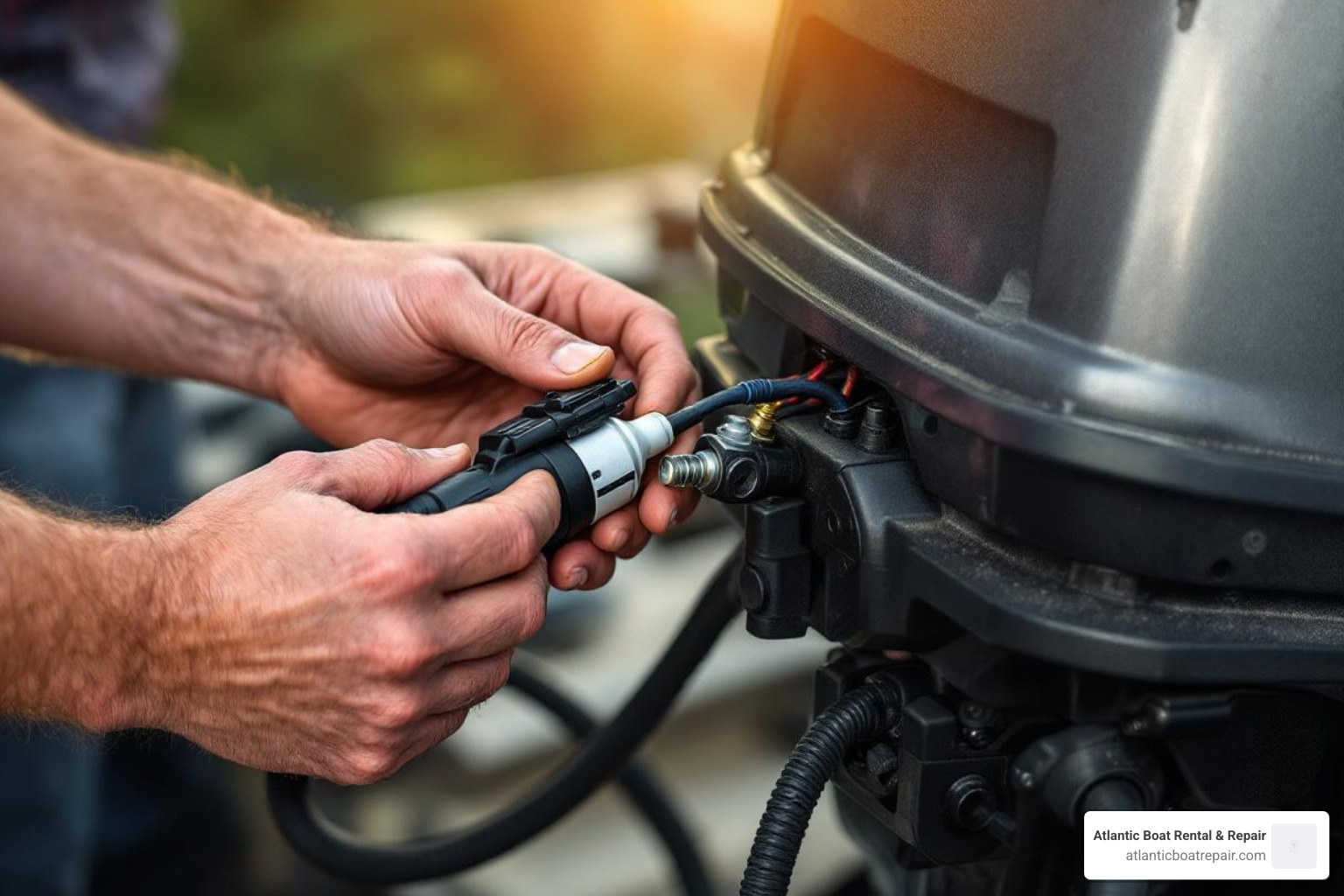
If your engine is turning over but refuses to fire up, it's usually a problem with either fuel delivery or ignition.
Fuel Delivery Issues:
- Empty Tank or Closed Vent: A common oversight! Ensure your tank has fuel and the vent is open.
- Clogged Fuel Filter: Debris or water can clog filters, especially after winter storage. Replace filters annually.
- Bad Fuel: Fuel can degrade in as little as eight weeks. Water in fuel is also a major culprit; check the fuel/water separator.
- Primer Bulb: A soft or collapsing bulb indicates a fuel delivery issue. It should get firm after 3-5 squeezes.
- Fuel Line Connection: Ensure the fuel line is secure and not pinched.
Ignition System Checks:
- Spark Plug Inspection: Pull and inspect the plugs. Fouled, wet, or damaged plugs won't create a strong spark. Check them seasonally.
- Weak Spark Test: Use a spark gap tester. A strong blue spark should jump a 7mm gap. A weak or absent spark points to coils, wiring, or the ECU.
- Battery Voltage: While cranking, battery voltage shouldn't drop below 9.5V. A weak battery may crank the engine but lack power for a strong spark.
2-Stroke vs. 4-Stroke Differences in Cold Start: Carbureted 2-strokes use a manual choke, while many 4-strokes use a cold start enrichment valve. Fuel-injected engines rely on sensors to tell the Engine Control Unit (ECU) how much fuel to inject. On any of these, a fault in the cold-start mechanism (sticking choke, bad gaskets, faulty sensor) can make starting difficult.
Engine Won't Crank at All
If you turn the key and hear nothing or just a click, the problem is likely electrical or a safety interlock.
- Kill Switch Lanyard: The simplest fix! Ensure the lanyard is fully seated.
- Neutral Safety Switch: The engine won't crank unless it's in neutral. A faulty switch can prevent cranking.
- Battery Terminals: Clean loose or corroded terminals until they shine.
- Battery Voltage: A reading below 12.6V (engine off) means your battery is discharged or dead.
- Starter Solenoid: A click with no crank often points to a faulty solenoid.
- Fuses and Circuit Breakers: Check for blown fuses or tripped breakers.
Diagnosing a Flooded Engine
A flooded engine has too much fuel in the combustion chamber. Signs include a strong gas smell and wet spark plugs.
Common Causes:
- Overusing the choke.
- Over-pumping the primer bulb.
- Using the choke on a warm engine.
Procedure to Clear a Flooded Engine:
- Disconnect Fuel Line and push the choke in.
- Open Throttle to the wide-open position.
- Crank Engine several times to clear excess fuel.
- Wait 10 minutes for fuel to evaporate.
- Reconnect Fuel Line and try starting again without the choke.
Diagnosing Performance Issues: When Your Engine Runs Rough
So your engine starts, but it's not running right. This could manifest as overheating, loss of power, unusual noises, or steering problems. These issues require specific outboard motor diagnostics to pinpoint the cause.
Overheating and Cooling System Failures
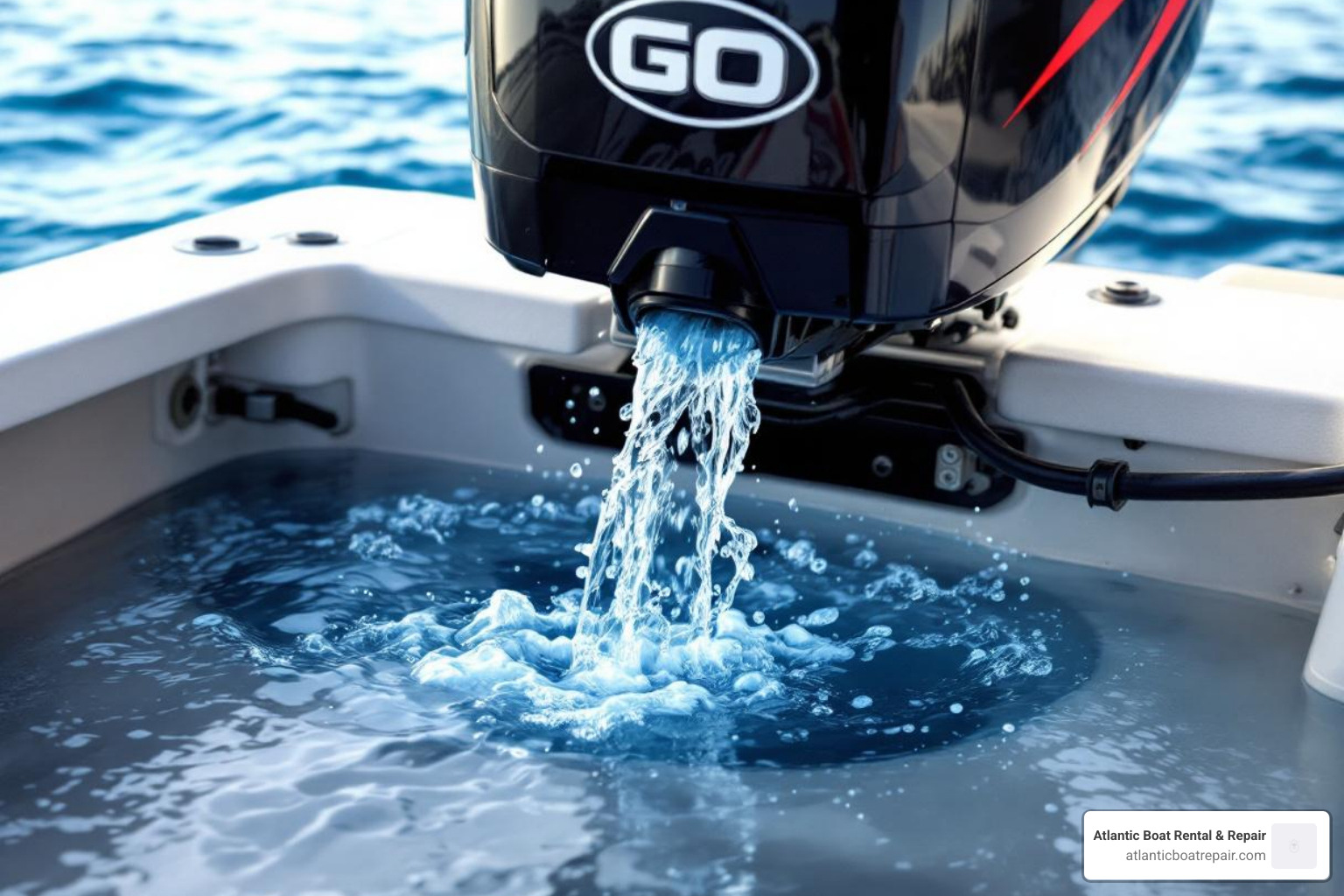
Overheating can quickly cause severe engine damage. Signs include steam, a "hot" smell, an alarm, or no water from the "tell-tale" discharge hole.
Immediate Steps to Take:
- Shut Off Engine Immediately to prevent damage.
- Check Tell-Tale: A weak or absent stream means the cooling system isn't circulating water properly.
- Blocked Water Intakes: Tilt the engine and clear any debris (seaweed, plastic bags) from the intake grates on the lower unit.
- Faulty Water Pump Impeller: The rubber impeller wears out. We recommend replacing it every 300 hours or three years as crucial preventative maintenance.
- Thermostat Issues: A stuck thermostat can block coolant flow and must be replaced if faulty.
If the problem persists, return to shore and seek professional help.
Power Loss, Stalling, or Rough Running
These symptoms often point to fuel, ignition, or propeller issues.
- Fuel Contamination: Water or debris in fuel causes sputtering and stalling. Check your fuel/water separator and use fresh, stabilized fuel.
- Carburetor vs. Fuel Injection Issues: A dirty carburetor is a common culprit on older engines. On fuel-injected models, issues can stem from clogged injectors or faulty sensors.
- Air Leaks: On carbureted engines, leaks around gaskets can lean out the fuel mixture, causing rough idling. Spraying carb cleaner near suspected leaks can help identify them.
- Spark Plugs: Fouled or worn plugs cause misfires, leading to rough running.
- Propeller Damage: A damaged prop reduces performance and causes vibration. Inspect for dings, bent blades, or fishing line wrapped around the shaft.
Tilt and Trim System Problems
The tilt/trim system is essential for shallow water navigation and trailering.
- Engine Stuck Tilted: This can happen if left in gear. To manually lower it, find the small metal pin on the starboard side, lift it, and gently lower the engine.
- Hydraulic Fluid Levels: Low fluid can prevent operation. Check the reservoir and top up as needed.
- Electrical Connections: Check wiring to the tilt/trim motor and switches for corrosion.
- Tilt/Trim Motor: If the motor runs but the engine doesn't move, the pump or seals may be faulty. If it doesn't run at all, check fuses and the motor itself.
For more complex issues, we offer comprehensive More info about our repair services.
The Modern Approach to Outboard Motor Diagnostics
Gone are the days when all outboard motor diagnostics relied solely on wrenches and intuition. Modern engines, especially those with Electronic Fuel Injection (EFI), leverage sophisticated technology to monitor performance and log issues.
Understanding ECU Fault Codes and Sensors
Fuel-injected (EFI) outboards differ significantly from carbureted ones. Instead of a manual choke, EFI engines use an Engine Control Unit (ECU) that gets data from sensors to calculate the ideal fuel-air mixture. This means cold start issues in EFI engines often trace back to a faulty sensor.
- Role of the ECU: The ECU is the engine's "brain," controlling fuel delivery and ignition timing. When it detects a problem, it stores a "fault code" or "trouble code," a concept similar to the On-Board Diagnostics (OBD) systems in modern cars.
- Common Sensors: Key sensors include Coolant Temperature, MAP (Manifold Absolute Pressure), Crankshaft Position, and Oil Level/Pressure.
- Interpreting Fault Codes: These codes are invaluable for diagnostics. A scan tool connects to the ECU and retrieves codes that correspond to specific malfunctions, quickly pointing a technician to the problem.
- Using Diagnostic Scan Tools: Professional tools like Diacom Marine allow for quick and accurate diagnosis of EFI system problems by connecting a laptop to the engine. They support a broad range of engines, including many Mercury Outboards and Volvo Penta models.
We use advanced diagnostic equipment to quickly pinpoint issues with your modern outboard. Learn about our diagnostic capabilities.
What a Diagnostic Scan Reveals
A professional diagnostic scan of your outboard's ECU provides a wealth of information that's impossible to get through visual inspection alone.
- Engine Hours: The actual running time of the engine.
- RPM Run History: A breakdown of how the engine has been operated, revealing if it was consistently over-revved.
- Current & Historic Fault Codes: Active problems and past issues, which can help identify intermittent faults.
- Verifying Engine Health Before Purchase: An engine scan is a non-negotiable step when buying a used boat. It provides critical information about the engine's history, helping you avoid costly surprises.
Proactive Maintenance: The Best Diagnostic Tool
The best way to deal with outboard motor diagnostics is to avoid needing them in the first place! Regular, proactive maintenance is crucial for the longevity and reliability of your outboard.
The 100-Hour Service and Winterization
The "100-hour service" is a comprehensive routine recommended after every 100 hours of use or at least once a year. If you use your boat year-round in our Massachusetts waters, we recommend this service at least twice a year.
Key Maintenance Tasks:
- Change Engine Oil (4-stroke): Replace annually or every 100 hours to prevent corrosion from contaminants in old oil.
- Change Lower Unit Oil: Milky or cloudy oil indicates water intrusion and a failing seal that needs immediate attention. Change annually.
- Water Pump Impeller Replacement: Replace every 300 hours or three years to prevent overheating.
- Propeller Inspection: Check for damage and remove any fishing line wrapped around the shaft. Remove the prop, grease the splines, and use a new cotter pin.
- Fuel System Care: Check fuel lines for cracks and ensure the primer bulb is pliable. Install an inline fuel filter/water trap for extra protection.
- Spark Plugs: Inspect and replace plugs, applying anti-seize grease to the threads.
- Grease Fittings: Lubricate all grease points on the trim and steering mechanisms.
- Corrosion Protection: Inspect and replace sacrificial anodes if over 50% corroded. Spray external parts with a corrosion inhibitor.
For a detailed checklist, refer to this 100-Hour Outboard Service Checklist.
Preparing for Long-Term Storage (Winterization): Winterizing is vital to protect your engine during the off-season.
- Fuel Stabilization: For storage longer than a few weeks, either drain the fuel system completely or fill the tank with fresh, stabilized fuel and run the engine for 10-15 minutes.
- Fogging the Engine: Spray fogging oil into the air intake and spark plug holes to coat internal components, preventing corrosion during storage.
- Cooling System Flush: Flush the system with fresh water. For winterization, we recommend filling the system with marine-grade anti-freeze.
- Battery Care: Remove the battery, clean the terminals, and store it on a trickle charger.
- Protect the Exterior: Wash and wax the engine cowling and use a suitable cover.
Advanced DIY vs. Professional Outboard Motor Diagnostics
While many basic diagnostics can be done by a boat owner, some issues require professional tools and expertise.
- Compression Test: This test measures cylinder pressure and indicates overall engine health. Low or uneven compression can point to worn rings or damaged valves.
- Leak-Down Test: This advanced test pressurizes each cylinder to pinpoint the source of a compression loss.
- Internal Engine Noises: Rattling or knocking often indicates serious internal mechanical issues requiring a professional.
- When to Seek Professional Help: Call a pro for persistent warnings, complex electrical issues, internal mechanical problems, or if you lack the right tools or confidence.
At Atlantic Boat Repair, we specialize in comprehensive outboard motor diagnostics and remanufacturing. Our "0" time rebuilt outboards offer superior precision for new-like performance. Don't hesitate to Get a Quote for any repair or service need.
Conclusion: Ensuring Smooth Sailing with Proper Care
Mastering basic outboard motor diagnostics and committing to a routine maintenance schedule is your ticket to worry-free boating on the beautiful waters of Massachusetts. From the initial spark of a cold start to the smooth hum of a well-maintained engine, understanding your outboard empowers you to prevent problems, address minor issues promptly, and know when to seek expert assistance.
Remember the key takeaways:
- Know Your Engine: Understand the power head and lower leg components.
- Follow Procedures: Proper starting and shutdown can prevent many common faults.
- Fuel, Spark, Air: These are the three pillars of engine function, and the first place to look for starting issues.
- Listen and Observe: Pay attention to tell-tales, unusual noises, and performance changes.
- Maintain Proactively: The 100-hour service and thorough winterization are non-negotiable for longevity.
- Accept Technology: Modern diagnostic tools can quickly uncover hidden problems in EFI engines.
At Atlantic Boat Repair, serving Plymouth, Kingston, Duxbury, Bourne, and Sandwich, Massachusetts, we believe in empowering boat owners. Our decades of experience in outboard motor diagnostics and repair ensure that whether you need a simple fix, a comprehensive service, or a carefully rebuilt engine, you're always in capable hands. We’re here to help you steer rough seas and keep your adventures smooth and enjoyable.
Comments
Be the first to comment on this article!