
Fixing Your Prop Shaft: A Step-by-Step Repair Tutorial
Why Your Prop Shaft Matters: The Heart of Your Boat's Power
Prop shaft repair is a critical marine service that restores your boat's drivetrain to safe, smooth operationoften at a fraction of the cost of replacement.
Quick Answer: Key Prop Shaft Repair Methods
- Straightening - Cold or heat straightening (under 1000°F) using hydraulic presses for bent shafts
- Metalizing - Arc-spray or plasma flame coating to rebuild worn bearing surfaces
- Weld Overlay - Fusion welding with matching filler metals for deeper damage
- Machining - Precision work to restore tolerances and proper fit
- Coupling Work - Fitting, facing, and spotting to ABYC P-06 standards
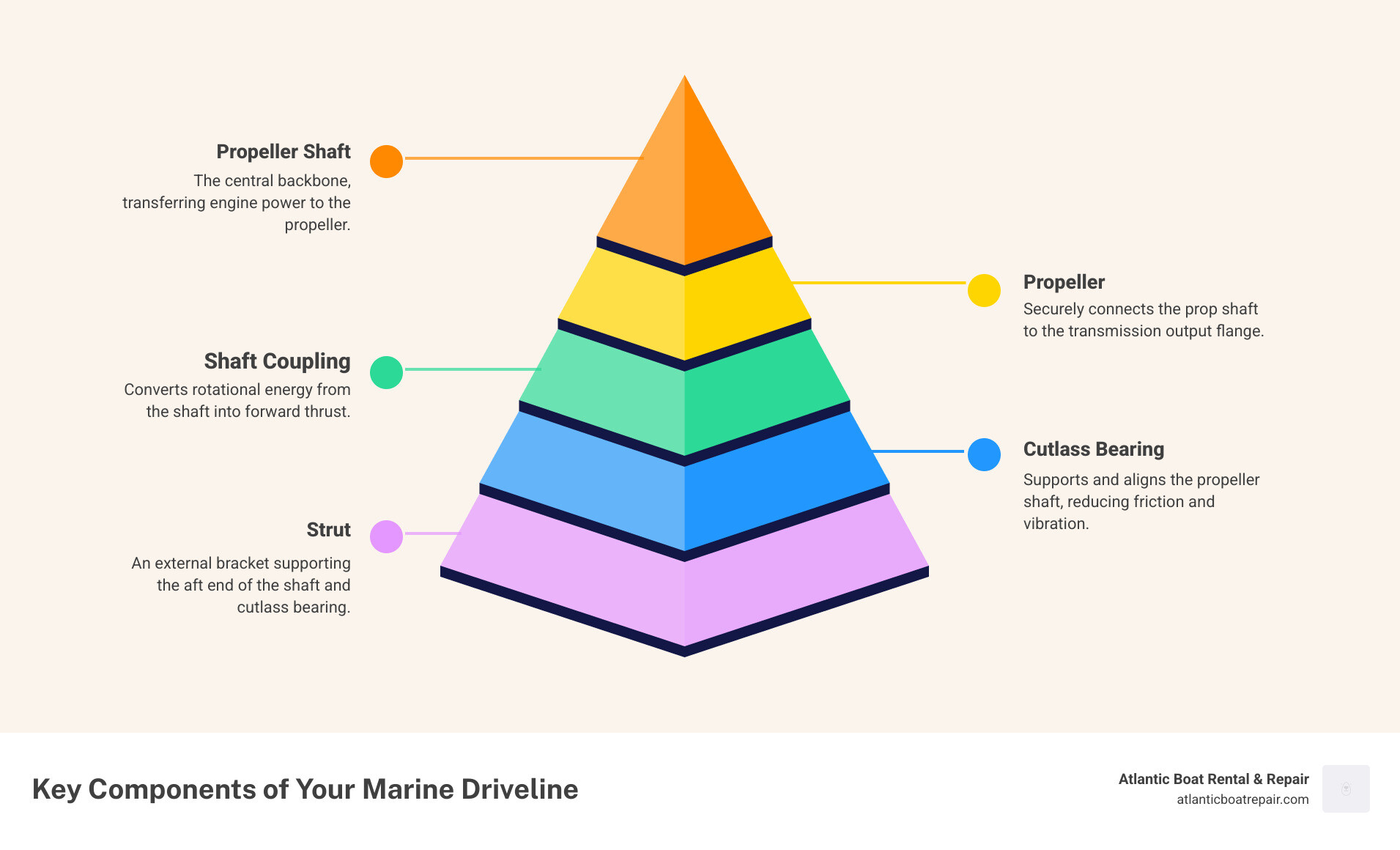
Your propeller shaft is the backbone of your boat's drivetrain, transferring power from the engine to the propeller to create forward motion. When this component fails from corrosion, impact, or wear, it can leave you stranded or cause serious issues like flooding or transmission damage.
The good news is that many prop shaft issues are repairable. Specialized processes can restore worn surfaces, and straightening can correct bends. Professional repair can save you thousands compared to replacement, especially on larger shafts.
However, improper repair is dangerous. A shaft that backs out of its coupling can sink your boat. Poor heat straightening can weaken the metal. A coupling that "slides on by hand" instead of requiring a light press fit is a problem waiting to happen.
This guide walks you through the prop shaft repair processfrom spotting damage to understanding professional methods and knowing when replacement is the only safe option. Whether you're dealing with vibration, a leaking stuffing box, or visible corrosion, you'll see what's typically fixable and what demands expert intervention.
Is Your Prop Shaft Damaged? Telltale Signs and Causes
Unusual vibrations or noises under power can indicate a problem with your propeller shaft. Recognizing these early signs can save you from costly repairs. Keep an eye (and an ear) out for:
- Vibration under power: This is often the most common and noticeable symptom. If your boat starts to shake or vibrate excessively, especially at certain RPMs, it could indicate a bent or unbalanced shaft.
- Unusual noises: Clunking, grinding, or rhythmic thumping sounds coming from the stern or engine area are red flags.
- Wobbly shaft: While your boat is out of the water, a visual inspection might reveal a shaft that appears to wobble or run unevenly when turned by hand.
- Leaking stuffing box: Excessive water leaking from the stuffing box (the seal where the shaft exits the hull) can indicate shaft wear, a bent shaft causing improper seal contact, or even a worn stern tube.
A routine visual inspection is always a good idea when your boat is hauled out. Look closely at the shaft itself for any obvious damage.
Common Causes of Prop Shaft Damage
Propeller shafts endure harsh marine environments and impacts. Understanding the common causes of damage can help you prevent future issues:
- Grounding impact: Accidentally running aground is a leading cause of bent or twisted shafts. Even a minor bump can cause significant damage.
- Striking submerged debris: Hitting logs, rocks, or other underwater hazards can bend the shaft or damage the propeller, which in turn can stress and damage the shaft.
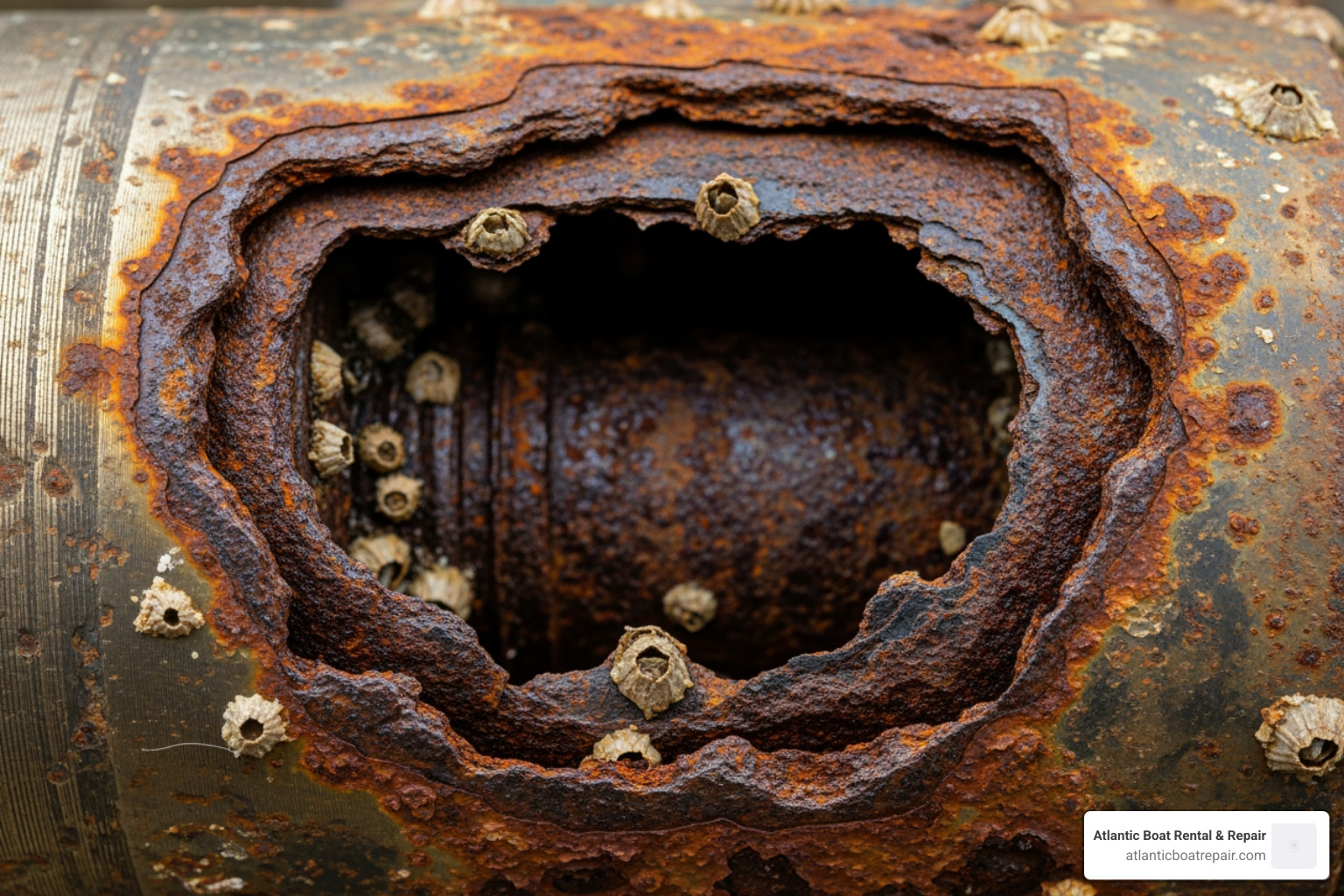
- Crevice corrosion: This insidious type of corrosion occurs in tight spaces where oxygen is limited, such as under a propeller, inside a coupling, or where a cutlass bearing meets the shaft. It can lead to deep pitting and material loss.
- Galvanic corrosion: If your shaft is not properly protected by anodes (zincs) or if there's an electrical imbalance, galvanic corrosion can eat away at the metal.
- Wear at cutlass bearing: The cutlass bearing supports the shaft as it exits the hull. Over time, friction and debris can cause wear on both the bearing and the shaft, leading to excessive play.
- Wear at stuffing box: Similar to the cutlass bearing, the stuffing box (or shaft seal) area can experience wear from friction, leading to leaks and potential shaft degradation.
- Improper installation: A poorly installed or machined shaft from the beginning can lead to chronic issues, including accelerated wear, vibration, and even catastrophic failure. This underscores the importance of precision from day one.
Performing a Basic Inspection
While a professional inspection uses specialized tools, boat owners can perform a basic visual and tactile check to identify potential issues.
- Checking for straightness: With your boat on the hard, slowly turn the shaft by hand. Look for any visible wobble or deviation. Even a slight bend can cause significant vibration.
- Run-out measurement: For a more accurate assessment, a professional will use a dial indicator to measure "run-out," which is the deviation from perfect straightness as the shaft rotates. This is typically done on a lathe or with the shaft installed.
- Identifying pitting: Carefully examine the shaft surface for pits, especially in areas where it meets the propeller, coupling, or stuffing box. Pitting indicates corrosion and can compromise structural integrity.
- Inspecting keyways: Check the keyways (slots for the propeller and coupling keys) for any signs of wear, deformation, or cracking. A worn keyway can lead to a loose propeller or coupling.
- Checking coupling fit: The coupling should have a "light interference fit" with the shaft—meaning it should require some effort or light tapping to install, not slide on easily by hand. A loose fit is dangerous and can lead to shaft separation.
For more detailed information on proper shaft installation and fitting, we recommend checking out this resource: A New Prop Shaft
Repair or Replace? A Critical Decision for Your Boat
Deciding whether to repair or replace a damaged prop shaft means weighing cost, time, extent of damage, and safety. At Atlantic Boat Rental & Repair, we help boaters in Plymouth, Kingston, Duxbury, Bourne, and Sandwich, Massachusetts choose the right option for their situation.
| Factor | Repair | Replace |
|---|---|---|
| Cost | Often significantly lower, especially for larger shafts (saves thousands) | Generally higher, but provides a brand-new component |
| Turnaround | Standard 1-2 weeks; emergency services available | Varies based on availability, custom fabrication can take longer |
| Damage Type | Minor bends, surface wear, pitting in non-critical areas | Severe bending, deep corrosion, cracks, metal fatigue, unknown alloy |
| Structural Integrity | Restored to original specs with professional methods | Guaranteed new integrity |
| Material | Can be restored with matching or superior materials | Allows for upgrade to higher-grade alloys (e.g., Aqualoy 22HS) |
| Safety | Safe and reliable when performed by certified professionals | Safe and reliable with proper installation |
When to Choose Repair
Prop shaft repair is often a highly viable and cost-effective solution when done by a specialist.
- Minor bends: If your shaft has a slight bend but no other structural damage, straightening can usually restore it to proper alignment.
- Surface wear: Areas worn by cutlass bearings or stuffing boxes can be rebuilt using techniques like metalizing or weld overlay to return the shaft to its original diameter and surface finish.
- Pitting in non-critical areas: Localized corrosion pitting that has not compromised structural integrity and is away from highly stressed areas can often be repaired.
- Cost savings on large shafts: For larger vessels, a new prop shaft can be extremely expensive. Repairing worn, pitted, or damaged shafts through specialized metalizing can save thousands over buying new.
- Quick turnaround: Many specialized repair shops, including ours, offer standard turnaround times of 1-2 weeks for prop shaft repair, with emergency 24-hour service available when time on the water really matters.
When Replacement is Non-Negotiable
Sometimes, for safety and long-term reliability, replacement is the only sensible choice.
- Severe bending: If a shaft is badly bent, the stresses on the metal may be too great to safely straighten, or the straightening process itself could create hidden damage.
- Deep corrosion: Extensive or deep corrosion, especially in critical areas like the taper or keyway, can weaken the shaft beyond safe repair.
- Visible cracks: Any visible crack in the shaft material is an immediate replacement scenario.
- Metal fatigue: Long-term service with repeated stress or impacts can create fatigue that is not always visible. A shaft with a long history of problems or major incidents may warrant replacement.
- Unknown shaft alloy: Welding a prop shaft requires knowing its exact alloy to select the correct filler metal and heat treatment. If the shaft's material is unknown and chemistry analysis is not practical, a weld repair becomes risky.
- When safety is paramount: If there is any doubt about the long-term integrity of a repaired shaft, especially on a boat that sees heavy use or challenging conditions, replacement is the safest option.
A Guide to Professional Prop Shaft Repair
When it comes to prop shaft repair, precision is paramount. This is not a job for a general-purpose machine shop. Professional marine repair facilities, like Atlantic Boat Rental & Repair, use specialized equipment and experienced technicians to ensure accuracy and durability that meet demanding marine conditions.
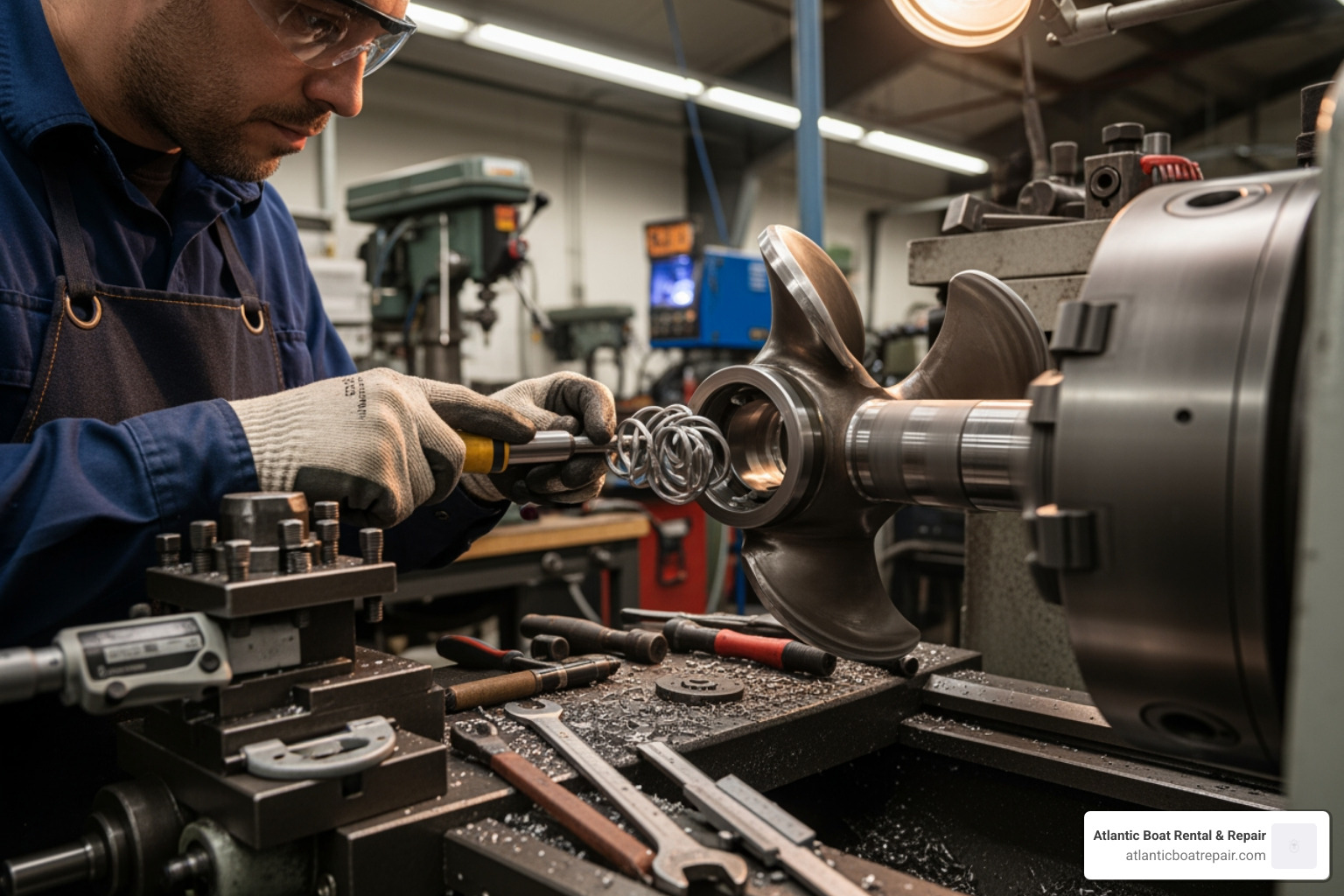
Want to see the straightening process in action? Check out this video: See the straightening process in action
Straightening a Bent Shaft
A bent shaft is common after a hard grounding or impact. Straightening aims to return the shaft to concentric, smooth rotation.
- Cold straightening: Preferred because it does not alter the metallurgical structure of the steel. Controlled pressure is applied to bent areas using hydraulic presses.
- Heat straightening: When cold work is not enough, carefully controlled heat can be applied. Temperature is limited to 1000°F (538°C) to avoid changing the shaft's mechanical properties. Technicians use temperature indicators (such as Tempil sticks) to ensure this limit is not exceeded.
- Hydraulic presses: Large presses are used to apply the required force for straightening without causing additional damage.
- Checking for run-out: Throughout the process, and as a final check, the shaft is inspected for straightness, diameter, and out-of-round tolerances. Dial indicators measure "run-out" how much the shaft deviates from its central axis as it rotates.
- ABYC P-06 standards: Straightening and inspection practices are guided by standards such as ABYC-P6 and ISO 10010 so the finished shaft runs smoothly and safely.
Restoring Worn or Pitted Areas: A Prop Shaft Repair Deep Dive
Worn bearing surfaces or localized pitting do not always mean the shaft is finished. Specialized techniques can rebuild these areas and restore the original dimensions.
- Metalizing: Arc-spray or plasma flame spray applies a new layer of metal to worn areas.
- Arc-spray and plasma flame spray: Plasma flame typically yields denser coatings and operates at relatively low work temperatures (about 200-400°F or 93-204°C) to minimize distortion. Type 304 stainless steel is a common coating. With proper preparation, the mechanical bond produces a durable surface.
- Weld overlay fusion: For deeper damage or specific material needs, weld overlay can be used.
- Matching filler metals and controlled technique create a metallurgically sound bond. Many shaft alloys do not require pre-heating. With the shaft indexed in a lathe, semiautomatic processes help minimize distortion.
- Machining to tolerance: Once new material is applied, the shaft is precision-machined to restore the exact diameter and surface finish so it meets or exceeds original specifications.
Understanding Shaft Materials and Repairability
Propeller shafts are built from high-grade alloys, and the specific material affects how repairs should be carried out.
- Stainless steel alloys: 316 stainless steel is common and offers good corrosion and pitting resistance.
- Aqualoy and Aquamet series: Alloys such as Aqualoy 17, Aquamet 17, Aqualoy 19, Aquamet 19, Aqualoy 22, Aquamet 22, and Aqualoy 22HS are widely used for their strength and corrosion resistance.
- Welding considerations: Some alloys, such as Aqualoy 17, can form untempered martensite in the heat-affected zone, reducing ductility unless properly treated.
- Post-weld heat treatment: For certain alloys (for example, Aqualoy 17), a post-weld heat treatment around 1150°F (621°C) for several hours can help restore mechanical properties in the weld area, and re-straightening may be needed afterward.
- Matching fillers: Using matching filler metals in weld overlay is important. Alternate fillers may not provide the same hardness, strength, or corrosion resistance as the base metal, which can limit repair life.
The Dangers of a Botched Job: Why Professional Repair is Crucial
"Penny wise, pound foolish" applies directly to prop shaft repair. An improperly repaired shaft is not just an annoyance; it can create serious safety and cost consequences.
- Catastrophic failure and shaft separation: A poorly repaired or incorrectly fitted shaft can separate from the coupling or break. This can allow the shaft to back out of the boat, leading to rapid water ingress and potential sinking.
- Sinking risk: A shaft log failure or a shaft backing out can cause substantial flooding, putting your vessel and everyone aboard at risk.
- Gearbox damage: Using the wrong tools, such as a slide hammer, to remove a shaft from a coupling can damage the gearbox and bearings, setting the stage for later gearbox failure.
- Increased vibration: A shaft that is not straight, properly balanced, or correctly aligned will cause vibration, which leads to accelerated wear on bearings, seals, and mounts.
- Further corrosion: Incorrect welding or metalizing, or the use of the wrong filler metal, can accelerate corrosion and create new weak areas.
For a detailed real-world account of a prop shaft log failure and its implications, you can read this story: Read a real-world sinking story
The Critical Final Steps: Fitting and Finishing
A repair is not complete until the shaft is properly integrated back into the drivetrain. The final fitting steps greatly affect reliability.
- Coupling fit: The coupling should have a light interference fit and should not simply slide on by hand. This helps ensure a secure connection.
- Facing the coupling: After installation on the shaft, the face of the coupling is machined true to the shaft's rotational axis. This minimizes vibration and helps alignment with the transmission.
- Keyway cutting: Accurate keyways for both propeller and coupling are essential for proper torque transfer. Filleted or radius keyways can reduce stress concentrations.
- Spotting for set screws: Spotting creates a small recess for the set screw to seat into. This is called out in ABYC P-06 as a safeguard against the coupling backing off.
- Final polishing: A smooth, polished shaft surface reduces friction and helps seals and bearings last longer.
Industry Standards for Quality Prop Shaft Repair
When you choose a shop for prop shaft repair, make sure they follow recognized industry standards and are willing to explain their process.
- ABYC-P6: The American Boat & Yacht Council (ABYC) sets important safety standards for propeller shafting systems.
- ISO 484/2 and ISO 10010: These standards specify accuracy requirements for marine propellers and shaft straightening.
- ASE J755 and ABS Rules for Shipping: These standards provide additional guidance for shafting and related components, especially for commercial and larger vessels.
- Importance of certification: Technicians trained in marine shaft repair understand the specific alloys and loads involved in marine drivetrains.
- Asking the right questions: Ask prospective repair shops if they perform fitting, facing, and spotting, what equipment they use, and whether they follow ABYC standards. A reputable shop will be clear about their methods and quality controls.
Frequently Asked Questions about Prop Shaft Repair
What is the typical cost and turnaround time for a prop shaft repair?
The cost and turnaround time for prop shaft repair depend on several factors:
- Cost factors: Shaft size and material, type and extent of damage (for example, a simple bend versus pitting that requires metalizing), and the machining needed. Repairs are often more economical than replacement on larger shafts.
- Turnaround time: Typical turnaround is about 1-2 weeks. This can vary with workload and complexity.
- Emergency services: Some shops, including Atlantic Boat Rental & Repair, offer expedited service for urgent situations.
For a personalized estimate, we encourage you to: Request a Quote
Can I repair a prop shaft myself?
Prop shaft repair is generally not recommended as a DIY project.
- Risks of DIY: Improper repairs can lead to failures that may cause flooding, gearbox damage, or severe vibration.
- Specialized tools needed: Industrial lathes, precision measuring instruments, and hydraulic presses are typically required, along with proper fixturing.
- Metallurgical knowledge: The response of different shaft alloys to heat, welding, and machining must be understood to avoid weakening the metal.
- Safety implications: Because the prop shaft is a critical safety component, any doubt about its integrity is unacceptable.
For anything beyond minor cosmetic clean-up, professional service is the safer choice.
How do I choose a reliable prop shaft repair shop?
Choosing the right shop is essential for a safe and long-lasting prop shaft repair.
- Certifications (ABYC, ISO): Look for shops that follow standards like ABYC-P6, ISO 484/2, ASE J755, and ABS Rules for Shipping.
- Experience with marine shafts: Marine shafts operate in a unique environment and see different loads than automotive or industrial shafts.
- Proper equipment: A capable facility will have large lathes, straightening presses, and metalizing or weld overlay equipment, plus precise measuring tools.
- Customer reviews: Online reviews and feedback from local boaters in areas like Plymouth, Kingston, Duxbury, Bourne, and Sandwich, Massachusetts can be helpful.
- Asking about their process (fitting, facing, spotting): Ask how they handle coupling fit, facing, and set-screw spotting. Clear, detailed answers are a good sign that your shaft will be handled correctly.
Conclusion: Ensuring a Safe and Seaworthy Drivetrain
Your boat's prop shaft is a small component with a big job: transferring power reliably so you can get on and off the water safely. When it is damaged, dealing with it promptly and professionally is essential.
As you've seen, prop shaft repair can often restore a shaft to proper service and save significant time and money compared with full replacement, especially on larger or more specialized shafts.
Atlantic Boat Rental & Repair brings specialized equipment and a strong focus on precision and testing to every prop shaft repair we perform for boaters in the Plymouth, Kingston, Duxbury, Bourne, and Sandwich, Massachusetts area.
Don't let a damaged prop shaft keep you at the dock. Our team can help you return your drivetrain to smooth, dependable operation.
Comments
Be the first to comment on this article!