
The Shocking Truth About Spark Plug Replacement: Costs, Tips, and Tricks
Why Spark Plug Replacement Matters for Your Engine
Spark plug replacement is one of the most straightforward maintenance tasks you can do to keep your engine running smoothly—whether it's in your car, truck, or outboard motor. Here's what you need to know:
Quick Answer: How to Replace Spark Plugs
- When to replace: Every 30,000-60,000 miles (or per manufacturer specs)
- Time required: 30 minutes to 3 hours depending on engine access
- Cost savings: DIY can save $100+ in labor costs
- Essential tools: Spark plug socket, torque wrench, gap gauge
- Key benefit: Improves fuel economy by up to 4%
Spark plugs are small electrical devices that ignite the air-fuel mixture in your engine's cylinders. Without them, your engine simply won't start. Over time, these plugs wear down—the electrodes erode with each spark, the gap widens, and performance suffers. You'll notice misfires, rough idling, poor acceleration, and decreased fuel economy.
The good news? For most engines, replacing spark plugs is a manageable DIY project that doesn't require advanced mechanical skills. You just need the right tools, a little patience, and proper technique.
Modern spark plugs—made from ceramic with iridium or platinum electrodes—can last 60,000 miles or more. But manufacturer recommendations can be overly optimistic. If you're experiencing performance issues or haven't checked your plugs in years, it's worth pulling them to inspect their condition.
I'm Ron Cribbie, owner of Atlantic Boat Repair, and I've spent decades maintaining and repairing marine engines where proper spark plug replacement is critical for reliable performance on the water. In this guide, I'll walk you through everything you need to know to do the job right—or help you decide when it's time to call a professional.
Understanding Spark Plugs and Their Importance
Spark plugs are the unsung heroes of your engine's ignition system. These small but mighty components are responsible for igniting the compressed air-fuel mixture within each cylinder. When that mixture explodes, it drives the piston, which in turn rotates the crankshaft, generating the power that moves your vehicle or propels your boat across the waters of Plymouth, Kingston, or Duxbury.
Beyond just starting the combustion process, spark plugs also play a crucial role in managing engine temperature by pulling heat away from the combustion chamber. Think of them as tiny, high-performance igniters that also act as heat sinks.
There are several types of spark plugs, primarily differentiated by their electrode material, which impacts their lifespan and performance:
- Copper Plugs: These are the most common and economical. Copper is an excellent conductor of electricity, but it's also a softer metal, so these plugs wear out faster. They typically need spark plug replacement every 30,000 miles.
- Platinum Plugs: Featuring a platinum disc welded to the center electrode, these plugs are more durable than copper. Platinum resists corrosion and wear better, extending their lifespan to around 60,000 miles or more.
- Iridium Plugs: The crème de la crème of spark plugs, iridium is incredibly hard and offers superior durability. Iridium plugs often have a very fine wire center electrode, which allows for a more efficient spark. These can last for 100,000 miles or even longer.
While modern spark plugs, especially iridium and platinum, boast impressive longevity of 60,000 miles plus, it's still wise to inspect them periodically.
Signs Your Spark Plugs Are Failing
Your engine has a way of telling you when its spark plugs are getting tired. Ignoring these signals can lead to bigger problems down the road, so it's important to pay attention. Here are the most common signs that your spark plugs might need attention:
- Engine Misfires: This is perhaps the most obvious sign. If your engine feels like it's stumbling or momentarily losing power, especially during acceleration, it's likely a misfire. Worn spark plugs struggle to create a consistent spark, leading to incomplete combustion.
- Rough Idle: If your engine sounds and feels shaky or uneven when idling, old spark plugs could be the culprit. A healthy engine should purr smoothly.
- Poor Acceleration: Does your vehicle feel sluggish when you press the gas pedal? Are you struggling to get up to speed on Route 3 or when accelerating out of a Bourne harbor? Worn spark plugs can significantly reduce your engine's power output.
- Reduced Fuel Economy: As spark plugs degrade, they become less efficient at igniting the fuel. This means your engine has to work harder and consume more fuel to achieve the same power, leading to more frequent trips to the gas pump.
- Check Engine Light: While this light can indicate a myriad of issues, a persistent misfire caused by bad spark plugs will often trigger it. If it's flashing, that usually signals a severe misfire that could be damaging your catalytic converter, so address it immediately!
- Difficulty Starting: If your engine cranks but struggles to turn over, especially on cold mornings, weak spark plugs might not be providing enough spark to get the combustion process going efficiently.
- Visible Wear: Upon inspection, old spark plugs might show signs of worn electrodes (the metal tips look rounded or eroded) or excessive carbon buildup, which can interfere with the spark.
How Often Should You Replace Spark Plugs?
The question of "how often" is a classic in engine maintenance, and the answer often comes with a bit of nuance. The golden rule is always to consult your vehicle or engine's owner's manual for manufacturer recommendations. These intervals can vary widely, from 30,000 miles for copper plugs to 100,000 miles for some iridium types.
However, we've found that manufacturer recommendations can sometimes be a bit optimistic. While some spark plugs are indeed rated for 100,000 miles, many automotive experts, including us, suggest that spark plug replacement or at least inspection every 30,000 miles (or 48,280 kilometers) is a good rule of thumb. This is especially true if you do a lot of stop-and-go driving or operate your marine engine in demanding conditions around Sandwich or the Cape Cod Canal.
If you can't recall the last time your spark plugs were changed, or if your manual's recommendation seems unusually long, it's worth removing them and checking their condition. A visual inspection can tell you a lot:
- Healthy plugs typically have light brown electrodes and insulators, showing no signs of melting, excessive wear, or heavy deposits.
- Oil deposits might indicate worn piston rings.
- White deposits could signal that the plug's heat grade isn't right for your engine.
- Carbon deposits often point to a rich fuel mixture or a weak ignition system.
Regular inspection, perhaps every 30,000 miles, allows us to catch issues early and ensure your engine maintains optimal performance. For more detailed guidance on diagnosing spark plug condition, you can refer to resources like this: Spark Plug Replacement: Haynes Shows You How .
Your DIY Guide to Spark Plug Replacement
Replacing spark plugs yourself can save you at least a hundred bucks in labor costs, and it's a deeply satisfying project. For many engines, the process can take up to an hour, but some more complex layouts might take longer. Here's how we approach it.

Gathering the Right Tools and Parts
Before we dive in, let's ensure we have everything needed for a smooth operation. Having the right tools makes all the difference and prevents frustration (and potentially damage!).
Here's our essential toolkit for spark plug replacement:
- Spark Plug Socket: This isn't just any socket; it has a rubber insert to protect the ceramic body of the spark plug and hold it securely during removal and installation. You'll typically need 5/8 inch or 13/16 inch sizes.
- Torque Wrench: Absolutely critical! Under-tightening can lead to a bad connection, while over-tightening can damage the spark plug or, worse, the cylinder head threads. We use a torque wrench to ensure every plug is tightened to the manufacturer's exact specifications.
- Ratchet and Extensions: A good ratchet, along with various extensions (3-inch, 6-inch, 10-inch), will help you reach plugs in tight spots. A wobble socket or universal joint can also be a lifesaver for awkwardly placed plugs.
- Spark Plug Gap Gauge: Even if new plugs are "pre-gapped," we always double-check. Shipping can sometimes alter the gap, and precise gapping is crucial for optimal performance.
- Compressed Air or Shop Vacuum: To clean around the spark plug wells before removal. We don't want any dirt or debris falling into the engine cylinders!
- Anti-Seize Lubricant: Applied to the spark plug threads (unless specified otherwise by the manufacturer), this prevents the plugs from seizing in the cylinder head, making future removals much easier. If you use anti-seize, remember to reduce the specified torque by about 10%.
- Dielectric Grease: A small dab inside the spark plug boot prevents moisture intrusion and helps ease future removal of the boots.
- Correct Replacement Plugs: Consult your owner's manual or a reliable parts catalog to ensure you get the exact spark plugs specified for your engine. Using the wrong type can lead to poor performance and even engine damage.
The Step-by-Step Installation Process for a spark plug replacement
With our tools and parts ready, let's get down to business. We always approach this task systematically to ensure safety and accuracy.
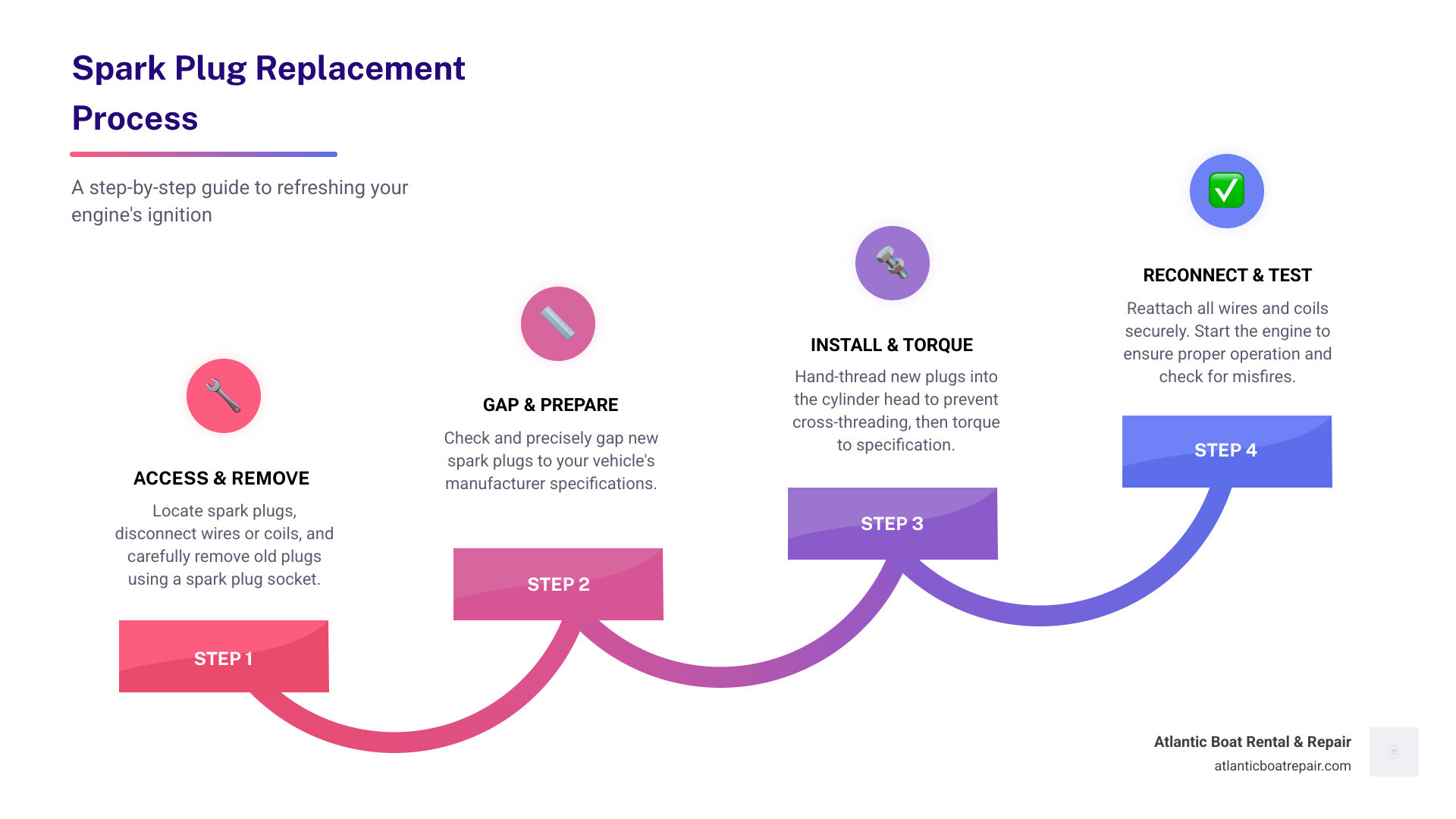
- Safety First! Cool It Down & Disconnect: We start by ensuring the engine is completely cool. Working on a hot engine is not only dangerous but can also damage components. For extra safety, especially if working on electrical components, we disconnect the negative terminal of the car battery.
- Clean Around the Plug Wells: Before removing anything, we use compressed air or a shop vacuum to thoroughly clean around each spark plug well. This prevents any dirt, dust, or debris from falling into the open cylinder once the old plug is removed. We don't want any unwanted surprises in there!
- Remove Coils/Wires One by One: This is a crucial step to avoid confusing the firing order. We remove and replace one spark plug at a time.
- For spark plug wires: Gently pull on the boot (never the wire itself!) to disconnect it. If it's stubborn, spark plug boot puller pliers can help prevent damage.
- For Coil-On-Plug (COP) systems: We disconnect the electrical connector, then unbolt and remove the coil unit. Some might have a hold-down bolt, typically 10mm.
- Remove the Old Spark Plugs: Using our ratchet, extension, and spark plug socket, we carefully unscrew the old spark plugs counter-clockwise. If a plug is particularly stubborn, we apply a penetrating oil and let it soak for a bit before trying again. For very tight plugs, we might turn it slightly clockwise, then counter-clockwise, working it back and forth gently.
- Gapping New Plugs (If Necessary): While many modern spark plugs come pre-gapped, we always double-check with our spark plug gap gauge. Consult your owner's manual for the precise gap specification (it's often between 0.02 and 0.06 inches). If the gap is too small, we gently pry open the ground electrode; if it's too large, we carefully tap the side electrode on a solid surface until the correct gap is achieved. Precision here ensures an optimal spark.
- Hand-Thread the New Spark Plugs: This is perhaps the most critical step to prevent cross-threading. We insert the new spark plug into the socket and carefully hand-thread it into the cylinder head. We turn it clockwise until it's finger-tight. If you feel any resistance, stop immediately, unscrew it, and try again. It should thread smoothly. For hard-to-reach plugs, a short length of rubber tubing slipped over the plug's ceramic top can act as a flexible extension to guide it in.
- Torque to Specifications: Once hand-tight, we use our trusty torque wrench to tighten the spark plug to the manufacturer's specified torque. This ensures a secure connection without over-tightening. If you used anti-seize, reduce the torque value by about 10%.
- Reattach Wires/Coils: Finally, we reattach the spark plug wire or coil-on-plug unit. For wires, we ensure the boot clicks firmly into place. For COP units, we rebolt them and reconnect the electrical connector. We double-check all connections are secure.
- Reconnect Battery & Test: If we disconnected the battery, we reconnect the negative terminal. Then, we start the engine and listen for a smooth idle. If anything sounds off or the Check Engine light flashes, we re-check our work.
Common Mistakes and When to Call a Professional
While spark plug replacement is a rewarding DIY task, it's not without its potential pitfalls. We've seen (and sometimes fixed) many mistakes that can turn a simple job into a costly headache. Understanding these risks helps us decide when to confidently tackle the job ourselves and when to seek professional help.
DIY Pitfalls to Avoid During Your Spark Plug Replacement
- Cross-Threading: This happens when a spark plug isn't perfectly aligned with the threads in the cylinder head and is forced in crooked. The result? Damaged threads, compression leaks, and a very expensive repair bill. Always hand-thread new plugs to avoid this.
- Over-Tightening: Too much muscle can strip the threads in the cylinder head, crack the spark plug's ceramic insulator, or make future removal nearly impossible. This is why a torque wrench is non-negotiable.
- Under-Tightening: Not tightening enough can lead to a poor electrical connection, allowing combustion gases to leak past the plug and potentially overheating it. This can cause misfires and damage the plug or cylinder head.
- Using Incorrect Plugs: Spark plugs aren't one-size-fits-all. Using the wrong heat range, thread size, or gap can lead to misfires, reduced fuel efficiency, and even engine damage. Always stick to the manufacturer's specifications.
- Debris in Cylinder: If dirt, dust, or other debris falls into the open spark plug hole, it can cause serious internal engine damage, reduce compression, and even harm your catalytic converter. Always clean the area thoroughly first.
- Damaging Wires or Boots: Pulling on spark plug wires instead of the boot can damage the internal conductor, leading to misfires. Similarly, careless handling of coil-on-plug boots can cause cracks or tears, leading to voltage leaks and poor performance.
- Incorrect Gapping: An improperly gapped spark plug can cause misfires, poor fuel economy, and reduced engine performance. Even "pre-gapped" plugs should be checked.
Knowing Your Limits: When to See a Pro
While we encourage DIY, we also know when to call in the experts. Sometimes, the cost of professional installation is far less than repairing damage caused by an improper DIY job.
Here are situations where we recommend you bring your vehicle or marine engine to us at Atlantic Boat Repair:
- Seized or Stuck Spark Plugs: If a spark plug won't budge after applying penetrating oil and gentle persuasion, stop! Forcing it can break the plug in the cylinder head or strip the threads, turning a simple spark plug replacement into a major engine repair.
- Complex Engine Access: Some modern engines, especially certain V-6 configurations, require removing the intake manifold or other components just to access the spark plugs. If the job involves more than simply unbolting and unscrewing, it might be best left to us.
- Lack of Proper Tools: If you don't have the essential tools like a torque wrench or specialized sockets, don't improvise. The right tools ensure the job is done correctly and safely.
- Stripped Threads: If you accidentally cross-threaded or stripped a plug, don't try to fix it yourself. This requires specialized tools and expertise to repair, and we can handle it.
- If You're Not Confident: There's no shame in admitting a job is beyond your comfort level. We're here to help! For professional, reliable service on your car or boat in the Plymouth, Kingston, Duxbury, Bourne, or Sandwich area, we're just a call away.
- Marine Engines: This is where our expertise truly shines. Marine engines operate in a harsh environment, and precise spark plug replacement is critical for reliable performance on the water. Our team at Atlantic Boat Repair specializes in marine engine repair and remanufactured outboard engines, ensuring superior precision (twice manufacturer specs!) and rigorous testing for new-like performance.
Don't hesitate to reach out for a professional opinion or service. We can provide you with an accurate estimate for your spark plug replacement needs. Get a quote today: Get a Quote.
The Payoff: Benefits of Timely Replacement
So, why go through all this effort for a simple spark plug? The benefits of timely spark plug replacement are significant and directly impact your wallet, your driving experience, and even the environment.
- Improved Engine Performance: A fresh set of spark plugs ensures a strong, consistent spark, leading to more complete combustion. This translates to better acceleration, smoother power delivery, and a more responsive engine. You'll feel the difference, whether you're merging onto Route 3 or opening up the throttle on your boat in Cape Cod Bay.
- Better Fuel Economy: Old, worn spark plugs are inefficient. By replacing them, you can improve your gas mileage by about four percent. Over the course of a year, especially with today's fuel prices, those savings can really add up!
- Smoother Idle: Say goodbye to rough, shaky idling. New spark plugs help your engine maintain a steady, quiet rhythm when it's not under load.
- Easier Starting: A strong spark is essential for quick, reliable engine starts. You'll appreciate this on a cold morning or when you're eager to get your boat out on the water.
- Reduced Harmful Emissions: Worn spark plugs cause misfires, which means unburnt fuel is expelled into the exhaust system. This increases harmful emissions, contributing to air pollution in our beautiful Massachusetts communities. New plugs ensure more complete combustion, leading to a cleaner exhaust.
- Preventing Catalytic Converter Damage: As mentioned, persistent misfires dump raw fuel into your exhaust, forcing your catalytic converter to work overtime. This can lead to premature failure of this expensive component. Timely spark plug replacement protects your catalytic converter and saves you a hefty repair bill.
- Overall Cost Savings: Beyond just fuel economy, preventing damage to other engine components like coils and catalytic converters saves you significant money in the long run. Replacing spark plugs is a relatively inexpensive preventative measure that avoids much larger repair costs.

Conclusion
We've covered a lot about spark plug replacement, from understanding their vital role in your engine to the step-by-step process of changing them and the common pitfalls to avoid. The truth is, maintaining your spark plugs is a simple yet powerful way to ensure your engine runs efficiently, saves you money on fuel, and reduces harmful emissions.
For many, a DIY spark plug replacement is a feasible and rewarding task. With the right tools, careful attention to detail, and a little patience, you can confidently tackle this maintenance item. However, knowing your limits and recognizing when a job requires professional expertise is equally important.
For specialized engines, especially marine outboards that demand peak performance and reliability on the water, precision is key. Trusting an expert like us at Atlantic Boat Rental & Repair ensures that your engine receives the meticulous care it deserves. We pride ourselves on superior precision and rigorous testing, ensuring your engine performs like new.
Whether you're cruising the coastline or navigating the local waterways, a well-maintained engine is a happy engine. If you're in Plymouth, Kingston, Duxbury, Bourne, or Sandwich, and need expert engine services, we're here to help.
Comments
Be the first to comment on this article!